Earbus Foundation delivers culturally safe, mobile ear healthcare to Aboriginal children across remote Western Australia, bridging access gaps.
Otitis media, or middle ear disease, is highly prevalent in Aboriginal children in Australia [1]. Studies have shown that otitis media can persist for up to 32 months in the Indigenous population within the first five years of birth, while the average duration is as low as three months in the non-Indigenous population [2].
Of the First Nations’ children over seven years of age, 43% had measured hearing loss, with the rate of hearing loss rising to 59% in remote areas [3]. Some of the reasons for this long-term hearing health issue include geographical isolation, limited access to primary healthcare and socio-economic factors such as overcrowded houses [1]. The presence of middle ear infection not only causes temporary issues such as loss of hearing, fever and ear pain but, when present for a long time, can impact learning, communication abilities and long-term developmental abilities [4]. By way of prevention, the healthcare system needs to be culturally safe and encourage community engagement, as well as ensuring there are regular hearing checks and swift intervention [5].
Such a healthcare system requires a strong workforce, efficient service delivery and accessible follow-up care in place. All three factors have been reported to be a challenge [5]. Earbus Foundation of Western Australia is actively working to bridge this gap by developing a service pathway that is culturally sensitive, efficient and can be easily accessed by every child. Earbus Foundation of Western Australia was founded in 2013 with the sole purpose of providing the best possible services to Aboriginal children of Western Australia who experience long-term otitis media.

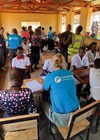
Earbus Foundation has successfully translated an innovative service delivery model into reality across multiple regions of Australia’s largest state. The mobile clinics serve as a comprehensive one-stop solution for ear health, equipped with cutting-edge IT technology, and state-of-the-art audiology equipment. The clinical team includes a nurse, nurse practitioner or a general practitioner, audiologist and an ENT specialist when needed. A child who comes to Earbus with a signed consent form will have an ear check, hearing test and, if there is active pathology, necessary intervention will be provided immediately. Foreign body and ear wax removal are similarly available. Children needing additional support, such as surgical intervention, are followed up regularly with the help of local support to ensure they receive appropriate care on time.
Partnerships with schools and local health services
To run this programme smoothly, Earbus works assiduously to build healthy relationships with local schools and healthcare services. Collaborating and partnering with local schools and medical centres requires consistent effort and perseverance which Earbus has undertaken for more than 12 years – not only by providing regular services but also ensuring there is continuous service and surveillance, with 57 of these remote locations receiving at least six visits annually.
Community engagement and cultural safety
Earbus Foundation’s programme has been meticulously and thoughtfully codesigned with Aboriginal communities, ensuring it meets the cultural safety standards of each community. This not only ensures cultural safety but also builds trust and long-term collaborations, which encourage long-term and sustainable health improvements.
Regional outreach and impact
Earbus regional programmes operate in Pilbara East, Central and South, Goldfields, Esperance, Southwest WA, Peel and Carnarvon. These sites are visited multiple times annually by Earbus, ensuring there is continuity and adequate follow-up care in these communities. Earbus Foundation conducted 98 regional trips in 2025 while diligently screening testing, and treating 4311 individual children.
Building positive relationships
Building trust starts with a simple wave
Our Earbus team visited a family home located at Carnarvon to deliver some medication and explain a management plan for a child. On their way home, they greeted some children playing in the street and said hello to everyone they passed by.
The next day to their surprise, a group of kids came running up to our team, enthusiastically saying: “We saw you on our street, you waved to us!”
For our team, that simple moment of recognition speaks volumes and is precious. It shows us the importance of being present, approachable and how much that matters for our community. These small, thoughtful gestures not only strengthen our connection and trust with the community but also reinforce the fact that our programme is here for the community and is willing to help.
Transforming a concern into comfort
During our team’s visit to Norseman, they met a 10-year-old student who had a small bead lodged inside the ear canal. Thanks to our team’s expertise, gentle care and equipment, they were successfully able to flush the bead out of the ear canal.
The smile on the student’s face said it all, moments like these are truly special for our team. Such incidents show the importance of having a healthcare system that is easily accessible and the life-changing difference it makes for these children.

Addressing barriers to access
Two main factors that influence healthcare uptake in rural Western Australia are accessibility and cultural safety. With years of experience, Earbus Foundation has addressed these barriers efficiently by introducing the concept of mobile clinics and by designing culturally safe programmes encompassing local Aboriginal healthcare workers, respecting local customs and building trust. Mobile clinics immediately reduce the need to travel significant distances for basic health checks.
Challenges and future directions
Some of the challenges Earbus Foundation faces in keeping regional and remote services available to communities relate to funding, workforce and infrastructure. Funding, whether through government, corporate partners or private donations, needs constant effort and management. Workforce challenges include a shortage in the number of specialists or audiologists willing to travel long hours and face challenging work conditions. Having a mobile clinic itself is a challenge; the mobile van needs to be maintained and upgraded on a timely basis for the programme to run smoothly.
Some of the future opportunities are around making tele-audiology consultation and rehabilitation easily accessible and consistent.
Conclusion
Earbus has paved a way for addressing the barriers associated with accessing healthcare in remote regions by using an innovative strategy and by prioritising cultural safety. Earbus Foundation is actively closing the gap that is present in remote hearing healthcare. It is Earbus Foundation’s strong belief that location should not be a reason to stop a child from hearing, learning and thriving.
Celebrating 10 Years With Earbus at Rose Nowers
For the past 10 years, Earbus Foundation has been a truly special part of the Rose Nowers community – and that’s something worth celebrating! Each year, the dedicated Earbus team has visited our service to provide essential hearing screenings for our children, supporting early detection and intervention that can change lives. The positive impact they’ve had on our families is clear:
“We are so incredibly grateful for the Earbus Foundation and the life-changing support they have provided for our son.”
“I will forever be grateful for the service Earbus has provided. They have changed James’ life trajectory, allowing him the best start possible and helping improve his overall wellbeing and development. I cannot thank Earbus enough for the work they do.”
And the support doesn’t stop there. Following a recent week of developmental screenings organised by Rose Nowers, Earbus has generously offered to return for an additional two days per term, to continue screening children for developmental delays, provide therapy and support for families, and to provide valuable training for our educators. We are beyond thankful for their ongoing commitment, and we look forward to many more years of collaboration with this amazing organisation. Thank you, Earbus!
Lynda Lewis
Centre Director, Rose Nowers Early Learning Centre
References
1. DeLacy J, Dune T, Macdonald JJ. The social determinants of otitis media in Aboriginal children in Australia: Are we addressing the primary causes? BMC Public Health 2020;20(1):492.
2. Kong K, Coates HLC. Natural history, definitions, risk factors and burden of otitis media. Med J Aust 2009;191(S9):S39–43.
3. Australian Institute of Health and Welfare. Ear and hearing health of Aboriginal and Torres Strait Islander children. Canberra: AIHW; 2024.
https://www.aihw.gov.au/reports/indigenous
-australians/ear-hearing-health-indigenous
-2024/contents/summary
[Last accessed February 2026].
4. Williams CJ, Jacobs AM. The impact of otitis media on cognitive and educational outcomes. Med J Aust 2009;191(S9):S69–72.
5. Rural Health West, WA Primary Health Alliance, WA Country Health Service. WA Child Ear Health Strategy 2017–2021. Perth (WA): WA Country Health Service; 2017.
Declaration of competing interests:SAK is an employee of Earbus Foundation of Australia.