
In preparation for the British Association for Paediatric Otorhinolaryngology (BAPO) conference in September, Grace Khong interviews Sujata De, a consultant paediatric ENT surgeon at Alder Hey Children’s NHS Foundation Trust. Miss De is BAPO president and National Children’s ENT lead for Getting It Right First Time (GIRFT). Internationally, she is the Chair of the Education and Training Committee of the European Society of Paediatric Otorhinolaryngology (ESPO). Miss De is known by her peers for her straight-talking clarity, pragmatic leadership, and her commitment to mentoring both trainees and fellow consultants. Respected for her clinical expertise and national influence, she combines strategic vision with a grounded, approachable style that makes her a trusted colleague and advocate within the specialty.
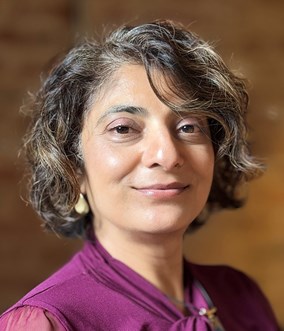
Sujata De.
Could you describe your role as National Children’s ENT GIRFT lead?
As you know, GIRFT is Getting It Right First Time, and essentially it is an NHS England initiative that pushes for improved care based on clinically led, data-driven initiatives. The idea is to reduce variation in practice around the country and essentially get the best practice that you can, while acknowledging at the moment that there are huge pressures on the services for children’s ENT and ENT as a whole.
In such a large national improvement programme, how do you measure success?
I think essentially what we’ve achieved is networking and communicating with various departments across the country. We have allowed them to reveal to us what their difficulties are, but also the little pockets of excellence where clinicians have been able to push forward initiatives that have really made a big difference.
By identifying these successful approaches, we can then actively share them with other centres. While adoption ultimately rests with each organisation, we’ve helped create connected networks of good practice. Importantly, we’ve brought operational teams from hospitals with us on the journey. Too often, clinicians generate strong ideas for improvement, but without operational backing those ideas struggle to gain traction. By engaging both clinical and operational colleagues, we’ve strengthened the likelihood that good ideas translate into sustainable change.
In your experience, has engagement from trusts and hospitals improved?
Yes, definitely. When we do GIRFT visits, we get engagement from the operational teams and buy-in from the hospital right up to executive level. And therefore, if we discuss an idea or outcomes of the meeting, it is then up to those operational teams to deliver. It’s not just a burden on clinicians.
What motivated you to take on this role alongside your clinical practice?
I’ve never been a researcher as such, but I’ve always felt that I’m a pragmatic person, and I like the concept of making pathways easier for clinicians to deliver – but not so much that you lose the nuance of clinical practice.
Having done some of the roles that I was already doing, I’d had some experience of working with operational teams and with pathways. When the GIRFT role came up, I initially said no. I was in two minds because I was busy at the time and, to be honest, a little bit fed up with the NHS.
I’m glad I stuck it out because I’ve really enjoyed this role. Things move very quickly within GIRFT, and that’s very refreshing compared to my previous experience of positive change in the NHS.
How does someone reach a national role like this in their career?
I think you work through the ranks, so to speak.
I’ve always been very vocal. I also seem to have an ability to see what won’t work. I used to think that was me being negative, but actually I feel it’s a skill – the ability to critique something.
As a junior consultant, it is working on quality improvement projects and then keeping your eyes open for opportunities – whether at hospital, regional, or national level. Sometimes they appear as random Communications emails that most people would delete. But just before you delete them, have a little look and ask yourself – could I fit into this?
For me it started in 2013 when NHS England began Clinical Reference Groups. I applied for two posts, got accepted, and in the next couple of years increased my understanding of the structures and processes. Once I’d learned that, I applied to chair one of the groups – Specialised Surgery in Children.
It’s interesting because you’re working at a strategic national level. The impacts are indirect rather than direct. But every now and then when you look at data, for example on Model Hospital, you can see that it’s had a bigger impact.
In a previous interview, you mentioned being particularly skilful in Microsoft Excel. How do you keep yourself organised?
When I was younger, I was able to multitask very well. As I’ve got older, I find that more difficult.
I flag emails — I think I’ve got about 500 flagged emails in my inbox now. If I do need to action something, I drag it into my calendar on an SPA day so I know there is allocated time for it.
Other than that, there is a lot of catching up on weekends and during time off, and that’s not necessarily something I’d recommend. I do think you need to learn to compartmentalise.
Has your definition of work–life balance changed?
When I was younger, I didn’t have huge ambition to have a family. Having a career and being independent were more important to me. I focused on my career until I became a consultant.
I had my first child the year I became a consultant and my second three years later. I was nearly 40 by the time I had my second child. Would I do it differently? No. I’m very happy with how things panned out.
I do think I’ve spent a lot of time working. My children have occasionally said, “you’re never there.” But they are independent young people now; that’s more than I could have hoped for and I’m very proud of them.
One thing I learned from maternity leave was that no one is indispensable. The first time I went on leave, I wrote lists for colleagues and booked keeping-in-touch days. I came back six months later — nothing bad had happened. Life had just moved on. That was a liberating realisation.
Do you feel women still face extra pressures juggling leadership, clinical work and family?
I think we like to think society has moved on at the same pace as we have. I’m not sure it has. The role of parent still often falls disproportionately on the mum, accepting that family structures differ and there are some situations where that isn’t the case.
In my opinion, we tend to put a lot of pressure on ourselves to be excellent at everything we do all the time. I just don’t think that is a realistic expectation. At any given point in time, something has to give. It's OK to be just OK at something whilst being excellent at something else. Just swap and change priorities as you can.
Reflecting on the present NHS, what three traits do you feel are essential for consultants?
Look after yourself first.
Accept that your priorities may not match the organisation’s – so pick your battles. Start with those where your priorities align with those of the organisation.
And choose your colleagues wisely. The support you get from your colleagues is crucial, because without it, the system can quite easily break you.
As President of the British Association of Paediatric Otolaryngologists (BAPO), what are your priorities and initiative?
BAPO is very dear to me. BAPO was the first organisation I joined as an SHO, the first meeting I presented was at a BAPO conference, I was a trainee representative and have served as a council member.
It’s always been supportive of trainees interested in paediatric ENT. As president, I wanted to build on that strength but also increase its profile as an influencer of policy – to help BAPO have a voice in the direction that GIRFT or ENT UK takes.
You are also the Chair of the Education and Training Committee of the European Society of Paediatric Otolaryngology (ESPO) and previously you were the Chair of the Local Programme Committee for the very successful ESPO conference in 2023. What would you say is the biggest challenge when working in organisations such as these?
The biggest challenge is people’s time. These roles are voluntary. None are remunerated. Everyone is busy so it’s about juggling people’s time with the jobs that need to be done.
But thankfully in medicine, and in ENT particularly, there are still people who have a passion to make things better – to improve teaching, training and service delivery. I'm sure everyone gets personal gratification from achieving this, but I do feel it exists because of a genuine desire to make things better for people.
ESPO Liverpool 2023 was a grand success and people still mention how much they enjoyed it. What can we expect from the upcoming BAPO meeting in Liverpool?
It will be smaller in scale than ESPO, but hopefully even better.
Two days of an excellent scientific programme, speakers from the UK and abroad, and a return to pop-up (5 minutes) oral presentations. This means more opportunities for trainee paper presentations. I might even use the BAPO horn if people overrun!
The day before is BAPO Juniors’ Day – high-value teaching particularly for trainees approaching exams.
We also have a secret new social element this year that I’m certain everyone will enjoy. And there is no place like Liverpool for hospitality – so there will be a fantastic networking evening.
BAPO 2026 will be held on 24th and 25th September 2026
with BAPOJ Revision Course on 23rd September in Liverpool.

www.BAPO.co.uk





