
 Syed Ahmed Shahzaeem Hussain, senior registrar, Department of ENT, University College of Medicine and Dentistry, University of Lahore, Lahore, Pakistan.
An ENT surgeon at an audiology conference? For someone accustomed to diagnosing hearing loss but often relying on audiologists to navigate the intricacies of hearing rehabilitation, the prospect was certainly intriguing! The inaugural Pakistan Audiology Conference promised an opportunity to broaden my horizons, strengthen interdisciplinary connections and, perhaps most importantly, find answers to those audiological questions that tend to linger at the back of a clinician's mind.
Held at the Pearl Continental Hotel in Lahore, the conference brought together audiologists, ENT specialists and hearing healthcare professionals from across Pakistan. A warm welcome, enthusiastic participation and thoughtfully organised proceedings set the stage for an engaging day of scientific learning and professional exchange.
The scientific programme commenced with Dr Saqib Mehmood's fascinating lecture on the genetics of hearing loss. Particularly relevant to Pakistan was the discussion surrounding consanguinity and autosomal recessive inheritance, alongside the growing role of genetic testing in diagnosis and counselling. Whilst advances in molecular diagnostics offer considerable promise, their financial implications in resource-constrained settings remain an important consideration. The emphasis on early identification, culturally sensitive genetic counselling and integrated care provided valuable clinical insights.
Among my personal highlights was the panel discussion, Why Amplification Fails: Patient, Device, or Process? Beyond the technical aspects of hearing aids, the discussion explored the equally important roles of patient expectations, psychological barriers, professional competence and appropriate rehabilitation. From concerns about appearance to unrealistic expectations of immediate benefit, the session reinforced an essential lesson: prescribing a hearing aid is only one step towards successful hearing rehabilitation.
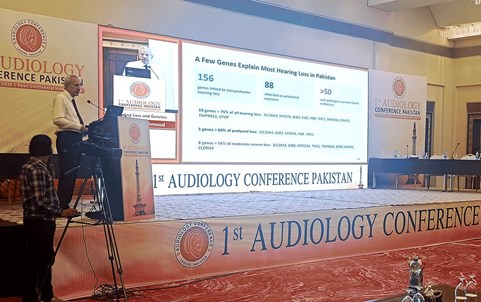
Dr. Saqib Mehmood delivering a lecture on 'Hearing loss and Genetics'
The discussion on 'Audiology in Pakistan: Past, Present and Future' offered an equally compelling perspective. Reflecting upon the profession's historical development, the panellists highlighted the challenges associated with unqualified providers, limited employment opportunities and the continuing need to strengthen professional recognition and clinical training. Perhaps most encouraging was the opportunity for audiologists themselves to take centre stage, articulate these challenges and discuss how their profession might progress.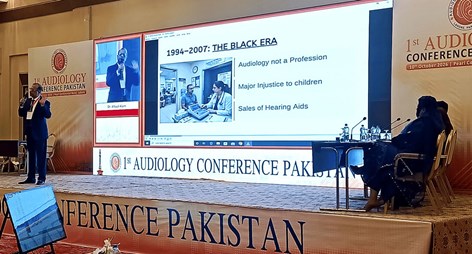
The scientific programme also featured clinical case scenarios, discussions on emerging innovations, a dedicated free-paper presentation session and an audiology quiz, providing a platform for emerging research and further opportunities for scientific exchange.
For me, the benefits extended well beyond the lecture hall. Working with patients for whom affordability frequently determines access to hearing healthcare, I have often struggled to identify reliable and economical hearing rehabilitation services. Conversations with experienced audiologists provided an invaluable opportunity to better understand the available services, establish professional connections and explore practical referral pathways. Learning about additional facilities providing specialised paediatric audiological assessment was particularly useful.
The exhibition stalls offered further opportunities to explore developments in hearing technologies, while the refreshment breaks and enjoyable lunch created a welcoming environment for informal discussions and networking.
Ultimately, the greatest achievement of the inaugural Pakistan Audiology Conference was perhaps its recognition of audiology as a discipline deserving a dedicated national platform. Hearing healthcare cannot thrive through isolated professional efforts; effective collaboration between audiologists and ENT surgeons is indispensable for translating clinical diagnosis into meaningful rehabilitation.
I arrived hoping to better understand the world of audiology and departed with a renewed appreciation of its complexity, its challenges and the expertise of the professionals who practise it. With engaging discussions, invaluable professional connections and plenty of lessons worth listening to, the inaugural Pakistan Audiology Conference certainly struck the right note!


