
 Lara Carvalho Sauer, ST7 Audiovestibular Medicine resident, St George’s hospital, UK
The annual BAAP Audit Meeting was hosted by Reeya Motha, consultant audiovestibular physician at Barts Health NHS Trust. There were 48 attendees this year, including audiovestibular medicine (AVM) consultants, AVM trainees, clinical psychologists and paediatricians with special interest.
Natalia Kharytaniuk, AVM registrar at UCLH kicked off the meeting with preliminary findings from an ongoing audit assessing how many older adults who qualify for hearing aids have them fitted and how many are using them at follow-up. A comparison of outcomes was made in patients with and without cognitive difficulties. The NICE guideline NG98 recommends enquiring about cognitive ability as part of audiological assessment for adults, since more than 80% of people living with dementia have clinically significant hearing loss. The results of the audit suggest that having a companion may help with engagement with the services.
The following audit was from Thomas Weddell, AVM registrar who assessed current practice in pulsatile tinnitus at UCLH. Pulsatile tinnitus occurs in less than 5% of tinnitus patients, with a vast differential diagnosis, depending on whether it is arterial or venous. Both history taking and examination can vary broadly between specialties, such as ENT, AVM, GP, neurosurgeons and neurologists, because, despite local guidelines, there is no international consensus for investigation. A review of 289 scans showed a 38.8% diagnostic yield, mainly with CT contrast, however, MRA may still be the best option, as it rarely misses serious causes. 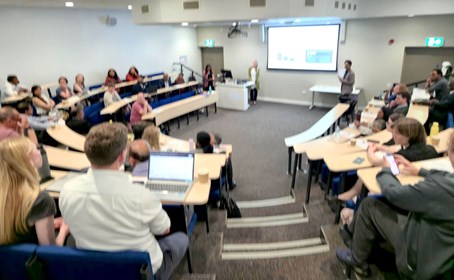
The third presentation of the day was by an AVM trainee, Sabarinath Vijayakumar, evaluating the clinical pathway of PPPD at the Royal Derby hospital. Management included patient education, providing information sheet and signposting to neurosymptoms to all patients, all were referred to vestibular physiotherapy (84% compliance) and advised CBT. In most cases an antidepressant was discussed. It is importance to document energy levels, as these can be associated with FND and it is a strong predictor of disability in those patients.
Natallia Kharytaniuk presented her second audit, this time on compliance with current NICE guidelines for acupuncture as a treatment option for vestibular migraine in UCLH, with the largest cohort reported to date (36 patients). Acupuncture is a recommended treatment when Propranolol, Topiramate and Amitriptyline are ineffective. The proposed mechanism is that it may modulate neuroplasticity within cortical and brainstem networks interacting across trigeminal, vestibular and autonomic pathways. UCLH offers 10 weekly sessions administered by trained senior clinical practitioners. Acupuncture had high compliance and a significant drop in the median of headaches days per month. Improvement was also seen in headache severity, acute analgesia usage and HIT-6 score. The authors reported the outcomes which were favourable, not only from the headache control but also from the self-reported improvement in vestibular symptoms.
As a compliment to the topic touched upon by the previous audit, Madeline Leadon, AVM registrar at UCLH has completed her audit on medication-overuse headache (MOH) in vestibular migraine. MOH should be considered if simple analgesia is taken for 15 days or more or if triptans/opioids/combinations are taken for 10 days or more. Interestingly, MOH can be developed even with analgesics that are frequently taken for non-headache pains. Their literature review showed that the risk is doubled in smoker and physically inactive patients. The good news is that is can be reversible. A good rule of thumb is to keep analgesia to less than 2 days (not doses) a week and to treat comorbid anxiety/depression, which can be present in 53.7% of cases. Patients with vestibular migraine should have documented acute headache medication usage and all patients with persistent headache should be screened for MOH.
After a lunch break, the afternoon session started with Susannah Price, clinical psychologist and Fadila Farag, an assistant psychologist, both working in the Ophthalmology Department in Great Ormond Street Hospital. They showcased their initiative of well-being groups for parents of children with Usher’s syndrome. They have described their approach to these families, including a third wave cognitive behavioural therapy (CBT) approach that incorporates mindfulness, experiential acceptance and valued action.
Following this, Vasileios Gkiousias, AVM registrar from Alder Hey Children’s hospital in Liverpool talked about late-onset permanent childhood hearing impairment (PCHI). He started off by reminding us that the NHSP may miss mild, high frequency and late-onset progressive hearing losses. Vestibular testing was performed in 71.2% of cases, with abnormal responses in 31.1% (most useful tests were ocular and cervical VEMPs). Only one third had a confirmed hearing aetiology after all investigations. The commonest imaging finding was cochlear nerve hypoplasia/aplasia, followed by EVA, SSCD, middle ear pathology and infective sequelae. This study concluded how school entry screening programmes are invaluable in identification of these cases. Yet this has been discontinued in many boroughs, which was considered a significant loss.
Doctor Shannon Gardiner presented her project from her medical student placement at Alder Hey Children’s hospital on syndromic and non-syndromic genetic hearing loss as detected by the NGS panel. It concluded that NGS is a reliable tool to detect sequences causing hearing loss and that it should be used in a timely manner to help management. She also mentioned that it was not recommended vestibular assessment in all cases of hearing loss and that Alder Hey has developed a fast-track system for vestibular assessment and the vestibular infant screening programme.
The day concluded with a presentation from Shobha Rajagopal from St Helier’s hospital. She described their very effective system where the audiologist discusses MRI with parents straight after a diagnosis of hearing loss on ABR. The audiovestibular physician follows-up with a telephone consultation and the child proceeds to have the MRI under natural sleep through a ‘feed and wrap’ protocol. This pathway is quick and children have their MRI within 13 days of hearing loss diagnosis, with a mean age of 47 days. This reduced the delay in diagnosis and the need for MRI under general anaesthetics. Their main imaging diagnostic finding was widened vestibular aqueduct, hypoplastic cochlear nerve, intracranial calcification and occipital stroke. The outcome of the audit was a beautiful informative leaflet created to share with parents prior to the MRI appointment.
This event is publicised each year around April and all members of the multidisciplinary MDT related to audiovestibular medicine are welcome to apply to present their audits or quality improvement projects.


