
 Liam Hyland, ENT ST3, Yorkshire and Humber Deanery
The 2025 Annual Meeting of the British Society for the History of ENT was once again held in the Royal Society of Medicine’s Toynbee Mackenzie ENT Room, a storied chamber in which the portraits, instruments and preserved artefacts encapsulate the very breath of the specialty’s past.
Attendees ranged from enthusiastic foundation doctors to seasoned former ENT surgeons, all gathering to celebrate and reflect upon the rich heritage of the specialty. The meeting was generously sponsored by Medtronic, whose support helped bring together a programme of exceptional historical scholarship. This year’s event drew remarkable interest, with over 40 abstracts submitted, culminating in 12 carefully selected junior presentations that together formed a vivid tapestry of ENT history. 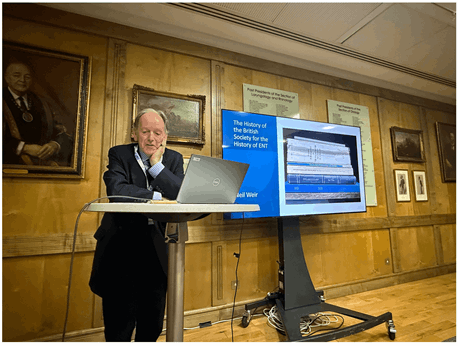
The programme opened with Kantida Koysombat, who traced the maxillary sinus from Highmore’s early anatomical descriptions to modern high-resolution imaging. Yi Sim then explored the evolution of the transnasal-transsphenoidal approach, from its origins in ancient mummification to its central role in contemporary skull base surgery. Sara Ibrahem closed the first session with an engaging examination of tuberculous otitis media and its diagnostic challenges across eras.
The second session began with Prabhsimran Kaur’s discussion of Kallmann syndrome, linking historical descriptions of olfactory agenesis to modern understandings of brain health, particularly Covid-19. Alexander Hunt revisited the enthusiasm for nasopharyngeal radium irradiation as a treatment for deafness, falling in and out of fashion in the 20th century. Alice Li offered a fascinating insight into forensic otology in British courts, while Cameron McCann illuminated the life of Dr L Brodsky, the figure behind the widely used tonsil grading classification.
The final session opened with Badriya Yussuf, who examined how focal theory fuelled the early 20th century tonsillectomy boom. Ritika Gera followed with an account of how the modified Young’s procedure transformed epistaxis management in hereditary haemorrhagic telangiectasia, while Amna Qamar explored how celebrity tracheostomies and laryngectomies shaped public perceptions of airway differences. Preena Patel showcased Esmé Hadfield’s pioneering work in occupational sinonasal cancer, followed by Emma Wauchope who revisited Sir William McAllen’s contributions to otologic innovation and Listerian asepsis. 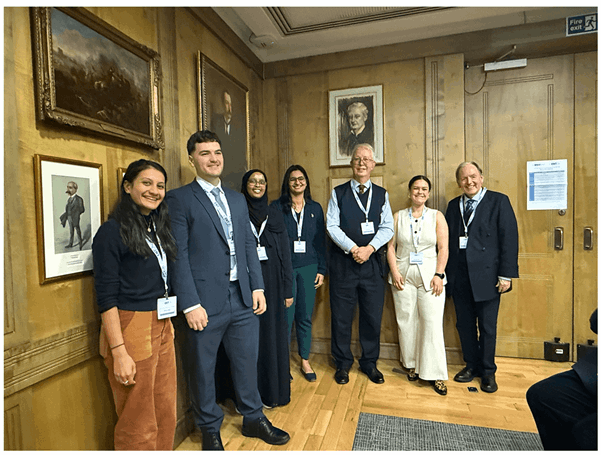
The standard of presentations this year was exceptionally high, prompting careful deliberation among the BSHENT Committee before awards were announced. Edward Fisher presented the prizes (above, with the prize winners): Alexander Hunt, Badriya Yussuf and Emma Wauchope were awarded joint first prize, while Preena Patel and Ritika Gera were recognised as runners-up.
Neil Weir concluded the meeting with a warmly received talk on the history of the society. His distinguished career, scholarship and unwavering dedication to preserving ENT’s heritage continues to inspire all who aspire to contribute to the specialty’s future.
The meeting closed with a sense of continuity and a reminder that ENT’s past is not merely something to study but something to carry forward. The next annual meeting will take place on 3rd December 2026; abstract submission guidance can be found on the BHSENT website.


