
London
W1G 0AE
Jie Lily Huang. Senior clinical fellow, Laryngology department, Guys and St Thomas's Hospital.
(see below for Esme Chan's report of the Cutting Edge Laryngology Hackathon!)
When the day-to-day grind of overbooked clinics and long waiting lists brings me to the brink of burnout, conferences like the British Laryngological Association’s Cutting Edge manage to infuse the room with oxygen again. Giants of laryngology, people whose names I have only ever seen in print, appear in the flesh, sharing insights and canapés. Between talks, kindred spirits from all corners of the world exchange hugs with old friends, introductions with new friends, and pictures of their growing children. It is enough to make me feel human again, reminding me why I do this job, why I love it. 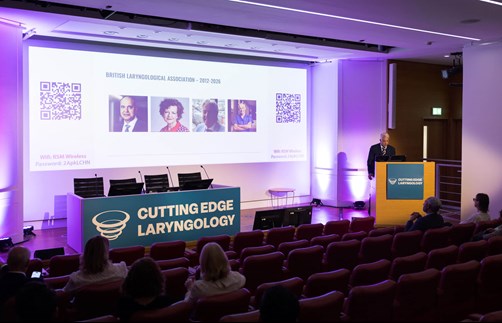
BLA Cutting Edge is a three-day conference held every two years, focusing, as its name suggests, on innovation in laryngology. It is testament to both the relative youth of the field and the pioneering spirit of laryngologists that the BLA’s flagship conference is dedicated to exploring new ideas and technologies. It was fitting, then, that the conference opened with robotics.
Professor Pietro Valdastri described his team’s work on the first magnetic robot colonoscopy in a human patient, completed in August 2026. Professor Martin Birchall, a founding member of the BLA, then took us into the world of soft robotics in laryngology and his own journey towards recreating laryngeal function. In a few droll sentences, he condensed decades of work: ten years spent on laryngeal implantation (didn’t work), ten years on tissue engineering (didn’t scale), and now electro-morphing gel (e-MG) robots, which may one day be able to mimic muscle function in the larynx or in facial nerve paralysis. For those interested, there is a YouTube video of an adorable e-MG gymnast robot. The concept of ‘robofood’ – a robot capable of crawling its way down the oesophagus in patients with dysmotility – had me recoiling just in time for the ta break. 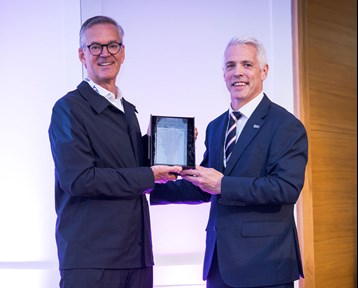
The robotics may have stolen the opening session, but there was plenty more innovation on the programme. Taran Tatla discussed optical markers of dysplasia beyond narrow-band imaging, while Alberto Paderno offered a reassuringly measured assessment of AI in detecting early laryngological disease, highlighting its dependence on image quality and the lack of large image databases on which to train. Medical student Lucinda Knight presented her evaluation of large language models in answering patient queries, finding them wanting in readability and prone to fabrication. For all the excitement around AI, it seems there is still some way to go before it can replace human clinicians. 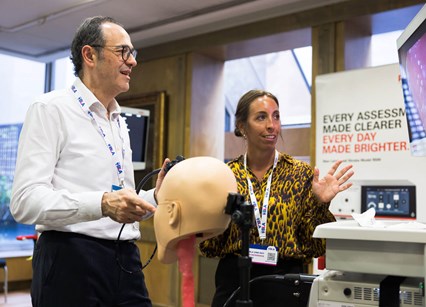
Some fantastic speakers brought fresh perspectives to familiar problems. Professor Markus Hess, who was awarded the Isshiki Award for his outstanding contribution to laryngology, explained what he does when faced with tricky cases. For example, in patients where rigid laryngoscopes offer a poor view of the vocal cords, a channelled flexible scope through a laryngeal mask airway allows him to biopsy and laser as needed. He also described how he’s moved away from using keels in glottic webs, instead opting for laser division of the synechiae followed by weekly gentle cleaning to prevent reformation. The chronic cough session was unexpectedly captivating. Claire Slinger managed to make a traditionally dry topic productive by stuffing it chock full of practice-changing tips, evidence, and guidelines. Bottom line: cough retraining therapy works as well as morphine. Professor Teemu Kirnari then made the provocative suggestion that laryngeal cancer is an infectious disease. He presented evidence that dysbiotic microbiomes cause the chronic inflammation that leads to dysplasia. Treating precursor lesions with a short course of antibiotics could resolve many of these lesions and avoid unnecessary biopsy. He contended that, given the long timeframe it takes for a dysplastic lesion to develop into a cancer, a delay of a few weeks does not cause any significant harm (although it sure would throw the UK’s Urgent Suspected Cancer pathway off kilter). What about that age-old question of how to treat reflux, especially since the TOPPITS and TALGITS trials suggest that PPIs and alginates are no better than placebo? Professor Nikki Johnston made a compelling case for HIV protease inhibitors that inhibit pepsin. Formulations are currently undergoing phase 1 and phase 2 clinical trials, unfortunately side effects seem to include gastrointestinal upset. These talks demonstrated outside-of-the-box thinking that challenges us to keep our minds open and our practices evidence-based.
Another topic at the forefront of laryngology is, of course, regenerative medicine. Professor Kiminori Sato delivered a fascinating keynote, painstakingly building his case, molecular study by molecular study, for the role of pluripotent stem cells in the laryngeal macula flava in maintaining and regenerating the layers of the larynx. We then heard about a succession of novel injectables designed to stimulate laryngeal regeneration, from nanofat, presented by the incomparable Professor Peak Woo, to stromal vascular fraction, platelet-rich plasma (PRP), and testosterone, which makes biological sense given that the larynx is a secondary sex organ with androgen receptors.
In the session on dynamic restoration of function in bilateral vocal fold paralysis, Professor Jean-Paul Marie, the godfather of selective laryngeal reinnervation, presented his series of more than 100 bilateral reinnervations. Prominent neurolaryngologist Professor Andreas Müller presented his minimally invasive laryngeal pacemaker, which offers almost immediate improvement in the airway without disrupting anatomy or compromising voice or swallowing. Professor Alexander Gelbard then gave a fascinating account of how he developed a bilateral laryngeal pacemaker and of the clinical trial of the first four implanted patients.
And, of course, every talk ended not only with an invitation for questions, but also with an invitation to visit the speaker, usually accompanied by an advertisement for a relevant course for those keen to explore the subject further. 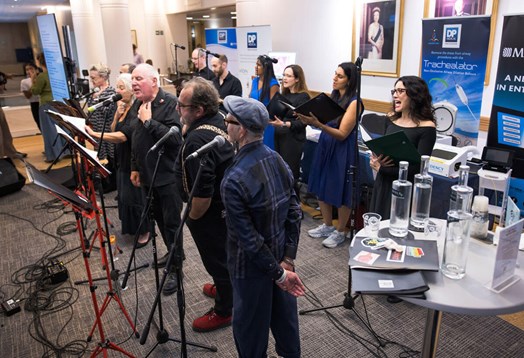
There were practical lessons, too. We were literally hypnotised by Yakubu Karagama, who demonstrated techniques for managing nervous patients during awake airway procedures in the outpatient clinic. The PENTAX ergonomics workshop assessments offered 30-minute posture evaluations with a PENTAX specialist representative and a physiotherapist. I was not pleased to discover, one week before starting my laryngology fellowship, that I had been scoping with the wrong hand all this time. Apparently, the scope is designed to be held in the left hand, allowing the light lead to rest comfortably in the crook of the thumb. I hope this news reaches some of you before you become too set in your ways. In happier news, Shout at Cancer’s Laryngectomy Choir reminded us that you don’t need a voicebox to sing. They encouraged us to join in – and laryngologists, it turns out, need very little encouragement to sing.
All in all, Cutting Edge was stimulating, thought-provoking and occasionally eyebrow-raising. As always, it brought together the founding members and pioneers of laryngology with the next generation of clinicians and researchers, creating a space to share ideas, challenge established thinking and push the boundaries of the field.
Next year's BLA Cutting Edge Laryngology will take place at the Royal Society of Medicine, London, on 24 September 2027.
https://britishlaryngological.org/bla-conference
And the Hackathon!
By Esme Chan
The first ever BLA Cutting Edge Laryngology Hackathon took place in September 2026 in collaboration with King's MedTech Society, and supported by DP Medical Systems, PENTAX Medical and KARL STORZ.
A multidisciplinary cohort of participants was selected, bringing together medical students, engineers, clinicians and industry professionals for a full day of collaborative problem-solving. This mix of perspectives reflects how meaningful MedTech innovation happens in practice. Throughout the day, teams explored a wide range of challenges facing modern laryngology, including: point of care diagnostics, digital screening and self-surveillance, surgical robotics and clinician workload, training the future laryngologist, and voice loss. 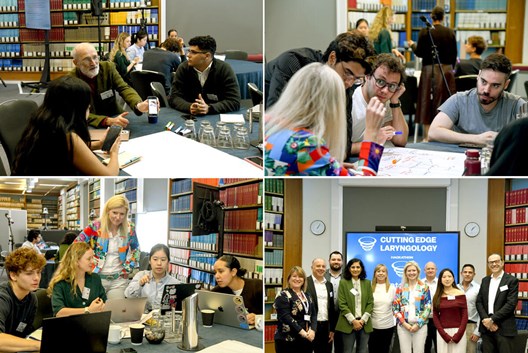
A distinctive feature of the day was the combination of clinical and industry mentorship. Laryngologists helped teams ground their ideas in genuine clinical pathways and unmet needs, while medical technology professionals encouraged participants to think beyond the initial idea towards feasibility, regulation, implementation, procurement and eventual clinical adoption.
After several hours of rapid problem exploration, research and solution development, each team presented a six-minute pitch to the judging panel, followed by a two-minute Q&A. Ideas were assessed across clinical relevance, creativity, feasibility, implementation, potential impact, evidence and communication.
Congratulations to VoiceWell for winning the first place £1000 prize! They developed a digital platform that helps patients monitor symptoms, train swallowing function and preserve their voice, while contributing valuable real-world data to future laryngology research. Congratulations also to the runner-up, Shimmer, who developed a digital triage and longitudinal voice monitoring app for patients with voice disorders.
This marks the pilot of the BLA Cutting Edge Laryngology Hackathon and hopefully there will be more to come.


