
Piazza della Pilotta, 4
00187 Roma RM
Italy
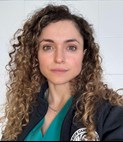 Chiara Lagravinese, ENT Resident, Campus Bio-Medico of Rome University Hospital, Rome, Italy.
The XXVIII National Congress of the Italian Society of Paediatric Otorhinolaryngology (SIOP) was a remarkable success. With over 800 participants, it confirmed its place as a major event for paediatric ENT in Italy. It provided not only a high-level scientific update, but also a valuable opportunity for exchange, collaboration and professional cohesion within the specialty.
Under the theme ‘Not only artificial intelligence’, the congress explored the many dimensions of innovation in paediatric ENT, while keeping the child, the family and multidisciplinary care at the center of discussion. The meeting clearly showed that innovation can support, but never replace, clinical judgement, specialist expertise and integrated care.
Across four days, the congress covered a wide range of topics with over 110 sessions, including congenital and acquired hearing loss, neonatal audiological and genetic screening, hearing rehabilitation, cochlear implantation, sleep-disordered breathing, recurrent infections, antibiotic stewardship, rhinology, laryngology, feeding and swallowing disorders. New technologies such as AI, telemedicine, advanced imaging and robotic surgery were presented as important frontiers and future challenges, with the aim of improving diagnosis, treatment and follow-up. 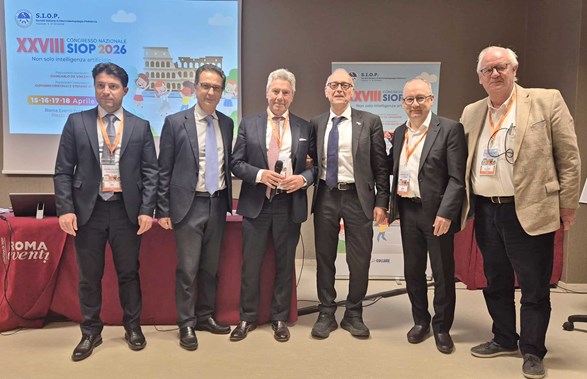
Otology and audiology were among the central pillars of the congress. Particular emphasis was given to the future of deafness genetics, reflecting the growing importance of precision medicine and genotype-informed care in paediatric hearing loss.
Sleep-disordered breathing and paediatric OSAS represented another major focus. The subject was approached from several complementary angles, including outpatient diagnostics, polysomnography, myofunctional therapy, orthodontic management, surgical decision-making and the particular challenges of syndromic patients. Several sessions underlined the importance of multidisciplinary teamwork in the management of sleep-disordered breathing in children. 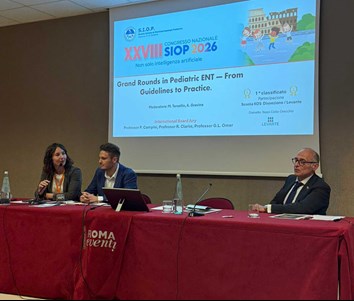
Rhinology, laryngology, feeding and swallowing disorders, transition from paediatric to adult care, paediatric neck masses and congenital airway conditions were also extensively represented, confirming both the breadth of the specialty and the richness of the meeting.
A special mention should be made of Professors Paolo Campisi and Ray Clarke, whose presence as international guests helped enrich the scientific program and highlighted the value of strengthening international collaboration in paediatric ENT. We hope that future editions of the congress will further expand international participation, encourage stronger multicentre exchange of expertise and experience, and create new opportunities for shared clinical and research projects. In this sense, the congress offered not only an opportunity for scientific update, but also a promising platform for building broader and more connected international networks. 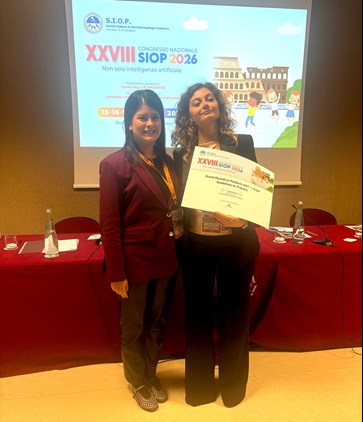
Finally, special recognition is due to the congress presidents, Professor Stefano Di Girolamo and Giovanni Cristalli, whose guidance and commitment were instrumental in shaping such a well-attended event. Equal thanks go to the faculty for their contributions, to the many participants, to the sponsors for their support, and to the organising staff whose work behind the scenes ensured the smooth running of the meeting.
The 2026 SIOP Congress closed with renewed energy and shared commitment to facing the future challenges of paediatric otorhinolaryngology together.
Photos from the top:
1) Honorary President of SIOP Giancarlo De Vincentis, with the two Presidents of SIOP 2026 (Giovanni Cristalli and Stefano Di Girolamo), with international guests.
2) Grand Rounds in Paediatric ENT.
3) Eleonora Trecca, the head of the young ENT specialists group and Benedetta Rizzelli, young ENT who won the Grand Round.


