
 .
.
By Rodrigo Silva, 5th-year medical student at NOVMedical School and vice president of the Fiscal Council of NOWACE.
The UK symposium on smell and taste disorders
Imagine the scent of a brand-new book. The aroma of your grandparents’ home. Now, the smell of freshly cut grass. Smell is invisible, nostalgic, and unforgettable. A recent study highlights that smell is our most underestimated sense, often overlooked until it disappears.
In June, top experts in smell and taste research convened at Cambridge’s Cavonius Center for the 4th UK Symposium on Smell & Taste Disorders, chaired by Prof Carl Philpott. As usual, the symposium talked not only about clinical science but also focused on personal stories of sensory loss and emphasised the importance of compassionate care.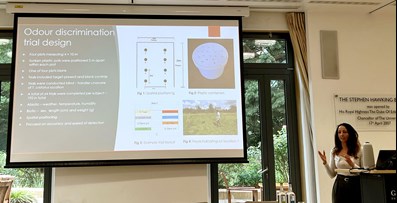
The Symposium began with impactful testimonies from Gerard King and Pat Marlin, who have both been living without a sense of smell for many years. It was incredibly important to hear that in traumatic cases like Pat's, patients do not want their concerns dismissed by simply being told to‘be thankful to be alive’.
Simon Gane set the stage for olfactory and gustatory function by reviewing the physiology and pathophysiology of SATDs. Following that introduction, the audience heard about different realities at major clinical centers across Europe. A highlight of the afternoon was the showcase of sophisticated diagnostic tools with Saber Sami and Sara Bengtsson, alongside Prof Caroline Huart, which demonstrated the value added by functional MRI, diffusion MRI, and OERPs in a research setting. These tools enable a better understanding of brain processing in the olfactory system, showing the wide interconnectivity that smell and taste have centrally in the brain.
The second day was more focused on the management of smell and taste disorders. Prof Matt Lechner began by explaining how to conduct history-taking for these disorders, reminding the audience that taste and smell are highly specific functions that can be affected by alterations we often overlook. The talks ended with a lecture by Prof Zara Patel, who explored the topic of future directions for treatment, mentioning the obvious biological treatments which we know are currently being trialed and referred to, as well as the Platelet-Riched-Plasma, for which Prof Patel has done much of the leading work in the field.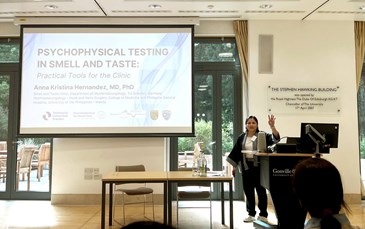
Sometimes medicine isn’t about curing, but about restoring the details that make life rich and meaningful. As research advances, hope grows that everyone will one day experience the world, not just seeing or hearing it, but truly smelling and tasting it.
The UK Semio-chemistry Network Meeting XXXIV
The UKSN Meeting, an event that has been held since 1988, was held on June 3 and 4 at the Cavonius Center at Cambridge University. The talks addressed four themes, ranging from mammalian semiochemistry to physiology, psychology/philosophy, and clinical research on the topic.
On the first morning, we learned about recent discoveries in the animal kingdom regarding the importance of smell for protecting endangered species and estimating the postmortem interval in pig models. Presentations by Heather Angell, Nikki Glover and Marlen Kücklich highlighted how the semiochemistry between species can influence ecosystems and aid in their preservation.
The latter was followed by some incredible talks on physiological discoveries underway across Europe. We heard from Ana Dorrego Rivas about potential coordination between axonal and dendritic maturation in mitral and tufted cells; from Allie McWhinnie and Moritz Nesseler about connections from the nose to the brain; and from Olivia Pedroncini about how odours affect behavior in naturally foraging mice. The inaugural Dave Kelly lecture was given by Prof Hiro Matsunami, a professor at Duke University in North Carolina, who provided a fascinating talk about his work on decoding olfaction through structure, AI and genomics.
On the second day, during the session led by Barry Smith, which included talks by Chiara Bonzo and Sofia Livi, we entered the psychological and philosophical world of smells and taste. The audience was fascinated and enthused by the concept of digital olfaction, and there is even a chance that this might be a concept in virtual reality, not that Barry Smith believes so.
The Meeting concluded with the Clinical Research Segment. Isabelle Williams highlighted the importance of improving and integrating care SATDs into services, Gabija Klyvyte talked about improving equality and diversity in SATD research, Will Ansley talked about the mechanistic data analysis from the APOLLO trial and Nicole Yang presented her feasibility study on a gum that might change how smell and taste training is conducted.
The meeting was an overall success, bridging the worlds of a diverse group of people interested in chemosensation across various academic disciplines and fostering valuable discussions and constructive criticism of the research and work being done.


