Can parent observations help identify persistent otitis media sooner? PLUM uses everyday listening behaviours to flag children who may need urgent specialist care.
Otitis media (OM) remains one of the most persistent health inequities facing Indigenous children globally. While prevalence varies by region, many Indigenous populations experience earlier onset, higher rates, and more severe disease than non-Indigenous children [1].
On re-reading, this isn’t quite right – I think it’s more accurate to say: For practitioners working with these communities, a familiar clinical challenge emerges: identifying which children have had OM for a short time from those with already persistent disease requiring specialist ear health and hearing care.
In Australia, this is the picture for many Aboriginal and Torres Strait Islander children. Current diagnostic pathways typically require families to return to primary care several times over three to six months to confirm persistence and establish impact on hearing. This delays specialist care for children who need it urgently. During this waiting period, children with already-persistent OM often experience deteriorating hearing during sensitive periods of listening, language and communication development [2].
"PLUM was co-produced in urban and remote communities with Aboriginal and Torres Strait Islander health practitioners and early childhood educators"
What is PLUM?
The Parent-evaluated Listening and Understanding Measure (PLUM) is a 10-item checklist that captures parent observations of their child’s everyday listening behaviours. Unlike otoscopy and audiometry, which provide point-in-time information about current ear status and hearing, PLUM reflects what parents notice over weeks at home.
The tool asks about specific listening behaviours across different situations:
- Does your child respond when you call their name in quiet? In noise?
- Can they follow simple instructions in quiet? In noise?
- Do they join in conversations with familiar people?
PLUM was co-produced in urban and remote communities with Aboriginal and Torres Strait Islander health practitioners and early childhood educators. This ensured the tool was grounded in community knowledge and priorities. Researchers from the National Acoustic Laboratories and Hearing Australia clinical audiologists working with Aboriginal and Torres Strait Islander communities collaboratively led the project.
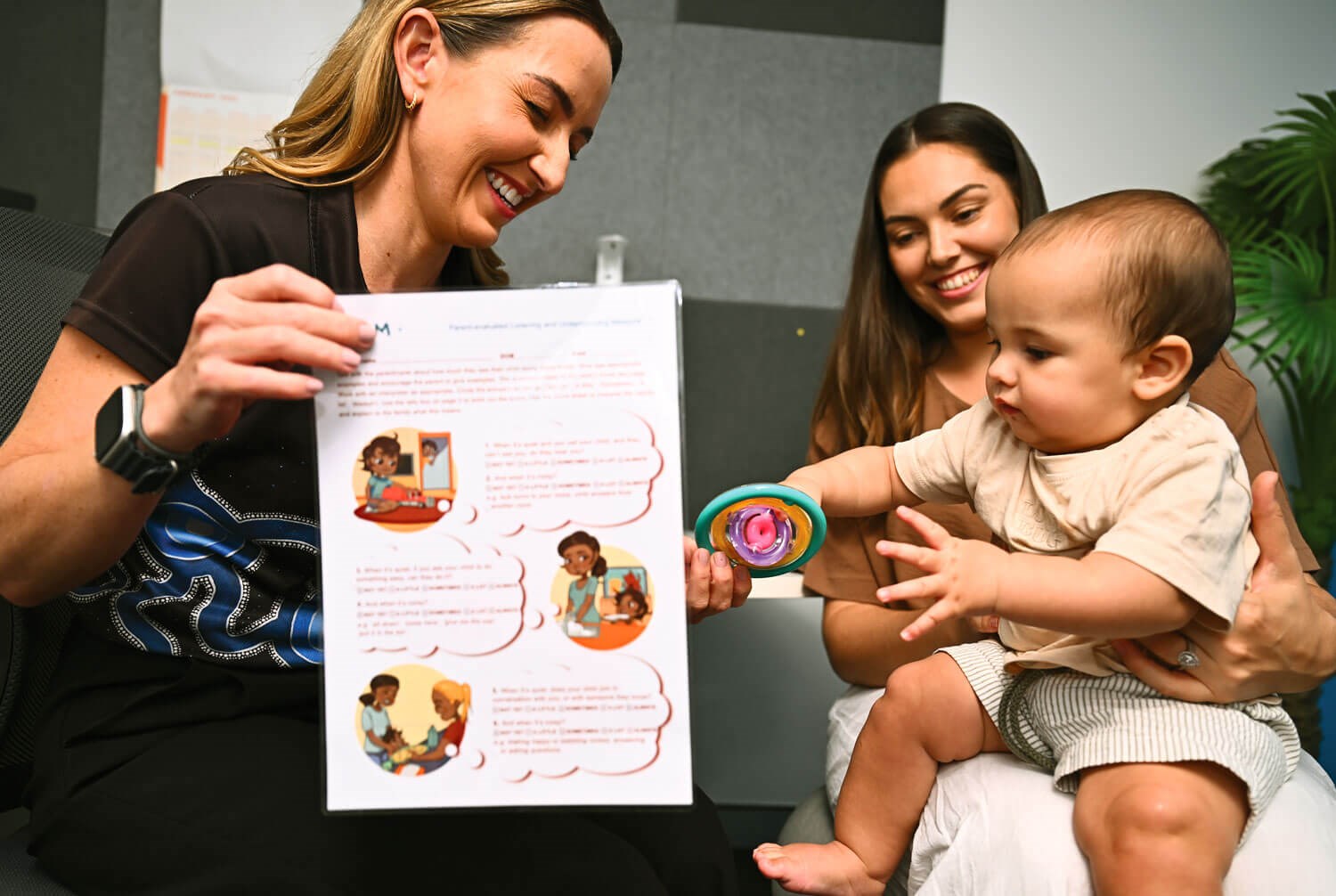
The checklist uses a picture format, designed to be talked through conversationally rather than read word-for-word. This creates space for parents to recall and talk about what they observe, while learning about listening as a developmental skill. PLUM can be used with families who speak any language, working with interpreters as appropriate.
How to use PLUM
PLUM was designed for use by health practitioners in primary care settings. In Australia, it is now also used in child health, audiology and ENT practices.
PLUM should be used as part of an ear health assessment battery, alongside otoscopy and tympanometry, and other available objective measures. It complements rather than replaces point-in-time measures by adding longitudinal perspective on how any hearing problems are affecting functional listening development.
How to administer
The practitioner talks through the 10 questions with parents, using the pictures as prompts. For each item, parents rate how often they observe the behaviour using five options: not yet; a little; sometimes; a lot; or always. Each response receives a score from 0–4.
The total score (0–40) is compared to age-based reference ages (five age groups from six to over thirty months) to determine to determine whether the child’s listening skills are:
- On track: listening skills developing as expected.
- Borderline: some concerns; reassess in three months.
- Not yet on track: significant concerns; refer to audiologist.
The evidence: validation study
A recent validation study published in the International Journal of Audiology examined PLUM results for 6716 Aboriginal and Torres Strait Islander children across 15,444 appointments [3]. What made this study unique was its use of longer-term hearing status – confirmed over three to six months – as the reference standard, rather than point-in-time hearing tests. This approach is critical for validating tools designed to detect fluctuating conditions like OM.
Key findings
Children rated ‘not yet on track’ on PLUM were 46 times more likely to have persistent OM with hearing loss >30 dB HL requiring specialist referral (odds ratio 45.73, 95% CI: 12.60–165.93). The tool demonstrated sensitivity of 82%, specificity of 91% and negative predictive value of 99%.
"Children with confirmed persistent hearing loss >30 dB HL scored more than two standard deviations below peers on listening skills – a substantial developmental gap"
Perhaps most striking was evidence of PLUM’s sensitivity to duration of hearing loss. Children with confirmed persistent hearing loss >30 dB HL scored more than two standard deviations below peers on listening skills – a substantial developmental gap. In contrast, children with similar hearing levels but likely transient loss scored significantly higher. For children with normal hearing or mild loss, PLUM scores were similar regardless of whether the hearing status was confirmed over time or captured at a single point.
This pattern demonstrates that listening skill development is measurably disrupted when hearing loss >30 dB HL persists beyond three months, while children appear to recover quickly once hearing normalises. The findings validate PLUM’s clinical utility for distinguishing persistent from transient cases.
Interpreting results in clinical context
When a child presents with bilateral OM on examination:
- Scenario 1: OM present bilaterally + PLUM ‘on track’
– Provide reassurance and practical monitoring guidance. Medical management and follow-up as clinically indicated. The research shows 99 out of 100 children ‘on track’ do not have sustained hearing loss >30 dB HL. - Scenario 2: OM present bilaterally + PLUM ‘not yet on track’
– Urgent referral for audiological assessment and ENT review. Provide active communication support strategies for parents and educators. These children are 46 times more likely to have persistent OM requiring specialist intervention.
If parents express concern about their child’s hearing or listening, refer to audiology regardless of PLUM results. PLUM complements but does not override clinical judgement or parent concern.
Clinical applications
For ENT specialists, a ‘not yet on track’ PLUM result with bilateral OM is a strong indication that the condition is persistent and the hearing loss is already impacting functional listening development – information that may inform decisions about treatment urgency.
For audiologists, results consistent with bilateral OM combined with a PLUM ‘not yet on track’ could reduce the need for a second hearing assessment three months down the track, and inform earlier ENT referral. In settings where audiometry access is limited, PLUM provides insight into the longitudinal impact of OM and practitioners can make more confident decisions about when specialist referral is warranted versus when monitoring is appropriate.
In all settings, talking through the PLUM leads easily into conversations with families about how to make communication at home easier and ways of supporting their child’s listening skills development while they are not hearing well.
While this validation was conducted with Australian Aboriginal and Torres Strait Islander children, the underlying principle – that parental observations of listening behaviours predict longer-term hearing status – has potential relevance for Indigenous (and non-Indigenous) populations globally. The conversational administration and use with interpreters make PLUM adaptable to diverse cultural and linguistic contexts.
Access
PLUM is freely available at www.plumandhats.nal.gov.au, along with training resources, scoring guidance and materials for families – including daily activities that support listening skills development.
By systematically capturing and valuing parent knowledge, PLUM offers practitioners a practical pathway to faster identification of persistent OM requiring specialist care, supporting earlier intervention during the critical early years when listening and language foundations are established.
References
1. Gunasekera H. The wicked problem of otitis media: summary of recent systematic reviews on otitis media with effusion. Paediatr Respir Rev 2025;56:10–4.
2. Kong K, Coates HL. Natural history, definitions, risk factors and burden of otitis media. Med J Aust 2009;191(S9):S39–43.
3. Harkus S, Ward M, Nash J, et al. Validating the Parent-evaluated Listening and Understanding Measure (PLUM): caregiver observations reliably reflect long-term otitis media-related hearing status in young Aboriginal and Torres Strait Islander children. Int J Audiol 2026:1–20.
4. Ching TYC, Hou S, Seeto M, et al. The Parents’ Evaluation of Listening and Understanding Measure (PLUM): development and normative data on Aboriginal and Torres Strait Islander children below 6 years of age. Deaf Educ Int 2020;22(4):288–304.
5. Harkus S, Marnane V, O’Keeffe I, et al. Routine ear health and hearing checks for Aboriginal and Torres Strait Islander children aged under 6 years attending primary care: a national consensus statement. Med J Aust 2023;219(8):386–92.
Declaration of competing interests: None declared.