
Clinicians often encounter patients with a Type A tympanogram who still present with conductive hearing loss. Traditional 226 Hz tympanometry has served as a reliable tool in audiology and otolaryngology practices since the 1970s, yet it often misses subtle variations in middle ear function.
Even with the research suggesting we need to use 1000 Hz probe tones for infants, many studies have suggested that around 30% of middle ear issues will be missed by relying on traditional (226 or 1000 Hz) tympanometry [1]. In fact, wideband tympanometry (WBT) has been used to predict effusion volume and viscosity with great accuracy [2,3] and machine learning algorithms have been developed to improve diagnostic accuracy [4].
By incorporating WBT, clinicians can better determine why those air-bone gaps exist, even when traditional tympanometry appears normal. It’s integration into routine practice can reduce missed diagnoses and improve patient outcomes.
The measurement may be called wideband tympanometry, acoustic absorbance, acoustic power reflectance and even 3D tympanometry, depending upon which immittance bridge you own. Each of the current available tests provides similar data: the amount of acoustic energy that is either absorbed or reflected as a function of frequency.
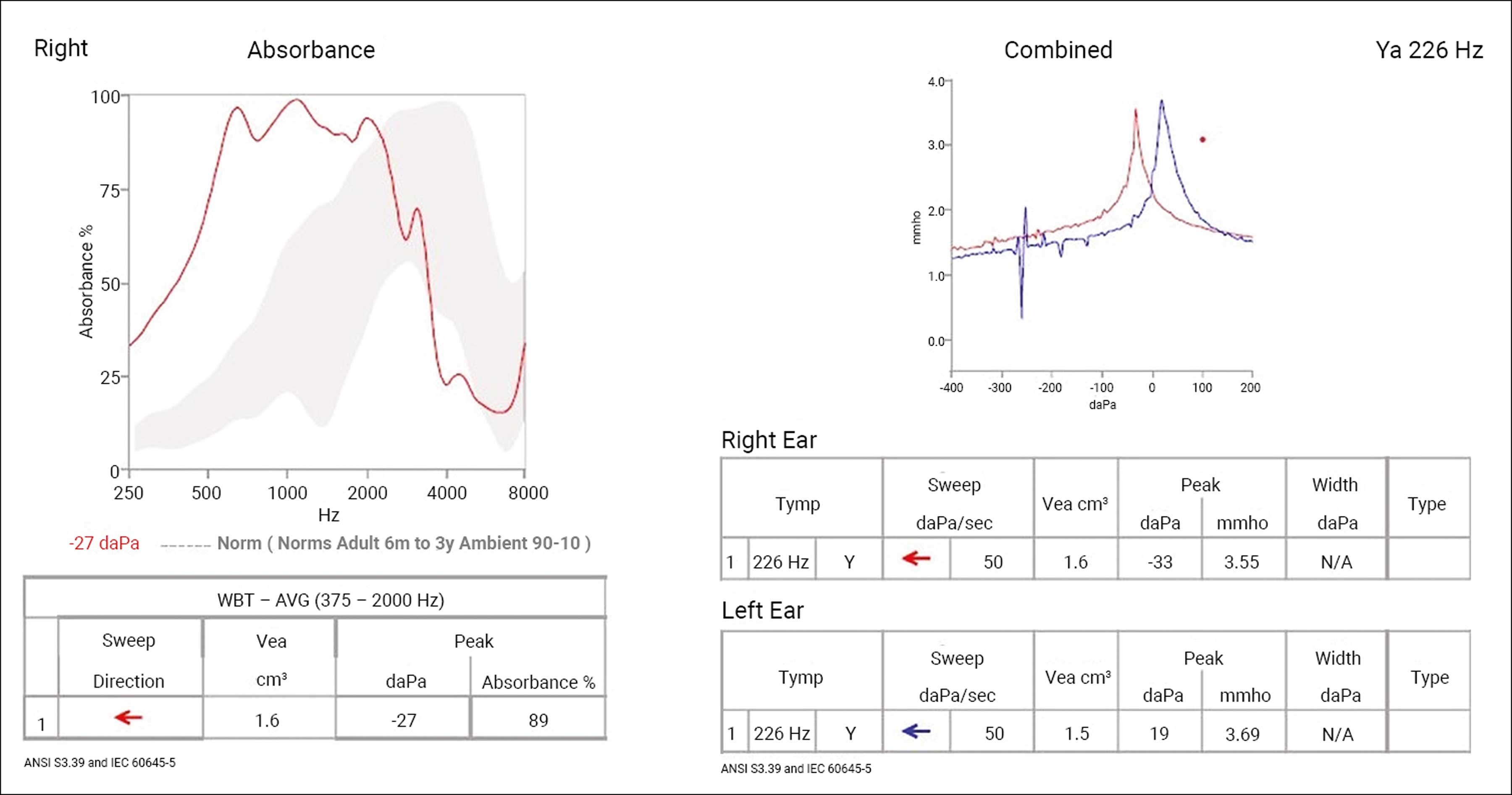
Figure 1: Sample of WBT absorbance curve vs. traditional tympanogram. Note how the traditional tympanogram has a normal shape, while the WBT paints a different story. The WBT demonstrates a mass-dominated pathology that was not evident using traditional approaches.
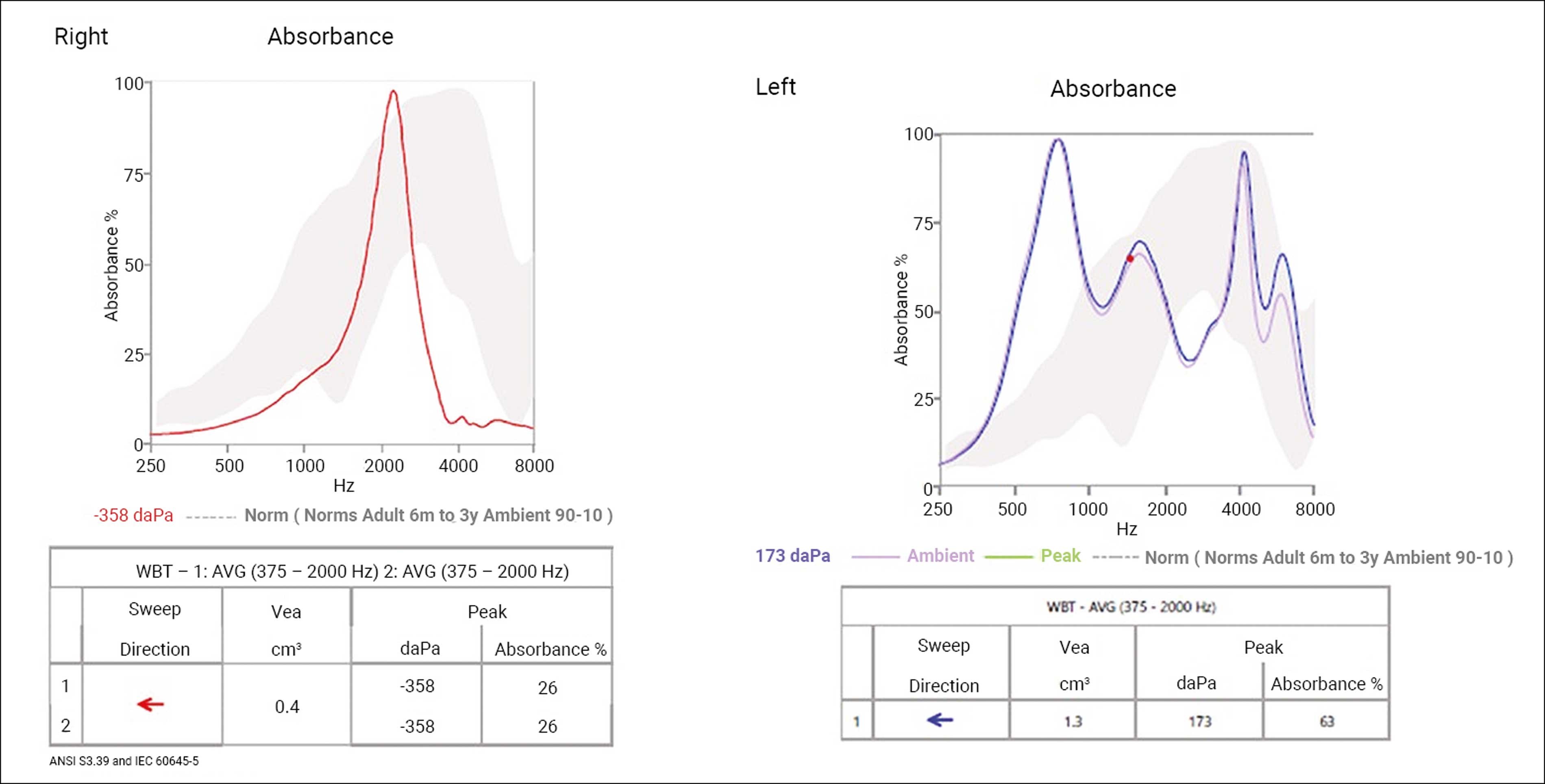
Figure 2: Absorbance curve patterns for stiffness (right ear) vs. mass-dominated pathologies (left ear). The right ear was diagnosed with otitis media while the left ear indicates a patent PE tube in a child who has Down syndrome.
Key advantages of WBT
- Broader diagnostic power: Captures stiffness-, mass- and friction-dominated effects across speech-relevant frequency bands. Such an example is seen in Figure 1. The non-compensated 226 Hz tympanometry suggested relatively normal function, while the WBT indicates a significant increase in the middle ear absorbance in the low frequencies with a decrease in the higher frequencies. This type of a pattern is a key sign of cholesteatoma, which increases the relative mass of the middle ear system.
- Improved paediatric assessment: Demonstrates higher sensitivity for newborns and infants compared to 1000 Hz tympanograms. Improves accuracy for diagnosing frictional and mass-dominated pathologies that are not captured with traditional 226 Hz tympanometry. Figure 2 demonstrates both a child with viscous otitis media (right ear) and a functional PE tube (left ear). The left ear example was from a child with Down syndrome whose ear canal volume measured with 226 Hz tympanometry might suggest a dysfunctional PE tube. The WBT response indicates the classic sharp low-frequency peak indicating the tube is in fact patent.
- Predictive correlation: Strongly correlates with behavioural audiometry and otoacoustic emissions for identifying conductive hearing loss. Efficient for diagnosing otitis media.
- Clinical efficiency: A single measurement can replace multiple tympanograms, simplifying workflows.
Interpretation made simple
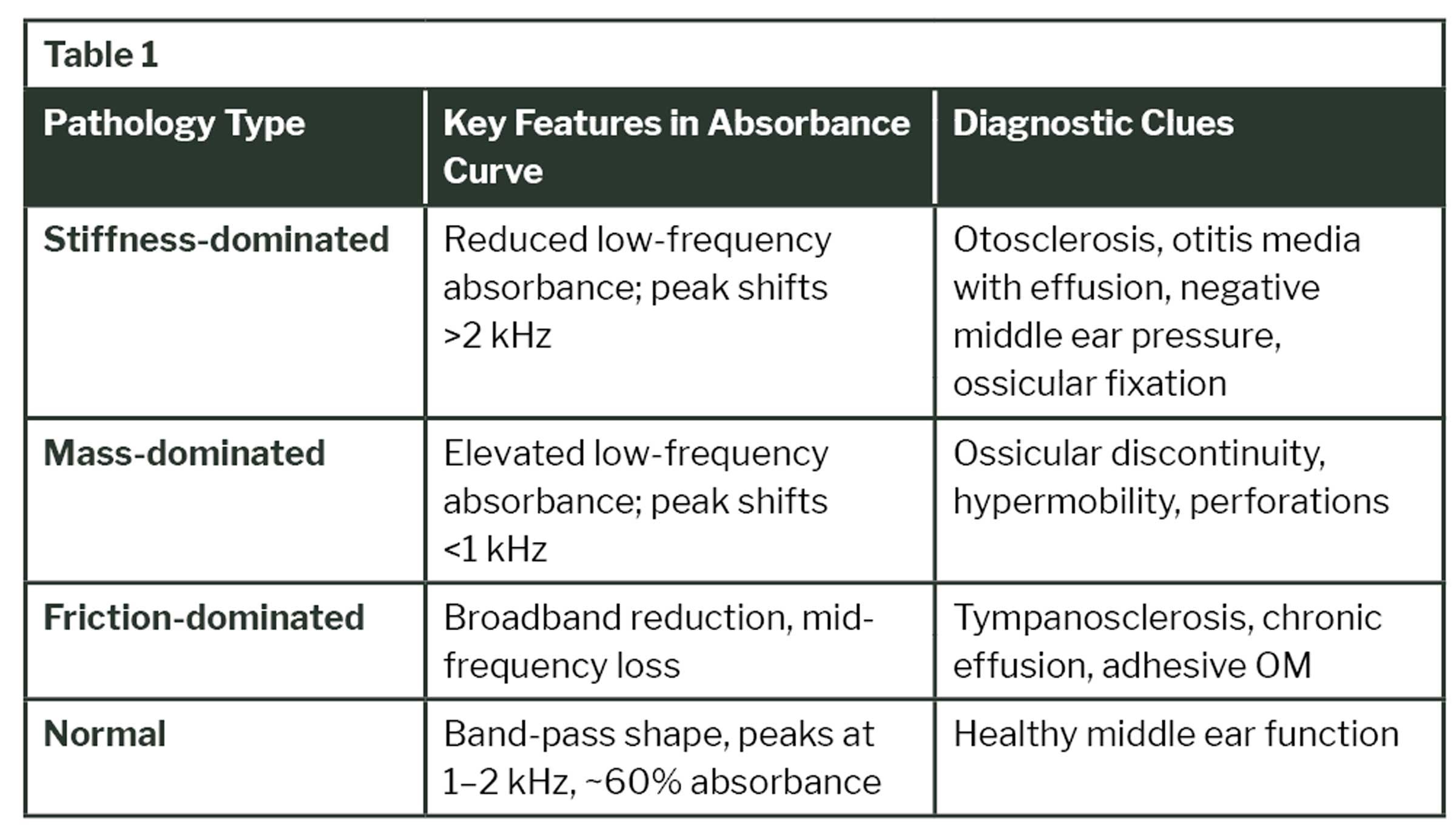
WBT plots energy absorbance across frequencies, and possibly at different relative pressures. Interpreting these curves can be simplified by recognising key mechanical patterns (Table 1).
Clinical integration tips
- Combine with behavioural testing: Use WBT as an adjunct to confirm CHL and quantify effusion impact.
- Adopt standard reporting: Example template:
– Normal: ‘Absorbance within expected limits (1–4 kHz); efficient sound energy absorption consistent with healthy middle ear function.’
– Stiffness: ‘Reduced absorption at low frequencies with peak shift above 2 kHz; consistent with stiff middle ear pathology.’ - Educate patients: Visual data helps explain fluid, ossicular or TM changes, improving patient engagement. Show absorbance curves alongside audiometry to illustrate differences.
Clinical impact and future outlook
WBT enables clinicians to differentiate subtle pathologies early, guide surgical decisions and tailor treatment plans. Research suggests the use of WBT could improve the diagnostic accuracy for assessing otitis media and assessing non-traditional middle ear pathologies. Its ability to highlight frequency-specific absorbance changes can streamline otologic evaluations, particularly in complex paediatric and surgical cases.
Conclusion
Wideband tympanometry represents a significant advancement in middle ear assessment, offering clinicians improved diagnostic accuracy and efficiency. It’s adoption can enhance patient care, particularly in paediatric and complex cases.
References
1. Li A, Yang X, Xu Y, et al. Clinical value of wideband acoustic immittance in the diagnosis of otitis media with effusion under negative intratympanic pressure in adults. Acta Otolaryngol 2024;144(10):533–4.
2. Merchant GR, Al-Salim S, Tempero RM, et al. Improving the differential diagnosis of otitis media with effusion using wideband acoustic immittance. Ear Hear 2021;42(5):1183–94.
3. Callaham S, Newby M, Saoji AA, et al. Assessment of pediatric middle ear effusions with wideband tympanometry. Otolaryngol–Head Neck Surg 2021;165(3):465–9.
4. Sundgaard JV, Värendh M, Nordström F, et al. Inter-rater reliability of the diagnosis of otitis media based on otoscopic images and wideband tympanometry measurements. Int J Pediatr Otorhinolaryngol 2022;153:111034.
Further reading
1. Sanford CA, Brockett JE, Aithal V, AlMakadma H. Implementation of Wideband Acoustic Immittance in Clinical Practice: Relationships among Audiologic and Otologic Findings. Semin Hear 2023;44(1):65–83.
2. Aithal S, Aithal V, Kei J, Wilson M. Predictive Accuracy of Wideband Absorbance in Infants. J Am Acad Audiol 2022;33(7–8):381–9.
3. AlMakadma H, Aithal S, Aithal V, Kei J. Use of Wideband Acoustic Immittance in Neonates and Infants. Semin Hear 2023;44(1):29–45.
Declaration of competing interests: JMD is a paid employee of Grason Stadler Inc. and been a paid guest speaker for A.T. Stills University. She is a regional coordinator for Healthy Hearing, Special Olympics Florida.




