
A standard NHS clinic appointment lasts 15 minutes. In that time, you are expected to call the patient in, greet them, take a full history, perform an examination, formulate a differential diagnosis, explain that diagnosis, discuss investigations, request those investigations, outline a management plan, prescribe medication, dictate a letter, code your findings and arrange follow-up.
Efficiency in the NHS is not a luxury – it is essential. It was with this reality in mind that I sat down with Dr David Lehman (senior principal medical director) and Mr Sam Cicogna (general manager of gastroenterology, urology, otolaryngology and allergy at ModMed) to discuss Scribe 2.0.
This system has been in development since 2012 and is now used by approximately 2500 ENT surgeons in private practice across the United States. It is available on iOS and as a web-based platform. The design is sleek and intuitive, consistent with a standard iOS interface. While the overall aesthetic cannot be altered, users can customise the toolbar to prioritise commonly used functions.
"What followed was striking, not because of the technology itself, but because of the absence of distraction"
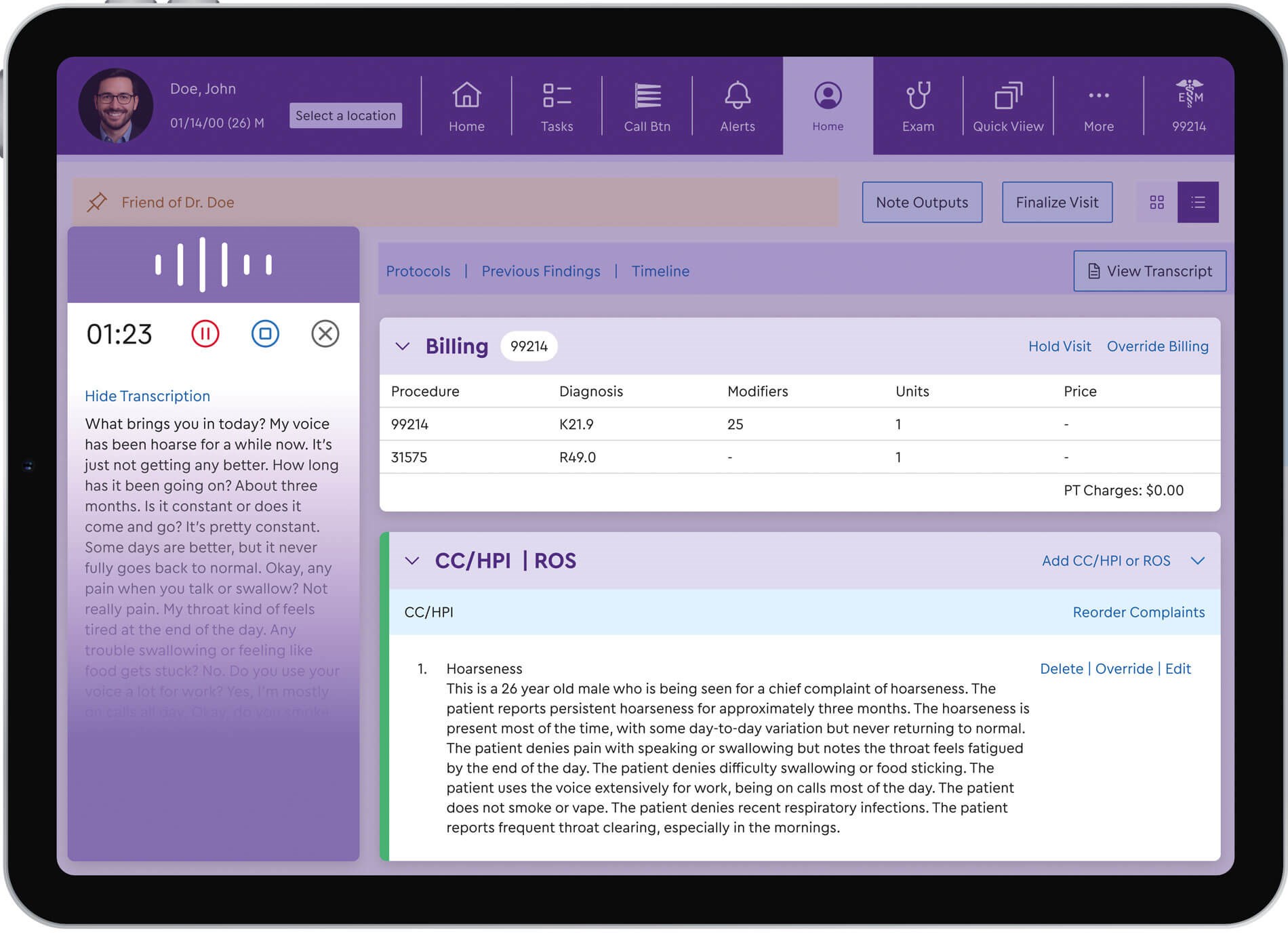
During the demonstration, Dr Lehman conducted a simulated ENT consultation with Mr Cicogna acting as the patient. A simple tap on the iPad initiated the consultation. What followed was striking, not because of the technology itself, but because of the absence of distraction. Dr Lehman maintained eye contact throughout. He observed body language, responded to social cues and remained fully engaged. As he took the history and performed the examination – verbalising his findings – the system transcribed and structured the encounter in real time. He explained the diagnosis in accessible language, outlined the management plan, provided safety-netting advice and addressed the patient’s questions. Another tap ended the consultation. Within seconds, a structured, logical clinical note appeared on the screen. Colloquial terms such as ‘swimmer’s ear’ were translated into ‘otitis externa’. Descriptions such as ‘red and swollen’ became ‘erythema’ and ‘oedema’. Examination findings were accurately captured, the diagnosis clearly labelled and the management plan precisely documented.
This photo is for illustrative purposes only.
However, Scribe 2.0 did not stop at documentation. Below the clinical note were pre-populated action boxes: a prescription for antibiotic ear drops at the correct dosage, relevant coding and billing options, follow-up booking tools, and suggested investigations where appropriate. These were not generic prompts; they were generated based on Dr Lehman’s individual practice patterns. The system had learned his typical next steps for specific diagnoses and predicted them accordingly.
Originally designed for ENT, Scribe 2.0 is now also used in dermatology, ophthalmology, orthopaedics, allergy and pain management. Its distinguishing feature is not merely speech-to-text capability, but its integration within a broader electronic health record (EHR) ecosystem. Because it functions within a unified platform, the AI adapts to the clinician’s habits – anticipating investigations, treatments, coding requirements and follow-up pathways specific to that user. It reduces duplication of work and removes the need to navigate multiple separate systems.
"These were not generic prompts; they were generated based on Dr Lehman’s individual practice patterns"
From an NHS perspective, important questions remain. How would the system handle the diversity of accents, dialects and languages across the UK? While it has not yet been formally tested in that environment, Dr Lehman reports no significant issues within his own diverse patient population in Florida.
It is also worth noting that Scribe 2.0 would not be entering entirely new territory within UK healthcare. Comparable AI-supported documentation and communication systems, including Accurx and Tortus, are already being utilised within parts of the NHS. Accurx has become widely adopted for patient communication, triage and workflow management, while Tortus has focused on ambient AI documentation during clinical consultations. Although these platforms share the common objective of reducing administrative burden and clinician burnout, they differ in both scope and functionality.
Where Scribe 2.0 potentially differs is in the depth of its integration. Rather than acting solely as a transcription or communication tool, it functions as part of a fully embedded clinical workflow system. Documentation, prescribing, coding, investigation requests and follow-up booking exist within a single environment. This level of integration allows the clinician to remain present with the patient while the system manages much of the administrative architecture in the background. The implications are significant. Time spent navigating screens, dictating letters after clinic or duplicating documentation could be reduced. Cognitive load may lessen. Most importantly, the quality of patient interaction – eye contact, attentiveness, rapport – could improve rather than deteriorate in the face of digital adoption.
"Most importantly, the quality of patient interaction – eye contact, attentiveness, rapport – could improve rather than deteriorate in the face of digital adoption"
Could Scribe 2.0 represent the future of NHS consultations? Potentially. Increased efficiency could translate into cost savings, improved clinician satisfaction and enhanced patient experience. However, significant barriers exist. The upfront financial investment and the challenge of integrating an entirely new EHR ecosystem into the complex and heterogeneous NHS infrastructure would be considerable. A nationwide rollout in secondary care may be unrealistic in the short term. That said, its appeal within private practice, and potentially within primary care settings, is evident. As AI-assisted documentation becomes more commonplace, systems that do more than transcribe – systems that learn, predict and integrate – may set the standard.
In a healthcare system where time is relentlessly constrained, tools that allow clinicians to be fully present while maintaining precision and efficiency are not simply convenient innovations; they may become essential to sustaining modern medical practice.
Declaration of competing interests: None declared.





