Navigating UK audiology registration can be complex. This article explains the process, underscoring why proper registration is vital for safe and professional practice.
Why register? This question is not unique to the UK. An article published by Goulios and Patuzzi examined registration from an international perspective, showing that 45% of countries reported that government registration was required to practise audiology, while 43% indicated that it was not mandatory [1]. The remaining 12% were unsure or did not provide a definitive answer.
Although the results of this article are dated, they do indicate that professional registration in audiology is considered internationally. In the UK, audiology professionals register with either (or both) the Health Care Professions Council (HCPC) and the Academy for Healthcare Science (AHCS). Across both AHCS and HCPC, the benefits of registration converge on a single purpose: protecting patients while supporting safe, accountable and professional practice. The distinction is how this protection is delivered (statutory vs. accredited), not whether it is needed. Both organisations position registration as a minimum professional standard, not an optional enhancement [2,3].
Decisions not to register as an audiology professional in the UK are often linked to the voluntary nature of accredited registration and the fact that many employers do not require it [4]. However, registration is intended to reflect professionalism, personal responsibility and a commitment to delivering safe, high-quality care; it is not meant to be driven by protected titles, specific functions or employer requirements. Being listed on a register demonstrates that the required standards of education, training and competence have been met. It also signals a commitment to clear codes of conduct, ethics and professional behaviour, providing colleagues, employers and the public with mechanisms to investigate concerns and act when standards are not met [2,3].
Whether registration is statutory or voluntary should ultimately be irrelevant, as both types provide formal accountability – an element that is absent for unregistered practitioners. Both the AHCS and HCPC operate clear and transparent processes for managing concerns, complaints and professional misconduct. The HCPC has statutory authority to impose sanctions, including restrictions or removal, through legal fitness-to-practise hearings, while the AHCS, through its Professional Standards Authority (PSA) accreditation, demonstrates that it upholds equivalent governance standards through its Fitness to Practise procedures. Together, these systems protect patients and maintain public confidence through proportionate and transparent outcomes. Employers may require registration even when it is not mandated by law, and both the HCPC and AHCS require applicants to disclose removals from other registers, which may render an individual ineligible to join if removed from a statutory or accredited register, despite the accredited registers’ voluntary nature.
So why do we have two options for registration in audiology in the UK? Creating a statutory title is linked to an Act of Parliament, so to understand how the current context came about, we need to go back in time to the Professions Supplementary to Medicine Act 1960 and the NHS Reform and Health Care Professions Act 2002, including its 2012 amendment. The 1960 Act established the Council for Professions Supplementary to Medicine (CPSM), which regulated education, conduct and registration for several healthcare professions, such as radiographers, physiotherapists and biomedical laboratory staff. Importantly, the Act allowed new professions to be added through amendment, subject to Privy Council approval. Using this mechanism, clinical scientists were granted statutory regulation in 1999. However, this decision created a division within healthcare science, as other healthcare science roles were excluded despite delivering similar levels of patient care [4].
In the early 2000s, professional regulation was modernised to improve public protection. The Health Professions Council (now HCPC) replaced the CPSM, and the Council for Healthcare Regulatory Excellence (CHRE) was created to oversee professional regulators. By 2012, CHRE supervised nine statutory regulators across healthcare.
A major shift occurred following the 2011 policy paper ‘Enabling Excellence’, which concluded that new statutory regulation should only occur in exceptional circumstances. Instead, patient safety risks would be managed through accredited voluntary registers. Consequently, the 2012 amendment renamed CHRE as the Professional Standards Authority (PSA) and granted it powers to accredit voluntary registers, effectively ending the expansion of statutory regulation. The risk-based regulatory approach is confusing in audiology because hearing care is delivered by professionals overseen by both the statutory regulator and the accredited voluntary register, who often work side by side [4]. Table 1 provides a summary of the different titles used in UK audiology.
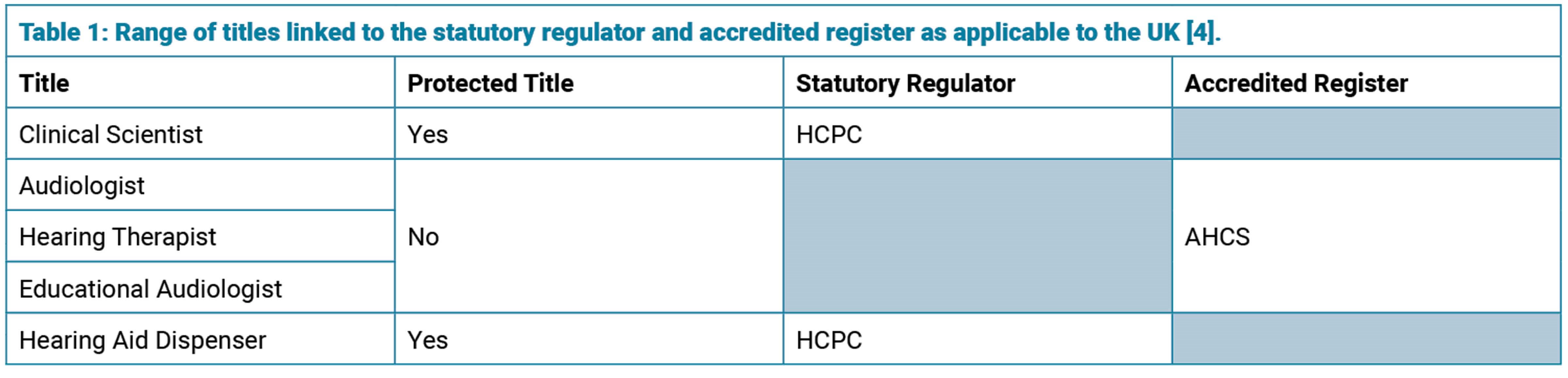
In general, the eligibility to register in the UK is linked to completing an accredited (AHCS) or approved (HCPC) qualification pathway. Applying to join a register in any country begins with understanding how that nation defines audiology roles, which organisations regulate the profession and whether registration is required at a national or local level. This includes identifying relevant job titles and any legally protected terms, determining whether audiologists and hearing aid dispensers require separate registration, and confirming both the necessity of registration and the recognition of your qualifications [5]. If you are based in the UK, you need to consider both the employer and the title used in the specific role.
Only HCPC-registered hearing aid dispensers may assess or test hearing, or prescribe hearing aids when the device is supplied through retail sale or hire. It is a criminal offence for anyone not so registered to carry out either activity, whether testing without prescribing or prescribing without testing. Registration in another profession does not confer this authority. Accordingly, AHCS-registered audiologists and HCPC clinical scientists (audiology) who wish to supply hearing aids by retail, sale or hire must also be registered with the HCPC as hearing aid dispensers.
If you find yourself in a position where you have never registered or perhaps decided to leave a register for whatever reason, contact the regulator and/or accredited register to determine how to apply for or reactivate your registration.
Internationally trained audiology professionals seeking to work in the UK can apply to the HCPC for registration as a hearing aid dispenser and or clinical scientist through the international application route. Those wishing to register as an audiologist with the AHCS are advised to use the Practitioner Training Programme (PTP) equivalence route.
In summary, professional registration in audiology is fundamental to safeguarding patients, maintaining a trusted and accountable workforce, and upholding the integrity of healthcare. It reinforces the profession’s very purpose: providing safe, competent and reliable hearing care to people. With that in mind, the real question becomes: why wouldn’t someone register?
References
1. Goulios H, Patuzzi RB. Audiology education and practice from an international perspective. Int J Audiol 2008;47(10):647–64.
2. Health Care Professions Council. Why your registration matters. 2023.
https://www.hcpc-uk.org/registration/your
-registration/why-your-registration-matters/.
3. Academy for Healthcare Science. About us: What we do.
https://www.ahcs.ac.uk/about-us/what-we-do/.
4. Steenkamp L. A Fragmented Profession within the System of Professions: The Experience of the Audiology Professional in the United Kingdom. PhD thesis 2023. Queen Margaret University.
https://eresearch.qmu.ac.uk/items/f909bcf2
-89eb-4b51-84ee-cf321c3fa9e2
5. Hudson CL. An audiologist abroad. ENT & Audiology News 2022;23(3).
[All links last accessed February 2026]
Declaration of competing interests: LS is employed by the Academy for Healthcare Science as Head of Accreditation.