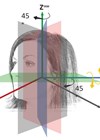
PPPD is a vital diagnostic framework for chronic dizziness. But a normal vHIT does not always mean that the vestibular system has finished telling its story.
The patient who is still dizzy
A patient returns after an episode of vertigo. The positional test is now negative. There is no spontaneous nystagmus. The video head impulse test (vHIT) is normal. The report may suggest, implicitly or explicitly, that the vestibular system looks fine. But the patient is not fine. They still feel unsteady, visually overwhelmed, motion-sensitive, detached from the ground or unable to return confidently to normal life. This is one of the most common and frustrating scenarios in vestibular practice.
What PPPD says
Persistent postural-perceptual dizziness (PPPD) has been a major advance because it moved the field beyond the unhelpful division between ‘organic’ and ‘psychogenic’ dizziness. The Barany Society criteria define PPPD as persistent dizziness, unsteadiness or non-spinning vertigo present on most days for three months or more, exacerbated by upright posture, active or passive motion and exposure to moving or complex visual stimuli. It is usually precipitated by a vestibular, neurological, medical or psychological event, causes functional impairment or distress, and is not better accounted for by another disorder [1]. That last criterion is important. PPPD is not invalidated by every vestibular abnormality, but neither should it become a shortcut for stopping the vestibular investigation too early.
The time-domain problem
The vHIT is an excellent test of the fast, high-acceleration, canal-driven vestibulo-ocular reflex. It asks a precise question: can the semicircular canals and their high-frequency pathways generate an appropriate eye movement during a brief head impulse?
However, many dizzy patients do not complain only during brief head impulses. They complain while walking through a supermarket, turning repeatedly, standing in a visually busy environment, recovering after positional vertigo or trying to maintain orientation in space over time. These behaviours may depend on slower, sustained, otolithic, visual-vestibular and velocity-storage-related mechanisms that are not fully captured by the vHIT.
This is the essence of time-domain dissociation: fast vestibular responses may appear preserved while sustained or integrative vestibular processing remains abnormal. In a recent hypothesis-generating case series, four patients with persistent dizziness showed different patterns of this dissociation, including impaired low-frequency integration, incomplete compensation of vestibular asymmetry, selective otolithic loss and bilateral sustained vestibular hypofunction [2].
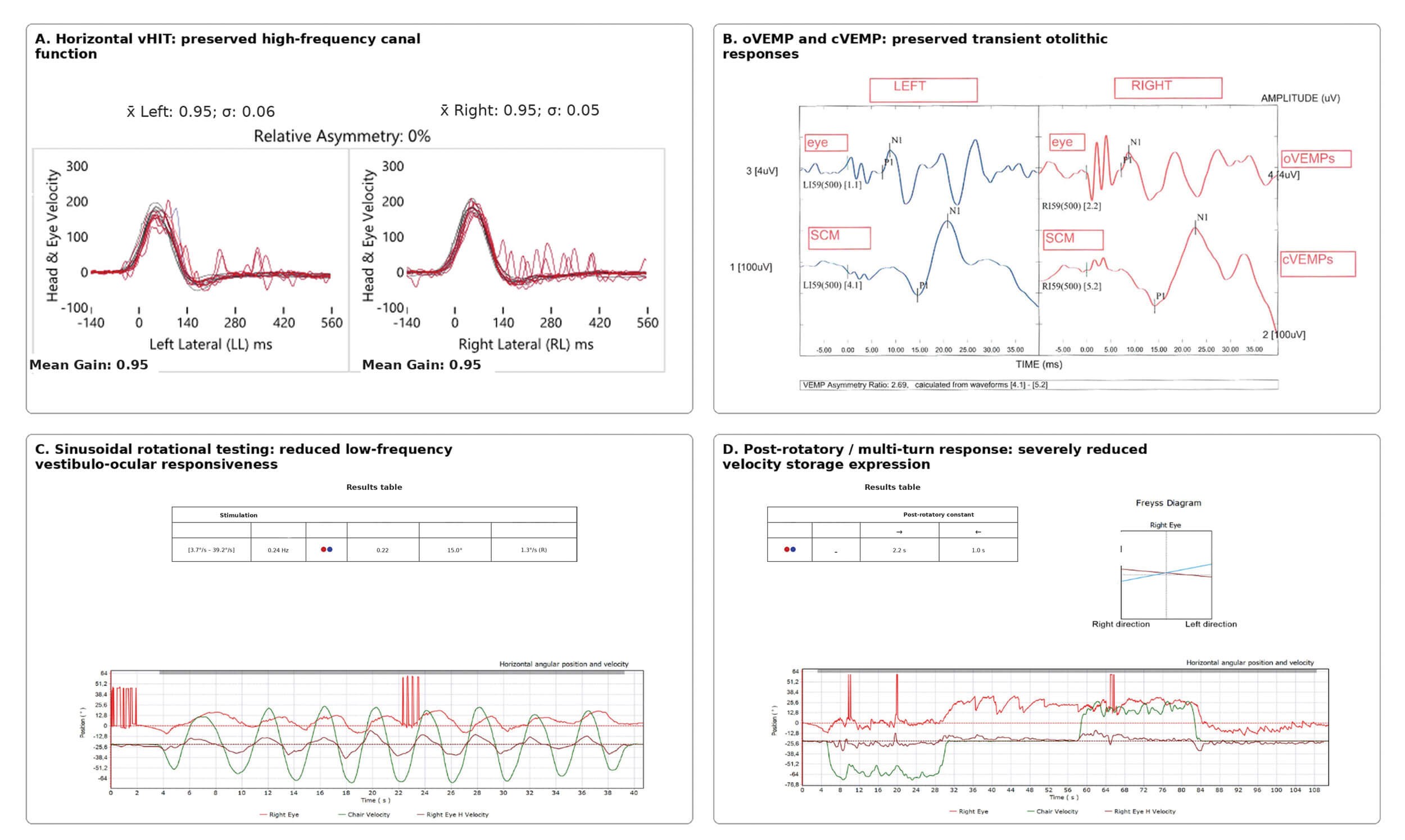
Figure 1: Clinical example of time-domain dissociation. Preserved high-frequency canal function on horizontal vHIT and preserved transient otolithic responses coexist with markedly reduced low-frequency rotational responsiveness and severely reduced post-rotatory/multi-turn velocity-storage expression. Reproduced/adapted from Manzari and Manzari, Healthcare 2026, under the Creative Commons Attribution License [2].
A real patient example
Figure 1 shows one of these clinical patterns. The patient had preserved horizontal vHIT gains and preserved transient otolithic responses on oVEMP and cVEMP. Yet sinusoidal rotational testing showed markedly reduced low-frequency responsiveness and the post-rotatory/multi-turn response showed severely reduced velocity-storage expression. The message is not that the vHIT was wrong; it answered its own question correctly. The problem was that the patient’s disorder lived in another vestibular domain.
From reflexes to prediction
Vestibular function is not only a reflex arc. It is a predictive, multimodal, body-centred system for self-motion control. This point is central to the modern interpretation of Kathleen Cullen’s work: vestibular nuclei, cerebellar and cortical networks integrate labyrinthine signals with proprioception, optic flow, motor commands and behavioural context. A patient may therefore show preserved high-acceleration reflexes but still experience visual-motion intolerance, defective self-motion perception or abnormal sustained vestibular processing [3].
Jean Laurens has provided a complementary systems-neuroscience view of the nodulus and uvula as an ‘otolith vermis’: a cerebellar internal model that predicts otolithic activation, resolves tilt-translation ambiguity and sends prediction-error feedback to update internal estimates of self-motion [4]. This helps explain why gravity, otoliths, visual motion and velocity storage cannot be separated clinically as neatly as our tests sometimes suggest.
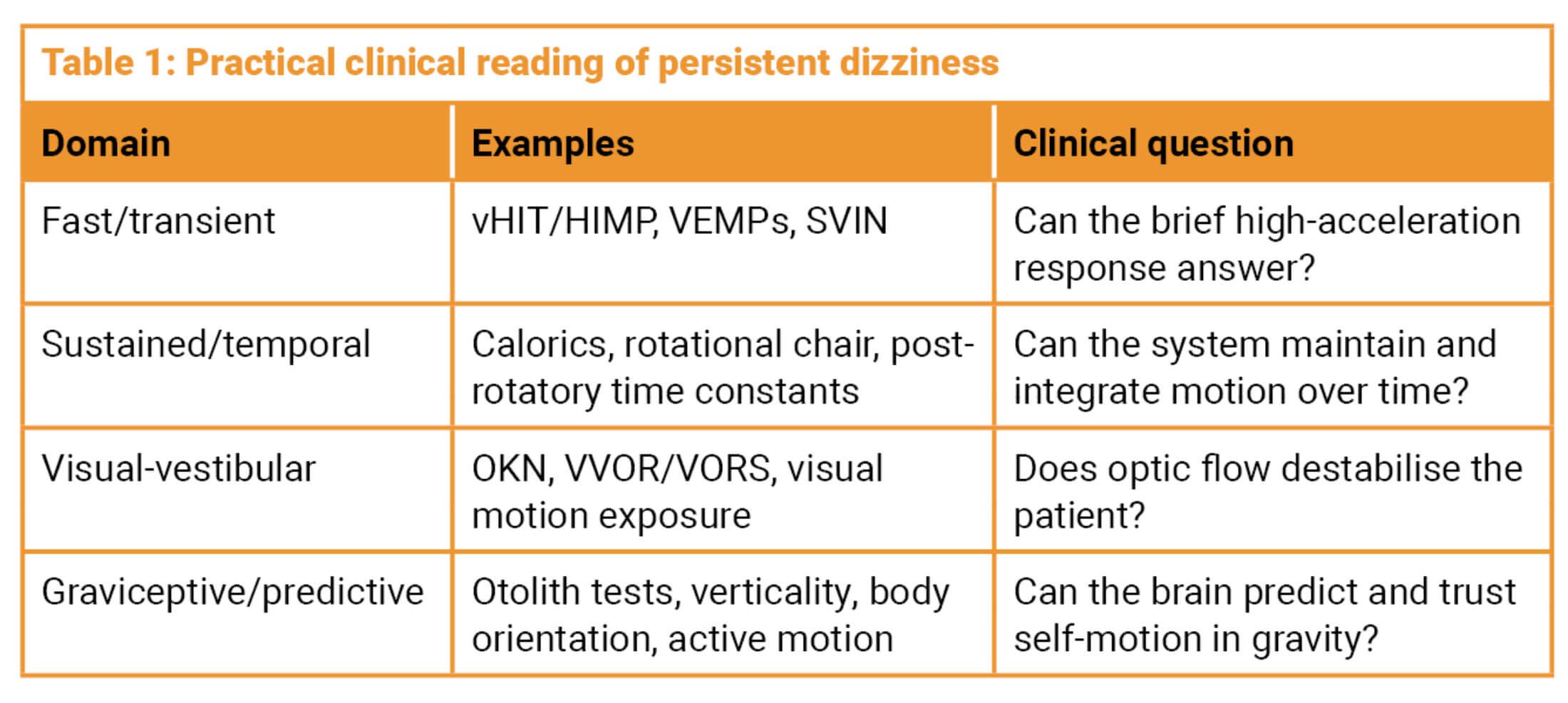
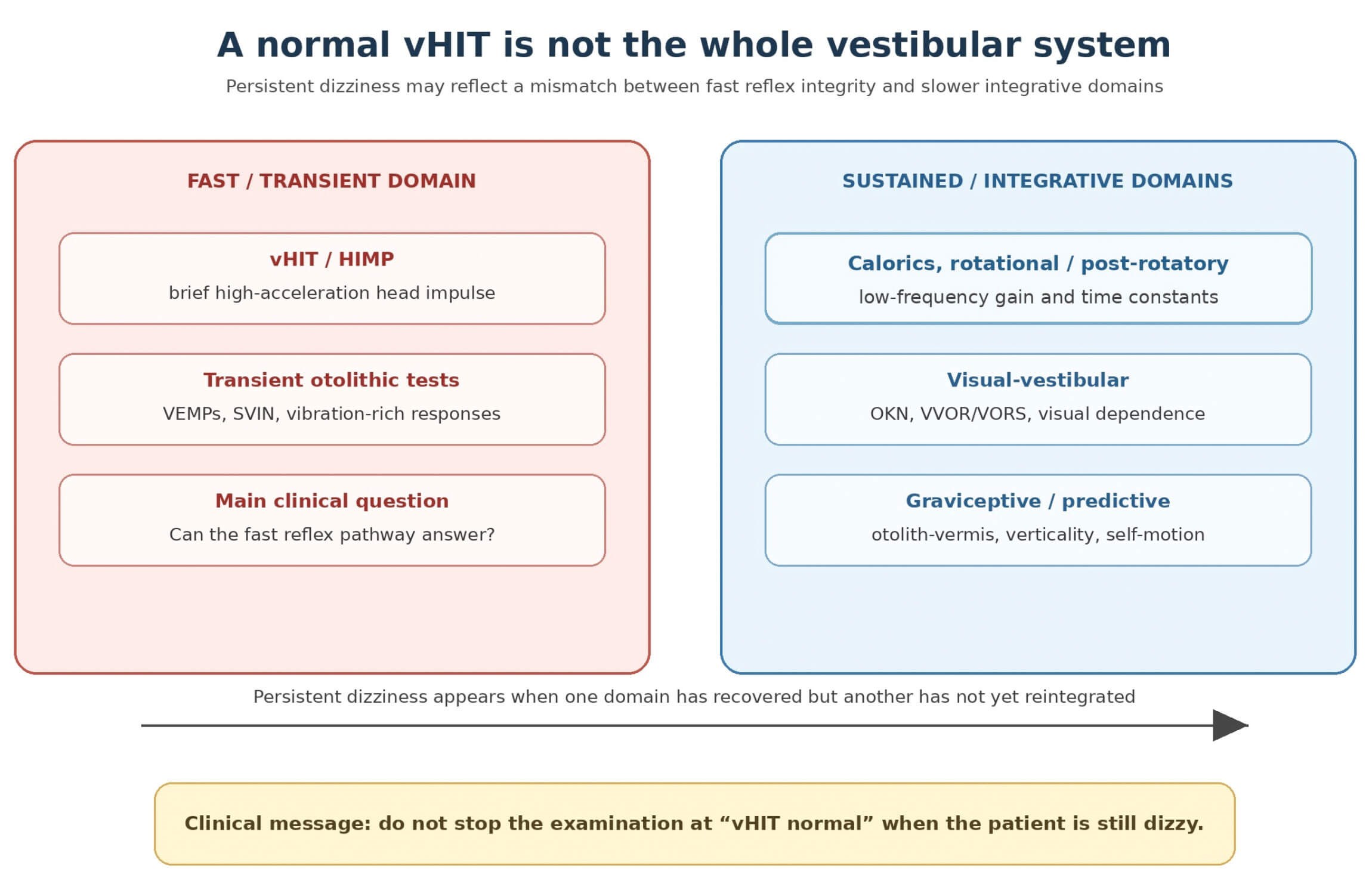
Figure 2: Conceptual summary. A preserved fast/transient response may coexist with impaired sustained, visual-vestibular, graviceptive or predictive self-motion processing. Persistent dizziness often requires listening beyond the impulse response.
Which test hears which language?
A multidomain vestibular assessment does not mean testing everything in every patient. It means selecting tests according to the clinical question. Fast, jerk-rich paradigms such as vHIT, VEMPs and skull vibration-induced nystagmus preferentially probe transient pathways. Caloric testing, sinusoidal rotation, post-rotatory responses, optokinetic responses, VVOR/VORS and OVAR explore slower, sustained or integrative behaviour, often with stronger velocity-storage or visual-vestibular engagement [5,6].
Rehabilitation should follow the failed domain
The aim is not to create more labels. The aim is to avoid treating all chronic dizziness as if it were physiologically identical. A patient with visual-motion sensitivity may need graded optokinetic and visual-motion exposure. A patient with sustained-domain impairment may need carefully dosed habituation and motion tasks that challenge slow integration rather than only gaze stabilisation. A patient with otolithic or graviceptive involvement may require exercises that rebuild body orientation, verticality and postural confidence.
TAKE HOME MASSAGE
PPPD remains a valuable and necessary diagnosis. But in some patients, PPPD may coexist with a residual vestibular-domain abnormality that has not been identified because the examination stopped too early.
The vestibular system speaks many languages: impulse, gravity, rotation, visual motion, posture, velocity storage and prediction. If we listen only to the impulse, we may miss the sentence. Persistent dizziness challenges us to move beyond the question ‘is the vHIT normal?’ and toward a more useful question: which vestibular domain has not yet recovered, adapted or disengaged?
References
1. Staab JP, Eckhardt-Henn A, Horii A, et al. Diagnostic criteria for persistent postural-perceptual dizziness: Consensus document of the Committee for the Classification of Vestibular Disorders of the Barany Society. J Vestib Res 2017;27(4):191–208.
2. Manzari L, Manzari MS. Persistent dizziness and time-domain dissociation in vestibular function: A hypothesis-generating case series and spatiotemporal framework for targeted vestibular rehabilitation. Healthcare (Basel) 2026;14(11):1560.
3. Manzari L. From reflexes to prediction: Kathleen E. Cullen’s contribution to modern vestibular neuroscience and clinical otoneurology-A conceptual narrative review. Audiol Res 2026;16(4):96.
4. Laurens J. The otolith vermis: A systems neuroscience theory of the Nodulus and Uvula. Front Syst Neurosci 2022;16:886284.
5. Manzari L. Velocity Storage Integrator (VSI): Mechanisms, circuits, and clinical implications. Am Otolaryngol 2026;47(3):104834.
6. Manzari L. Multiscale integration of acceleration and jerk sensing in the vestibular system. Audiol Res 2026;16(1):21.
Declaration of competing interests: None declared.