Recognising handedness could help create a more inclusive surgical environment. A team from Imperial College and Cambridge explores the challenges and practical solutions.
Surgical disciplines require a high level of fine motor skills. Many procedures in ENT simultaneously challenge a surgeon’s dexterity in both their dominant hand and non-dominant hand (NDH). For some endoscopic work, equipment is available with right- and left-facing instruments to allow bilateral access. Despite this, most surgical instruments and operating theatre setups are designed for use in the right hand by right-hand-dominant (RHD) individuals.
Left-hand-dominant (LHD) individuals account for approximately 10% of the population, with a similar proportion represented within the surgical profession [1]. However, there is very limited reference to hand dominance in medical school, surgical training books or the workplace, with an overall paucity of research in this area and its impact on surgical skill.
A mixed-methods cross-sectional survey was conducted by teams from Imperial College Healthcare Trust and Cambridge University Hospitals to explore the technical and social implications of working and training with colleagues of different hand dominance (HD).
Of the 88 participants who responded, 25% were LHD, a higher proportion than in the general population. This may be secondary to selection bias among survey participants, with individuals interested in the topic being more likely to participate. Higher proportions of LHD surgeons have also been reported by Alhussien et al. in an ENT cohort from Saudi Arabia (13.7%) [1], as well as in other specialties, including orthopaedics (15%) [2] and neurosurgery (17%) [3].
Does ambidexterity serve as an advantage to the ENT surgeon? This study found that LHD participants felt more comfortable using their NDH compared with RHD participants. However, tonsillectomy was the only index procedure for which participants felt ambidexterity was essential. Thus, participants in both Brooks et al.’s study of left-handed surgical trainees and surgeons [4] and our cohort did not perceive LHD as an advantage. This may reflect the additional challenges experienced by LHD surgeons within a predominantly right-handed surgical environment.
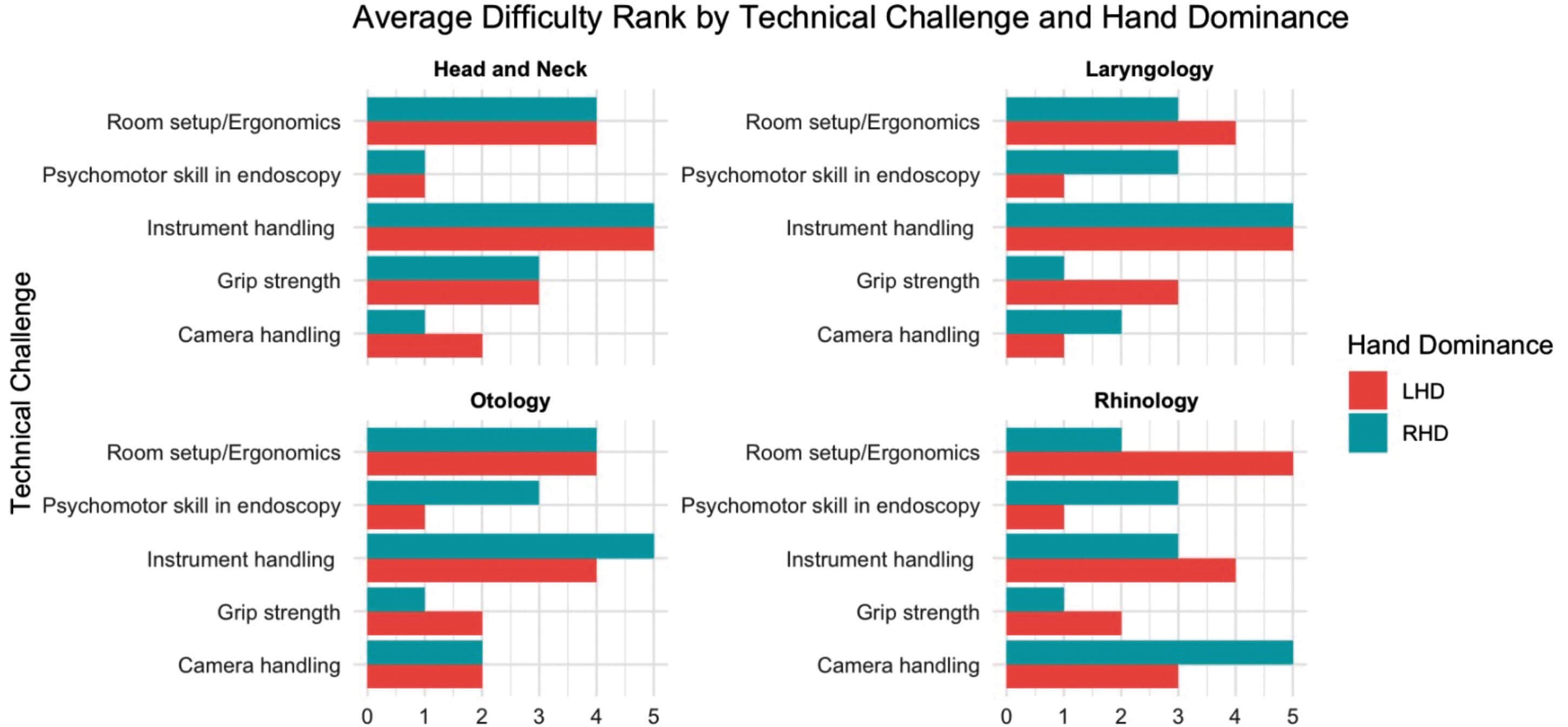
In this cohort, 37% of LHD participants reported negative interactions with colleagues related to their HD, a finding echoed by Othman et al., who reported similar experiences in 80% of LHD participants, including refusal by colleagues to teach them unless they used their right hand [5]. Brooks et al. further reported that being asked not to perform certain operative steps with their dominant hand was a “near universal” experience among LHD surgeons, and that LHD surgeons were often perceived as awkward when operating. Although RHD trainers were generally willing to accommodate LHD trainees, Brooks et al. found that they were often unsure what adaptations to suggest. It may be that RHD trainers are less accustomed to identifying practical strategies that help LHD trainees develop their surgical skills.
Physical discomfort and injury potential have been identified as concerns when reviewing the literature on surgical ergonomics and the risk factors affecting LHD individuals. Among ENT surgeons performing endoscopic sinus and skull base surgery, work-related musculoskeletal disorders (WRMDs) have a 12-month prevalence of 82% [6]. In comparison, this study found a lower proportion of participants experiencing physical discomfort and no significant difference between LHD and RHD participants. Despite this, the majority of WRMDs develop during specialist training, underscoring the importance of early education and training in ergonomic principles.
Learning and teaching across different hand dominance were highlighted as challenges in this study. LHD participants were significantly more likely than RHD participants to report difficulty learning from trainers with opposite HD. This may be attributable to the increased frequency with which LHD individuals encounter such differences, making the experience more salient and easier to recall. RHD surgeons have fewer additional obstacles (e.g. needles to adjust or adaptations to the handedness of their trainer); therefore, the HD of their trainer may have less impact. With respect to teaching those of different HD, LHD participants again found this more challenging. However, the higher proportion of RHD trainers in this study is echoed in Brooks et al’.s review, which also found that RHD trainers were less comfortable training LHD trainees. In contrast, there is much to be learned from someone of the opposite HD, particularly in considering different solutions to surgical challenges and approaches to tissue handling.
As highlighted in our qualitative analysis, there may also be benefits to operating with a surgeon of the opposite HD, allowing both surgeons to stand on opposite sides of the table in complementary positions and use their dominant hand. Interestingly, head and neck surgery and rhinology were the disciplines in which differences in HD were more apparent. This may reflect challenges identified in room setup, ergonomics and camera handling, which have a greater impact in rhinology. For both laryngology (centrally) and otology (on the side of the ear being operated on), there is only one position for the operating surgeon in relation to the patient and scrub team. This is less likely to be influenced by hand dominance compared with head and neck surgery and rhinology. Additionally, the use of the microscope often minimises differences in handedness due to the bimanual approach required for microsurgery. Despite this, in Alhussien et al.’s cohort, 47.8% of LHD surgeons were subspecialised or considering subspecialising in rhinology compared with 34.4% of RHD surgeons, demonstrating that hand dominance may not be a restricting factor in career development [1].
Adaptations can start small. Positioning and adapting theatre setups to improve ergonomics and facilitate training opportunities is achievable. However, 42% of LHD participants in this study were not implementing these, which may suggest a barrier at either a trainee or departmental level. Additionally, considering intentional pairing of LHD trainers with LHD trainees during their training, or having LH-specific stations, may present an opportunity to allow them to acquire key skills in a comfortable setting. This may be particularly relevant in the early years of training, to reduce the anxiety or tension that may arise from watching a trainee perform a procedure with the opposite hand, which may appear awkward to the trainer.
A commonly discussed adaptation is the use of LH surgical instruments to address one of the main difficulties experienced by LHD participants: instrument handling. However, none of the LHD consultants in the cohort had purchased LH-specific instruments. They felt that they had acclimatised to working with right-handed instruments during training, and that the logistics of having LH-specific instruments available for each case or during emergencies, particularly within the National Health Service (NHS), may be impractical. However, the acknowledgement that LHD trainees may need to use instruments slightly differently should be recognised and not penalised during training, provided this does not increase the risk of harm to the patient or the surgeon [7]. Increased use of technology and minimally invasive models, including the robot, will require different approaches to surgical skills training and may allow greater equity in ambidextrous skill development for all trainees.
A range of factors, including human, equipment and environmental considerations, contribute to the unique challenges faced, particularly by left-handed trainees. However, these challenges are not insurmountable. Through better communication within surgical teams and individual trusts, simple yet effective adaptations can be implemented. By actively addressing the barriers posed by hand dominance, the surgical community can promote improved performance, better patient outcomes and sustainable, pain-free careers for all surgeons, regardless of hand preference.
Declaration of competing interests: None declared.