Surgery has a significant environmental footprint. This article outlines practical ways to cut emissions, waste and energy use while embedding sustainability into surgical culture.
Europe experienced its most severe heatwave on record this summer. An omega blocking system locked unprecedented temperatures across the continent, with land surface readings exceeding 50°C in parts of France and Spain. The WHO estimated over 1300 excess deaths in the first weeks of the event alone.
A landmark analysis published in 2025 confirmed that the rate of global warming has accelerated markedly, with temperatures rising by more than 0.4°C in just two years [1]. The world is tracking towards 2.8°C of warming by 2100. This is almost double the 1.5°C Paris Agreement threshold [2]. The climate emergency is a consequence of more than a century of dependence on burning fossil fuels. We now know that for every one to four kilotonnes of CO₂ emitted into our earth’s atmosphere, one person will die prematurely [3].

Land surface temperature (°C) across Western Europe, 23 June 2026. Credit: European Union, Copernicus Sentinel-3 imagery.
Ironically, the delivery of 21st century healthcare is associated with a significant carbon footprint. Globally, healthcare contributes between one and five percent of greenhouse gas emissions. The supply chain is responsible for 62% of CO₂ emissions in the NHS, with a further 10% resulting from travel by patients, staff and visitors [4]. Operating theatres are among the most energy-intensive areas within the hospital setting and have been identified as a significant carbon hotspot within the delivery of healthcare. The operating theatre consumes three to six times more energy per square metre than a clinical ward, generates approximately 30% of all hospital waste and produces around 2300 kilograms of anaesthetic gas waste per theatre each year [5]. Environmental stewardship and ‘powering down’ the operating theatre must be prioritised by the surgical community in order to address the climate emergency and achieve net zero by 2050.
"Operating theatres are among the most energy-intensive areas within the hospital setting and have been identified as a significant carbon hotspot within the delivery of healthcare"
A framework for change
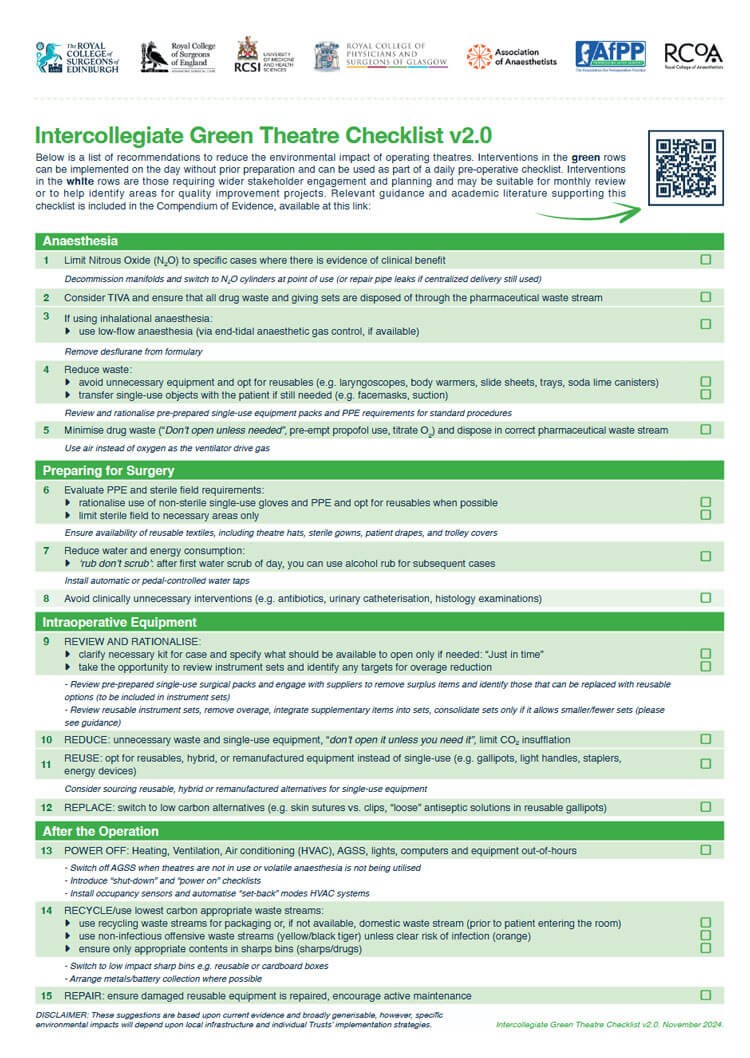
The Intercollegiate Green Theatre Checklist v2.0, launched by the Royal Colleges of Surgeons and Anaesthetists in 2025 [6], provides a framework for the multidisciplinary surgical team to support the delivery of sustainable care before, during and after surgery. It highlights the primary carbon hotspots within the operating theatre and identifies ways of mitigating each of them. These include reducing the use of volatile anaesthetic gases, particularly desflurane, and decommissioning nitrous oxide manifolds; embedding waste segregation protocols; and reducing energy consumption by turning off HVAC systems out of hours. Water waste can also be addressed in high-volume, low-complexity surgical operating lists by adopting a “rub don’t scrub” policy after the first traditional surgical hand scrub of the day. Annually millions of litres of water will be saved per operating theatre by switching to a waterless hand scrub in appropriate operative settings.
Focusing on the surgical instrument tray and what it contains is a key factor when it comes to the delivery of a greener surgical product. Significant carbon and financial gains can be achieved annually in the surgical suite by replacing single-use with reusable instruments, repairing and reprocessing equipment and rationalising the exact content of the surgical tray.
Achieving a ‘green shift’ in surgical culture
The recent survey of Irish surgeons identified that the majority of surgeons at all career grades are committed to reducing the carbon footprint of surgery [7]. The main barrier to meaningful change was felt to be breaking old habits and the need for a shift in culture.
The theoretical and practical scaffolding through which sustainable practice becomes normalised, team-owned and systems-embedded rather than dependent on individual champions is reliant on the behavioural change of the whole surgical team.
In order to address these issues, we have focused future research initiatives on behavioural change frameworks that could be introduced in order to embed sustainable surgical practice into operative care. The first is Normalisation Process Theory, which examines how new ways of thinking and working become embedded as standard practice in healthcare settings. Applied to sustainability, it helps teams understand how green behaviours can be normalised rather than treated as exceptional [8]. The second is the green Non-Technical Skills for Surgeons (NOTSS) framework, which positions environmental stewardship as a marker of a high-performing surgical team – placing sustainability alongside safety, communication and leadership as a core professional competency [9]. The third is the Systems Engineering Initiative for Patient Safety (SEIPS) model. This offers a sociotechnical framework for integrating ergonomics into the design of the operating theatre [10]. This is a ‘lean and green’ approach to theatre design, enabling the carbon footprint of operative care to be reduced without compromising the quality or safety of patient care.
"The main barrier to meaningful change was felt to be breaking old habits and the need for a shift in culture"
Currently, with funding from the Irish Health Service Executive, we are piloting these behavioural change initiatives at three hospital sites in Ireland. The sites include a dedicated surgical hub, a university public teaching hospital and a national surgical referral centre. The pilot initiative is aimed at creating a national accredited network of ‘green sustainable surgical theatres’ throughout Ireland. Using less volatile anaesthetic gas, generating less waste and reducing reliance on single-use products will ensure that surgeons are leaders in delivering safe, effective, sustainable patient care that achieves the global surgical triple goal of improved outcomes, equitable access, and environmental stewardship [11].
Click the image below for the Intercollegiate Green Theatre Checklist v2.0.
References
1. Hansen JE, Kharecha P, Sato M, et al. Global warming has accelerated: are the United Nations and the public well-informed? Environment 2025;67(1):6–44.
2. United Nations Environment Programme. Emissions Gap Report 2025: Off Target. 2025.
https://wedocs.unep.org/items/9f0bf855
-2069-42a6-a856-4b389f740c5c
3. Bressler S. The mortality cost of carbon. Nat Commun 2021;12(1):4467.
4. Tennison I, Roschnik S, Ashby B, et al. Health care’s response to climate change: a carbon footprint assessment of the NHS in England. Lancet Planet Health 2021;5(2);e84–92.
5. MacNeill AJ, Lillywhite R, Brown CJ. The impact of surgery on global climate: a carbon footprinting study of operating theatres in three health systems. Lancet Planet Health 2017;1(9):e381–8.
6. Winter BJ, Robb D, Chu H, et al. Intercollegiate Green Theatre Checklist v2.0. 2025.
https://rcoa.ac.uk/sites/default/files/documents/
2025-02/green-theatre-checklist.pdf
7. Umair M, Keane A, Mahmood M, Carroll, C. Sustainable surgery in Ireland: a national perspective on practices, perceptions, and challenges. Surgeon 2025;23(6).
8. May C, Finch T. Implementing, embedding, and integrating practices: an outline of normalization process theory. Sociology 2009;43(3);535–54.
9. Flin R, Youngson GG, Yule S (Eds.). Enhancing Surgical Performance: A Primer in Non-Technical Skills. Boca Raton, USA; CRC Press; 2016.
10. Carayon P, Hundt AS, Karsh BT, et al. Work system design for patient safety: the SEIPS model. Qual Saf Health Care 2016;15(Suppl 1):i50–8.
11. Liang R, Orchard JW, Robson SJ. The global surgical triple goal: Surgery must improve health, be equitable, and environmentally sustainable. J Clim Chang Health 2025;23:100458.
[All links last accessed October 2026].
Declaration of competing interests: None declared.