

WS Audiology (WSA), a leading hearing healthcare group, has announced the launch of WSA Sound Preference, a global programme designed to help hearing care professionals better understand how individual sound preferences influence hearing aid experiences and long-term satisfaction.
Despite advances in hearing technology, adoption and consistent use remain ongoing challenges. A 2023 meta-analysis found that only 62% of hearing aid users regularly use their devices1. At the same time, a separate study found that only about 50% of people who start their journey to better hearing successfully complete it2.
According to WSA, these trends underscore a critical gap in how hearing solutions are fitted and experienced. Therefore, WSA Sound Preference is designed to help clinicians better understand individual sound preferences, ultimately supporting higher adoption and long-term satisfaction.
New research conducted by WSA shows that up to 40 percent of listeners demonstrate a strong and consistent preference for one sound design over another. By establishing sound preference as a critical dimension of the patient experience, this research has the potential to set a new evidence-based standard for personalised hearing care across the industry – and support higher hearing aid adoption and long-term satisfaction.
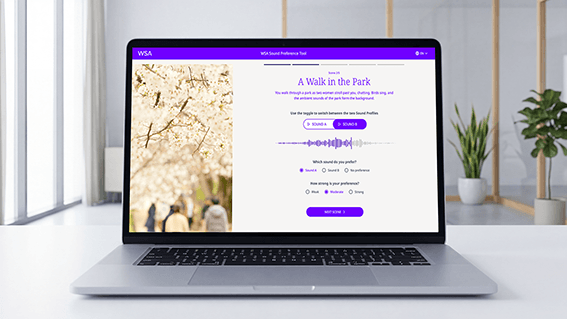
The WSA Sound Preference programme introduces new research, educational resources, and clinical tools to help hearing care professionals incorporate this dimension into patient consultations and fitting discussions.
Lewis Chisnall, Head of Sales (Independents) WSA UK & Ireland said: “We know that preference is everywhere; it drives every decision we all make on a day-to-day basis. In audiology, we have shown it is a phenomenon that we can measure and observe tangibly. Every patient hears the world differently, and hearing care professionals now understand that successful fittings require more than matching a device to an audiogram.
“Accounting for choice during hearing aid assessments ultimately leads to better clinical outcomes. That’s why WSA Sound Preference provides research, language, and specialised tools that help hearing care professionals explore this dimension of hearing more directly with their patients for better hearing aid adoption and satisfaction.”
Understanding different sound experiences
Research indicates that listeners often gravitate toward one of two distinct sound experiences.
Some listeners prefer a design that preserves the natural texture of the acoustic environment, where speech and surrounding sounds remain balanced and closely reflect the original sound scene.
Others prefer a sound profile that emphasises contrast and clarity, where speech is enhanced and background sounds are shaped to support understanding in more complex listening environments.
Both approaches can support successful hearing outcomes, yet individuals may respond differently to each. WSA’s research also found that sound preference could not be predicted by age, lifestyle, or demographic characteristics, reinforcing that preference is a complex and highly personal aspect of hearing.
For hearing care professionals, these findings help explain why patients with similar audiograms can report very different listening experiences.
Lewis Chisnall – Head of Sales (Independents) – UK & Ireland added: “WSA Sound Preference creates a win-win situation. Patients feel like they are receiving more personalised care, with quicker acclimatisation, which leads to higher satisfaction with the investment they had made. For hearing care professionals, it leads to stronger conversations, improved patient outcomes alongside commercial benefits in the form of higher sales and fewer returns.”
While sound preference is a universal dimension of hearing, WSA emphasises that enabling meaningful choice for patients depends on access to fundamentally different sound processing approaches.
WSA’s portfolio brings together distinct technologies, allowing hearing care professionals to offer genuine variation in how sound is delivered. Widex hearing aids, for example, uniquely use Time Domain processing to provide a natural hearing experience, while through Signia, WSA provides a Frequency Domain solution to enhance clarity and speech understanding.
By enabling both approaches, WSA supports more precise alignment between technology and individual sound preference, helping to improve fitting outcomes and patient satisfaction.
Tools to support patient conversations
Alongside the research, the WSA Sound Preference programme introduces resources designed to help hearing care professionals discuss sound preference during patient consultations.
One online tool offers an interactive listening experience that allows users to compare sound designs and reflect on which they prefer. The experience is designed to help patients recognise that preferences exist and to support more productive conversations on preference during the fitting process.
The initiative complements existing clinical practice by reinforcing what many clinicians already recognise: successful hearing outcomes depend on personalised care because each patient is unique.
To strengthen the scientific foundation of the programme, WSA is also establishing an independent scientific advisory board composed of university-affiliated audiologists and researchers. The board will review current research and help guide future studies exploring how sound preference influences hearing outcomes.
The Sound Preference programme was introduced globally beginning 20 April 2026, with educational resources and research materials made available to hearing care professionals worldwide.
________________________________________________________________________________________________________________________________
[1] Marcos-Alonso, S., Almeida-Ayerve, C. N., Monopoli-Roca, C., Coronel-Touma, G. S., Pacheco-López, S., Peña-Navarro, P., Serradilla-López, J. M., Sánchez-Gómez, H., Pardal-Refoyo, J. L., & Batuecas-Caletrío, Á. (2023). Factors Impacting the Use or Rejection of Hearing Aids—A Systematic Review and Meta-Analysis. Journal of Clinical Medicine, 12(12), 4030.
[2] MarkeTrak 2025: Consumer Perspectives on Hearing Health in an Evolving Market
FURTHER INFORMATION
WSA Sound Preference
E: marketing.uk@wsa.com
www.wsa.com/soundpreference


