
Access to temporal bone dissection varies worldwide. This article explores the potential and limitations of online pre-learning for cochlear implant surgery.
Cochlear implantation is now a mature procedure with reliable outcomes, and demand for it is rising fastest in countries where training infrastructure is thinnest. The World Health Organization estimates that by 2050, nearly 2.5 billion people will have some degree of hearing loss, and that the greatest unmet need sits in low- and middle-income regions [1]. Someone has to operate on those patients. The question for our specialty is how we train those surgeons.
A gap in access, not in motivation
Cadaveric temporal bone dissection is still the best way to build a three-dimensional understanding of this anatomy. Nothing replaces it. But dissection laboratories are costly and unevenly distributed and in many countries, they are effectively out of reach. Traditional courses require travel, time away from clinical work and significant expense. They are also usually delivered once. When the course ends, the material goes with it. This creates a specific problem. A surgeon attends a course, returns home and operates three months later. By then, the detail has faded and there is nowhere to return to for a refresher.
Alternatives are developing. Three-dimensional printed temporal bone models are promising, although the published evidence for their educational effect is still limited [2]. Virtual reality simulation has a stronger evidence base: a meta-analysis of mastoidectomy performance found a standardised mean difference of 0.87 in favour of trainees who trained on a temporal bone simulator [3]. Both approaches still require equipment, and equipment is exactly what many programmes do not have.
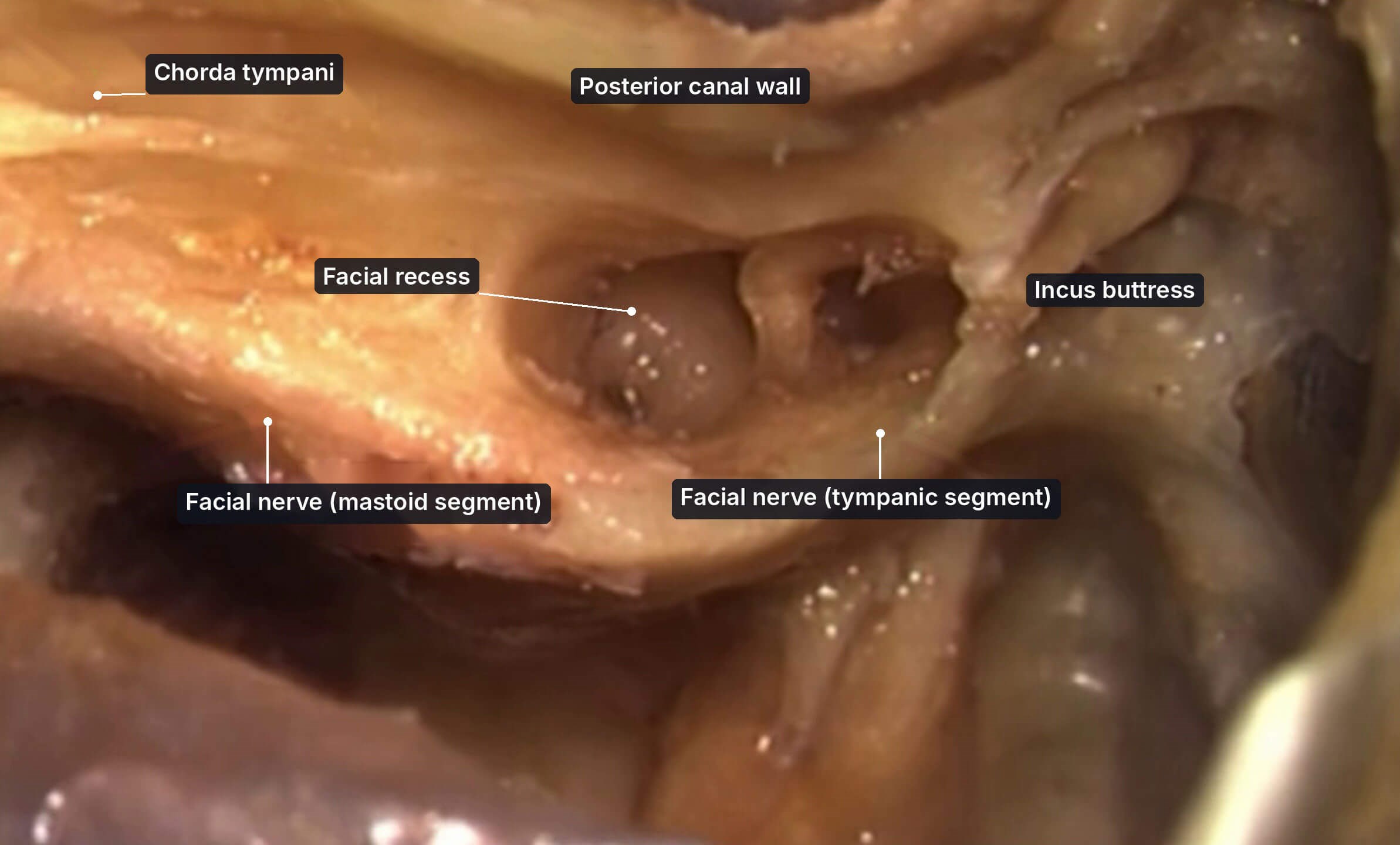
Cadaveric dissection of the right temporal bone showing the facial recess, with the facial nerve, chorda tympani and incus buttress labelled.
Why standardisation matters here
Ask 10 cochlear implant surgeons to describe how they drill a posterior tympanotomy and you will hear 10 descriptions. Most will be safe. Very few will be identical.
Some of that variation is legitimate. But when a technique is not taught as a defined sequence, steps get improvised. A surgeon early in the learning curve needs one reliable default before they can depart from it. In cochlear implantation, the margin is small. The target is a structure a few millimetres across, and the cost of intracochlear trauma is measured in a patient’s hearing for the rest of their life.
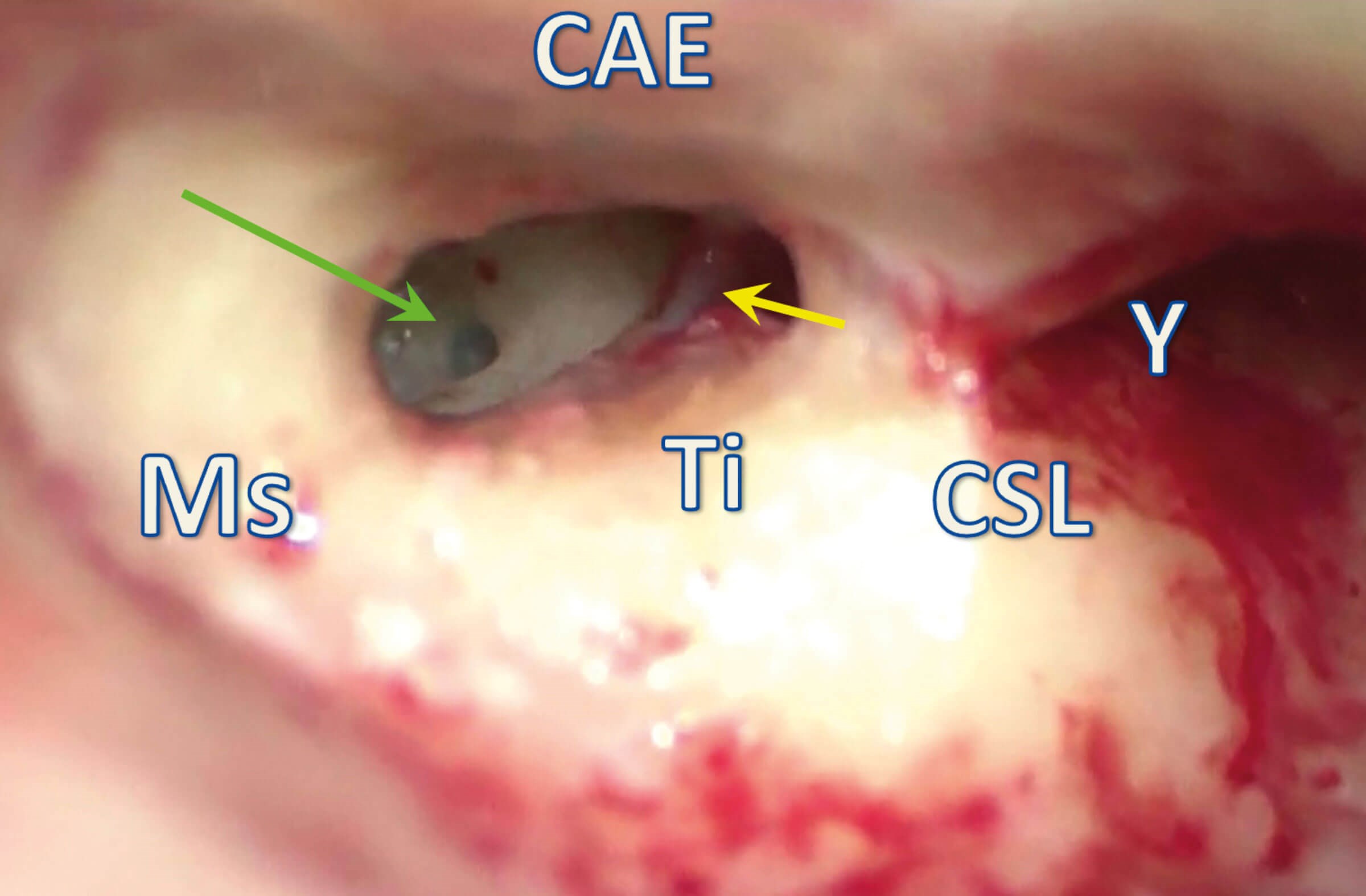
Intraoperative view of the round window niche after removal of the bony overhang, immediately before electrode insertion.
In my experience, the variability concentrates in a small number of places: how widely the facial recess is opened, how much of the bony overhang of the round window niche is removed, how the electrode is held and advanced, and what the surgeon does when the anatomy does not look like the textbook. These are not exotic problems. They are the ordinary decisions of an ordinary case, and they are exactly the points where a trainee benefits from seeing the same decision made the same way several times.
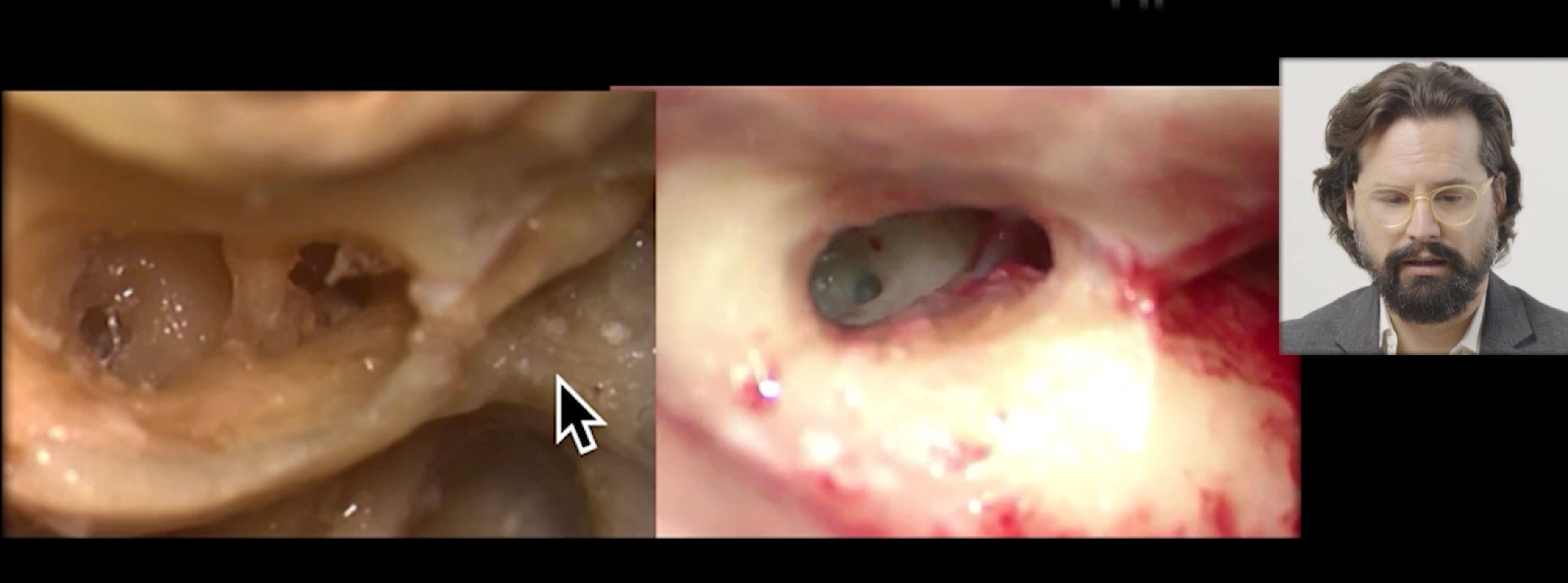
The same anatomical step shown as cadaveric dissection (left) and intraoperative view (right), illustrating the pairing described in the text.
What the evidence supports
E-learning in surgical training has been studied directly. A systematic review in the British Journal of Surgery found that e-learning was better than no training in 29 studies, and at least as effective as traditional methods in most direct comparisons [4]. The same review is careful about its limits: only two trials demonstrated transfer of skill into clinical practice, and none measured patient outcomes.
That is the honest position. Online material is well supported as a way to acquire knowledge and rehearse a sequence. It is not supported as a way to acquire manual skill. It cannot teach hands. Where it does appear to help is preparation. A surgeon who arrives at a dissection course already knowing the steps and the landmarks does not spend limited bench hours getting oriented. The same applies before a first independent case, or before a case with unfamiliar anatomy. The second advantage is repetition. Material that can be reviewed at any point during an access period behaves differently from a course delivered once, because it can be returned to at the moment it is actually needed, which is usually the night before the list.
Building the material
Three years ago, I built an online cochlear implant surgery course around this idea (https://doctorlabatut.teachable.com). It runs to seven core lessons totalling roughly two hours, plus a chapter on cochlear otosclerosis and the ossified cochlea. It moves from skin to skin: surgical field and flap; mastoid work and the labyrinthine block; posterior tympanotomy and the facial nerve; round window and cochlea; electrode insertion; difficulties and complications; and labyrinthectomy with simultaneous implantation.
Two design choices mattered more than I expected. The first was pairing cadaveric dissection video with live operative video of the same step. Dissection shows the architecture cleanly. Operative video shows how that architecture actually appears down the microscope, with bleeding and variant anatomy, at the pace of a real case. Learners who see only one of the two tend to recognise the anatomy in the format they studied and not in the other.
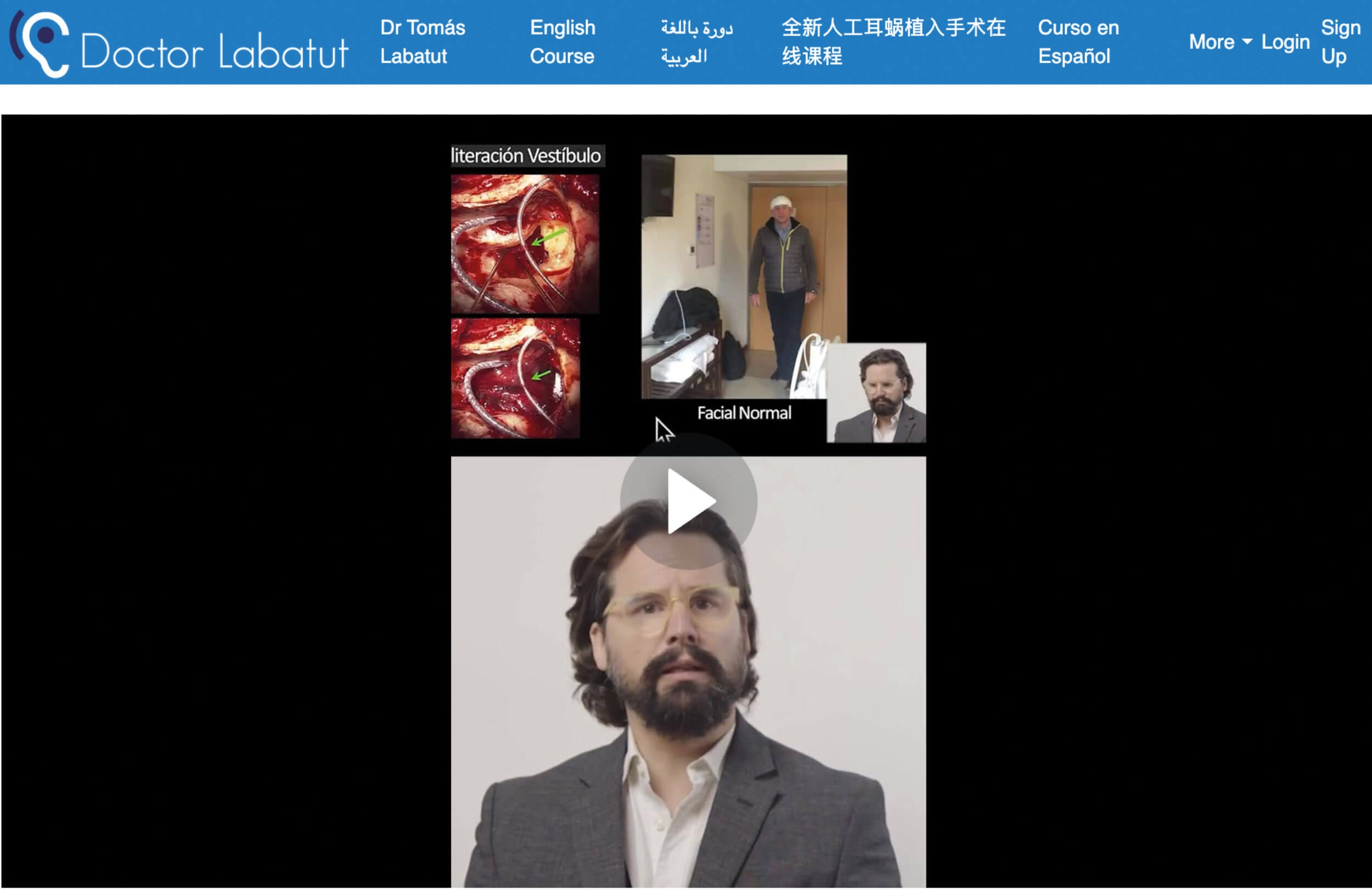
Course interface showing the lesson structure and the six available languages.
The second was teaching one technique rather than surveying several. The course presents the classic transmastoid approach through the facial recess with round window insertion, as I perform it with straight electrodes. That is not a claim that other approaches are inferior. It is a teaching decision, and I think it is the right one for surgeons at the start of the curve.
The sequence then moves deliberately beyond the straightforward primary implant. A chapter on difficulties and complications works through real cases where the anatomy or the insertion did not behave as planned, and later material covers cochlear otosclerosis, the ossified cochlea, and labyrinthectomy with simultaneous implantation in Ménière’s disease. The reason for including these is practical. A trainee’s first difficult case tends to arrive well before they feel ready for it, and recognising a pattern that has already been seen once is a very different experience from meeting it for the first time under the microscope.
Language is part of access
The course is available in English, Spanish, Portuguese, French, Arabic and Mandarin Chinese. Implant programmes are growing fastest in regions where English-language material is a real barrier and where the nearest laboratory is in another country. For any reader who develops teaching material, translation is one of the least expensive ways to widen its reach.
An offer to readers
I would like to make the course available to trainees at no cost. Otology fellows and ENT residents, or programme directors on their behalf, are welcome to contact me by email and I will arrange free access.
Online material will not produce a cochlear implant surgeon. Used before the laboratory and before the case, it can make the hours that do produce one considerably more useful.
References
1. World Health Organization. World Report on Hearing. Geneva, Switzerland. 2021.
www.who.int/publications/i/item/
world-report-on-hearing
[Last accessed October 2026].
2. Frithioff A, Frendø M, Pedersen DB, et al. 3D-printed models for temporal bone surgical training: a systematic review. Otolaryngology–Head and Neck Surgery 2021;165(5):617–25.
3. Lui JT, Hoy MY. Evaluating the effect of virtual reality temporal bone simulation on mastoidectomy performance: a meta-analysis. Otolaryngol Head Neck Surg 2017;156(6):1018–24.
4. Maertens H, Madani A, Landry T, et al. Systematic review of e-learning for surgical training. Br J Surg 2016;103(11):1428–37.
Declaration of competing interests: TL developed the Online Cochlear Implant Surgery Course described in this article and receives income from its sale. He received no payment for this contribution.