Health professionals often overlook the considerable impact tinnitus has on the individual, from its emotional burden to its complex relationship with the nervous system.
Tinnitus, which is defined as the perception of sound without an external source, affects an estimated 750 million people worldwide [1]. However, statistics alone do not capture the emotional weight of tinnitus.
For some individuals, tinnitus may be mild and unintrusive. For others, it takes over. It steals attention, hijacks sleep, affects relationships and alters their sense of who they are. When tinnitus reaches this level of impact, where it is no longer just a sound but a source of real suffering, it crosses a clinical threshold. That is what we call tinnitus disorder. By ignoring the distinction between tinnitus and tinnitus disorder, we risk treating the sound alone, which misses the point entirely.
The nervous system
To understand why tinnitus becomes so consuming for so many people, we need to understand the nervous system’s response to perceived threats. When tinnitus first appears, the brain does what it is designed to do: it flags the unfamiliar sound as potentially dangerous. The amygdala (the brain’s threat-detection centre) triggers the hypothalamic-pituitary-adrenal axis, flooding the body with adrenaline and cortisol. This causes the heart rate to increase, muscles to tighten and attention to narrow. This is commonly referred to as ‘fight or flight’.
"By ignoring the distinction between tinnitus and tinnitus disorder, we risk treating the sound alone, which misses the point entirely"
The problem is that tinnitus offers no threat to fight and nowhere to flee. The sound follows you, and because the brain cannot resolve the threat, the nervous system stays activated. As cortisol remains elevated, sleep deteriorates and anxiety builds. The tinnitus itself may not change, but the suffering is amplified. Tinnitus distress becomes less about the sound itself, and more about the brain’s interpretation of it.
The grief
One of the most overlooked aspects of tinnitus is grief. Many people experience tinnitus as a profound loss – of silence, of peace, of their sense of normality. Some feel they have lost the version of themselves they once were. Before the tinnitus, they may have been someone who fell asleep easily, who thrived in social situations, who felt spontaneous and free. Tinnitus can strip all of that away in a matter of weeks, leaving behind someone who is hypervigilant, exhausted and frightened. Many people with tinnitus are not just struggling with a symptom; they are grieving a self they feel they may never fully recover.
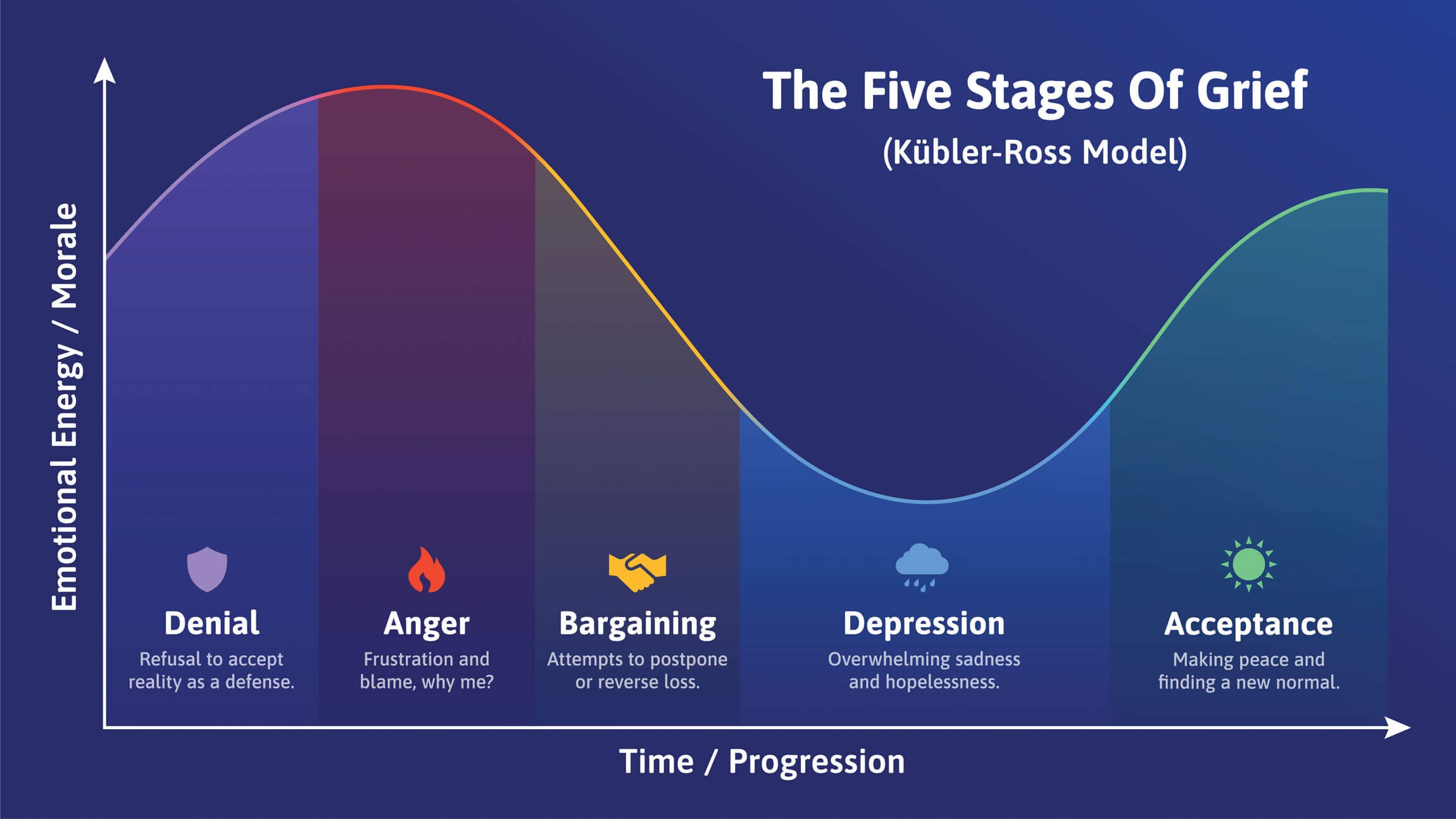
Figure 1: The five stages of grief [2].
Elisabeth Kübler-Ross described grief as moving through stages: denial, anger, bargaining, depression and, eventually, acceptance [2]. Many people with tinnitus will recognise this arc intimately (Figure 1). The desperate searching for a cure. The anger when (wrongly!) told that there is nothing that can be done. The bargaining with specialists and supplements. The deep, suffocating sadness that follows when their attempts do not work. And the tentative arrival at something that might, eventually, be called acceptance.
But, unlike bereavement, tinnitus grief is not socially sanctioned. People may say things like, ‘at least it’s not life-threatening’ or ‘you just need to get used to it’. This kind of minimisation compounds the suffering, adding isolation and shame to an already overwhelming experience.
How tinnitus affects loved ones
The impact of tinnitus rarely stays within the individual. Partners find themselves navigating a loved one who can no longer sleep comfortably beside them, who avoids social events, who withdraws into anxiety. Children notice that a parent is distracted, irritable or sad in a way that is hard to explain. Loved ones often feel helpless. They want to fix it, and they cannot. This can lead to frustration, particularly when they struggle to understand the experience themselves. The tinnitus sufferer’s world shrinks, and with it, so does their sense of who they are.
The trauma of tinnitus
The onset of tinnitus can be a traumatic event. In many cases, it meets the criteria for psychological trauma in every meaningful sense: it is sudden, overwhelming and threatens one’s sense of safety and wholeness, causing hypervigilance, intrusive thoughts and avoidance. The mental health statistics bear this out. Studies show significantly elevated rates of anxiety and depression in people with tinnitus disorder [3]. Suicidal ideation is also more prevalent in this population [4]. Acknowledging tinnitus as potentially traumatic is not catastrophising. It is accurate. And it is the first step towards offering the kind of care that actually helps.
Acceptance and commitment therapy
Acceptance and commitment therapy (ACT) is increasingly used in tinnitus management. ACT is a psychological approach that focuses on changing the relationship we have with difficult thoughts, emotions and sensations, rather than trying to eliminate them. It is grounded in the recognition that the struggle against tinnitus often causes more suffering than the tinnitus itself, and has been found to meaningfully reduce tinnitus distress and improve quality of life [5].
In tinnitus management, implementing strategies informed by ACT encourages people to acknowledge the presence of tinnitus while gently redirecting attention towards what genuinely matters to them. A person who has stopped going out for fear of noise might be supported to meet a friend in a coffee shop – not because the tinnitus has disappeared, but because connection is a value worth moving towards, even with tinnitus present.
"When someone identifies what genuinely matters to them and takes small, committed steps towards those things, tinnitus loses its position at the centre of their life"
In doing so, something important happens in the brain. The nervous system receives new information: this sound is present and I am safe. Life is still possible. When the amygdala stops reacting, cortisol decreases and attention gradually broadens beyond the tinnitus. The sound may remain, but its power to hijack the day begins to diminish.
Therefore, the central question in tinnitus management is informed by ACT and is a simple one: what has tinnitus stopped you doing? And from there, how do we move back towards the values that those activities represented, with tinnitus present, rather than waiting for it to be gone?
When someone identifies what genuinely matters to them and takes small, committed steps towards those things, tinnitus loses its position at the centre of their life. This is because something more meaningful has taken that space in their life.
ACT does not promise silence. It promises a life that is worth living, even with the noise. For many people, this provides a profound and unexpected freedom.
Conclusion
To clinicians supporting patients with tinnitus: the grief, the fear and the loss of identity are signs that something deeply disruptive has happened. Please reassure them that they are not alone and let them know that there is a way forward that requires the right support.
For patients who are ready to take that first step, my book Beyond the Noise offers a place to start. It is written for those who are living with tinnitus and looking for a grounded, compassionate framework for moving forward.
References
1. Jarach CM, Lugo A, Scala M, et al. Global Prevalence and Incidence of Tinnitus: A Systematic Review and Meta-analysis. JAMA Neurol 2022;79(9):888–900.
2. Kübler-Ross E. On Death and Dying (1st ed.). London, UK; Routledge; 1969.
3. Fetoni AR, Lucidi D, Cors6o E, et al. Relationship between Subjective Tinnitus Perception and Psychiatric Discomfort. Int Tinnitus J 2017;20(2):76–82.
4. McCray LR, Scharner MK, Nguyen SA, et al. Suicidal Ideation and Behaviors in Adults With Tinnitus: A Systematic Review and Meta-Analysis. Laryngoscope 2025;135(8):2653–61.
5. Hesser H, Gustafsson T, Lundén C, et al. A randomized controlled trial of Internet-delivered cognitive behavior therapy and acceptance and commitment therapy in the treatment of tinnitus. J Consult Clin Psychol 2012;80(4):649–61.
Declaration of competing interests: GS is the author of Beyond the Noise and provides tinnitus-related clinical services and education.