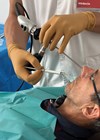
Four years of war have transformed nasal reconstruction in Kyiv, where surgeons are treating complex combat injuries with the paramedian forehead flap.
I am a first-year resident in otorhinolaryngology, sharing how, over four years of Russia’s full-scale invasion of Ukraine, a team of surgeons at St Michaels Hospital in Kyiv has helped wounded servicemen rebuild not only their faces, but their confidence, through staged reconstructive surgery.
Every face carries its own history – sometimes violently interrupted, with what remains having to be rebuilt, step by step. Since 2022, our department has treated a growing number of servicemen returning from the front with devastating nasal defects from blast injury, shrapnel and gunshot wounds. Combat nasal trauma differs from what most reconstructive surgeons train for: rarely clean surgical losses, but contaminated, ragged wounds, often combined with burns and facial fractures, further complicated by delayed presentation and prior field dressings. Restoring the nose, in a real sense, gives these men back part of their identity, and the confidence to carry on.
The choice of reconstructive method depends on the defect’s size and location, the condition of surrounding tissue, lining loss and whether the cartilaginous framework survived. For large, composite defects, the paramedian forehead flap is, in our experience, usually the only realistic option.
Here in Kyiv, a team of experienced surgeons works case after case, under the ongoing pressure of war and periodic attacks on the capital. These are stories the world should know and should not forget – of surgeons operating through blackouts and air-raid sirens, and patients who found their way back to themselves because of it. This team never treats wartime pressure as an excuse to stand still, and as a result, is shaping a generation that has learned, first-hand, what resilience and devotion to this profession look like under real pressure.
Why the forehead flap
The paramedian forehead flap, supplied by the supratrochlear artery, is widely recognised as the gold standard for nasal soft tissue reconstruction [1,2]. It provides a reliable blood supply, even to damaged recipient beds [2,3], and the colour, thickness and texture of its skin closely match those of the nose.
It can also be combined with cartilage grafting and folded to replace the lining – thereby addressing all three layers of the nose within a single reconstructive plan [3,4].
Our surgical approach
Reconstruction typically follows a staged protocol: harvesting the flap with reconstruction of the framework and inner lining, followed by inset (flap take is complete in approximately three weeks); division of the pedicle at three to four weeks; and subsequent thinning stages to refine the contour. Given the debridement these wounds require, the full course of treatment typically spans seven to 10 months and involves four to six surgical procedures per patient.
"All 24 flaps have survived – a 100% take rate, despite contaminated wound beds, associated burns and high smoking prevalence – reflecting careful patient selection and perioperative planning"
This approach is shaped by the nature of combat injuries, which has changed along with the war itself. First-person view (FPV) drones are currently the primary threat on the battlefield: at close range, their warheads shatter into small, irregular fragments that scatter over a wide area, causing numerous penetrating wounds and comminuted fractures rather than a single, clearly defined injury. This is now the most common cause of the complex nasal injuries we treat – lacerated, contaminated wounds, often accompanied by burns and, at times, traumatic amputation of the nasal tip.
Smoking is another near-constant factor: most patients smoke both before and during treatment. This is clinically significant, as smoking is a well-documented risk factor for flap and graft necrosis and for impaired healing [5,6]. We take this directly into account during consultations and perioperative planning, and inform patients about the possible consequences.
Our series
Over four years, our team has performed 24 paramedian forehead flap reconstructions in servicemen wounded defending Ukraine. Behind each number is a patient who went through months of treatment and multiple operations, adjusting to a face that looks different from before – accepting the result, getting used to how others react and feeling comfortable in public again. Reconstruction here is only half the story; the other half is the patient’s own road back to himself.
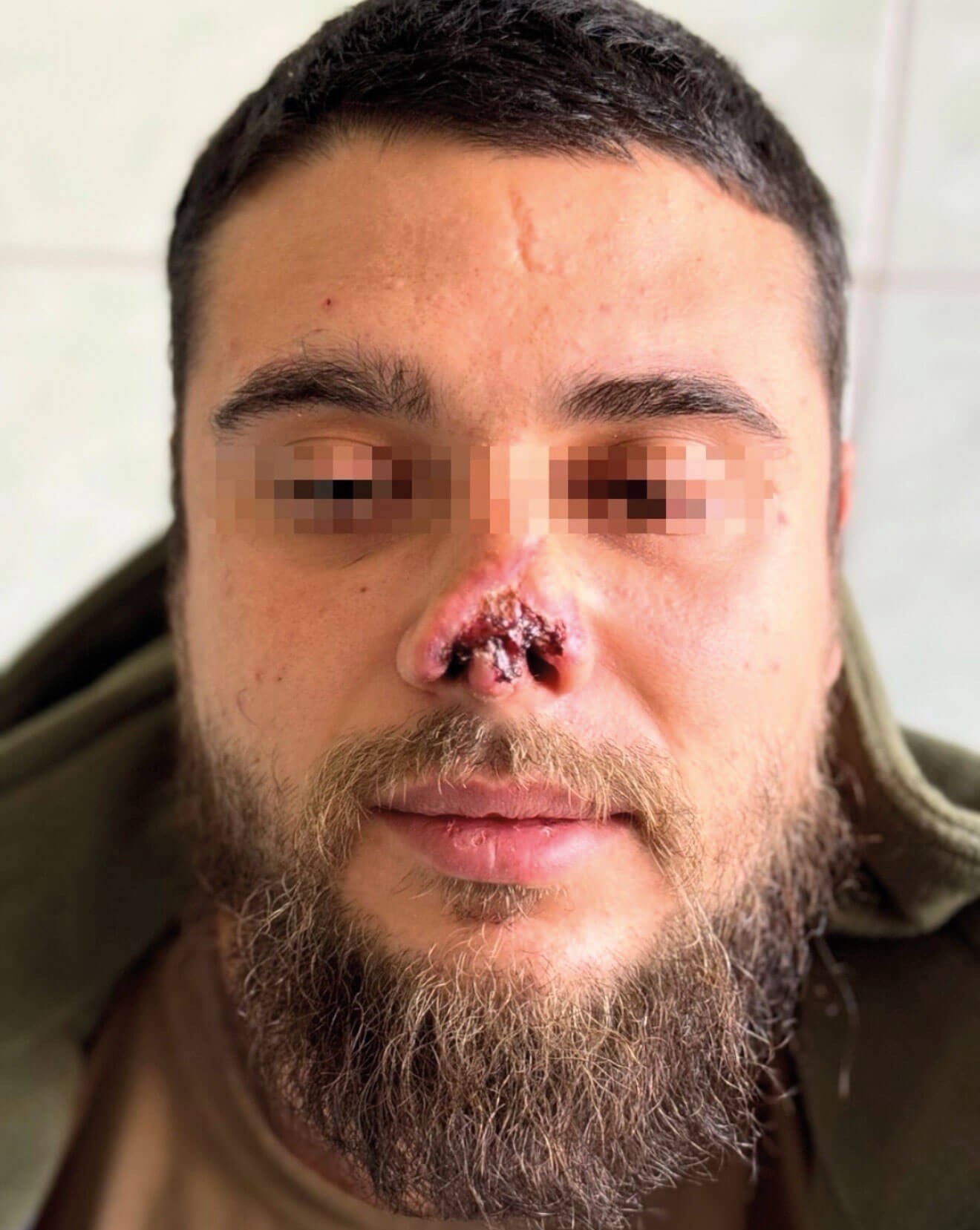
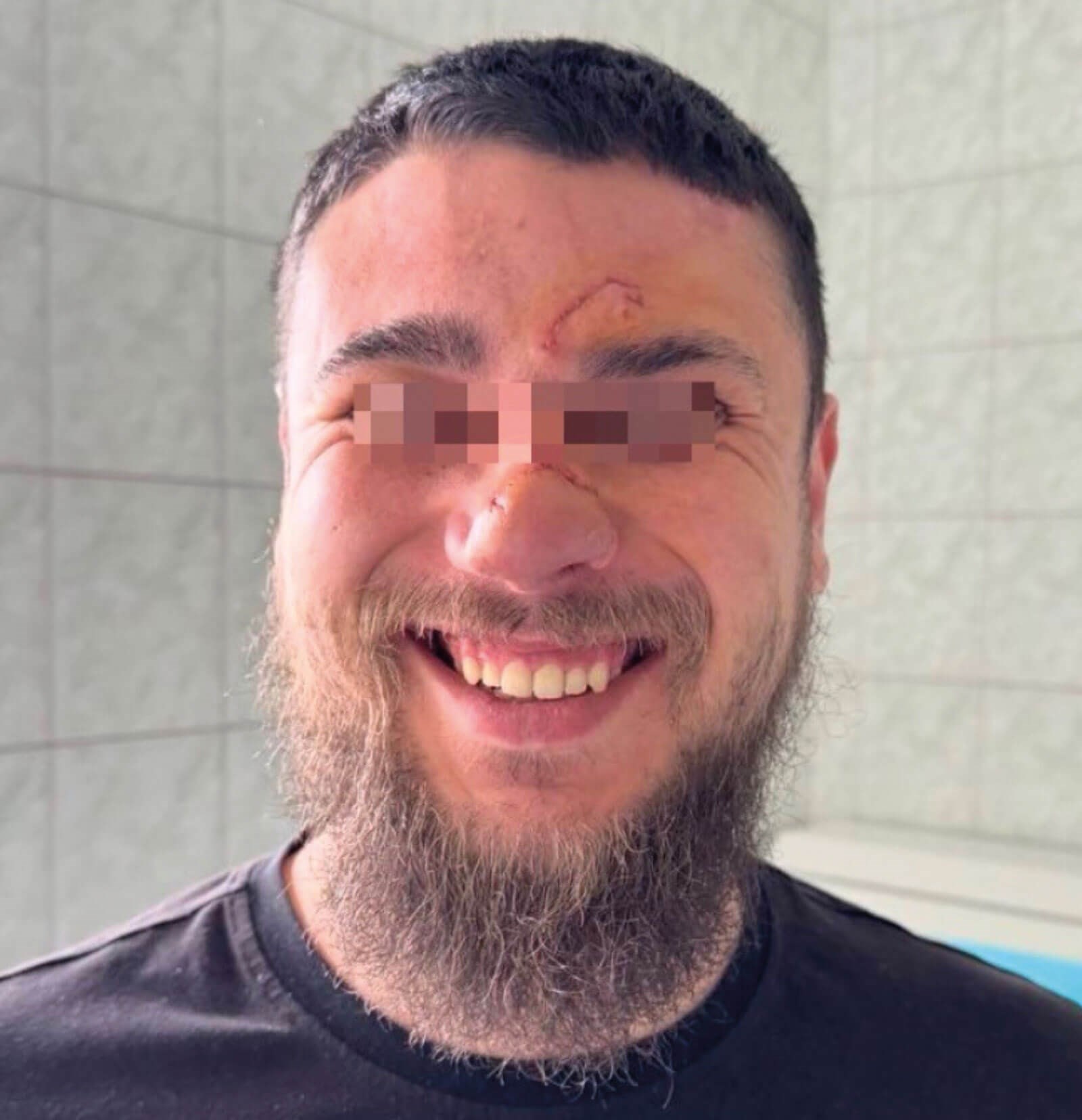
Case 1.
Case 1
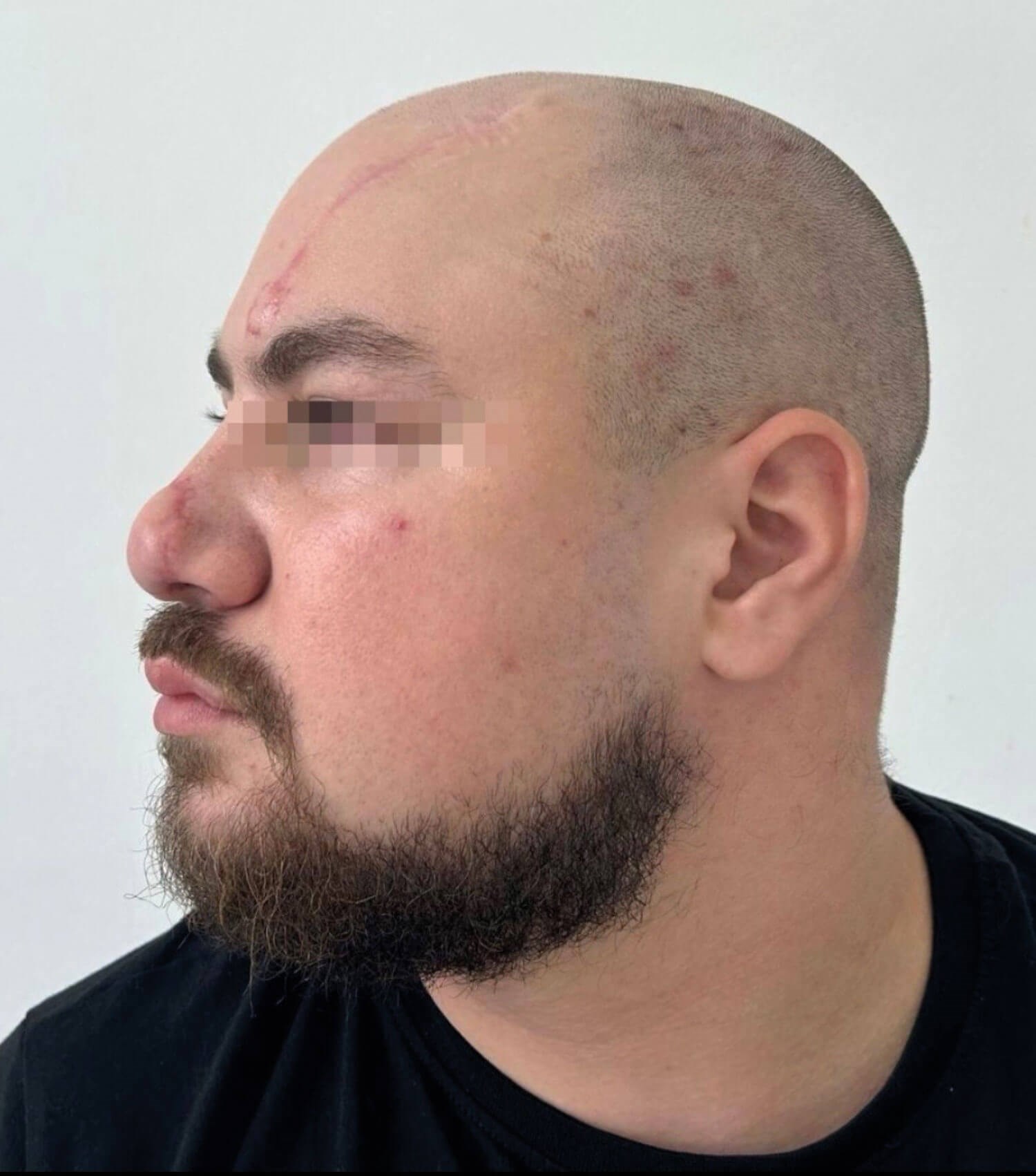
A serviceman presented with traumatic amputation of the nasal tip and alae, with loss of the underlying cartilaginous framework. Treatment spanned nine months and comprised five staged procedures.
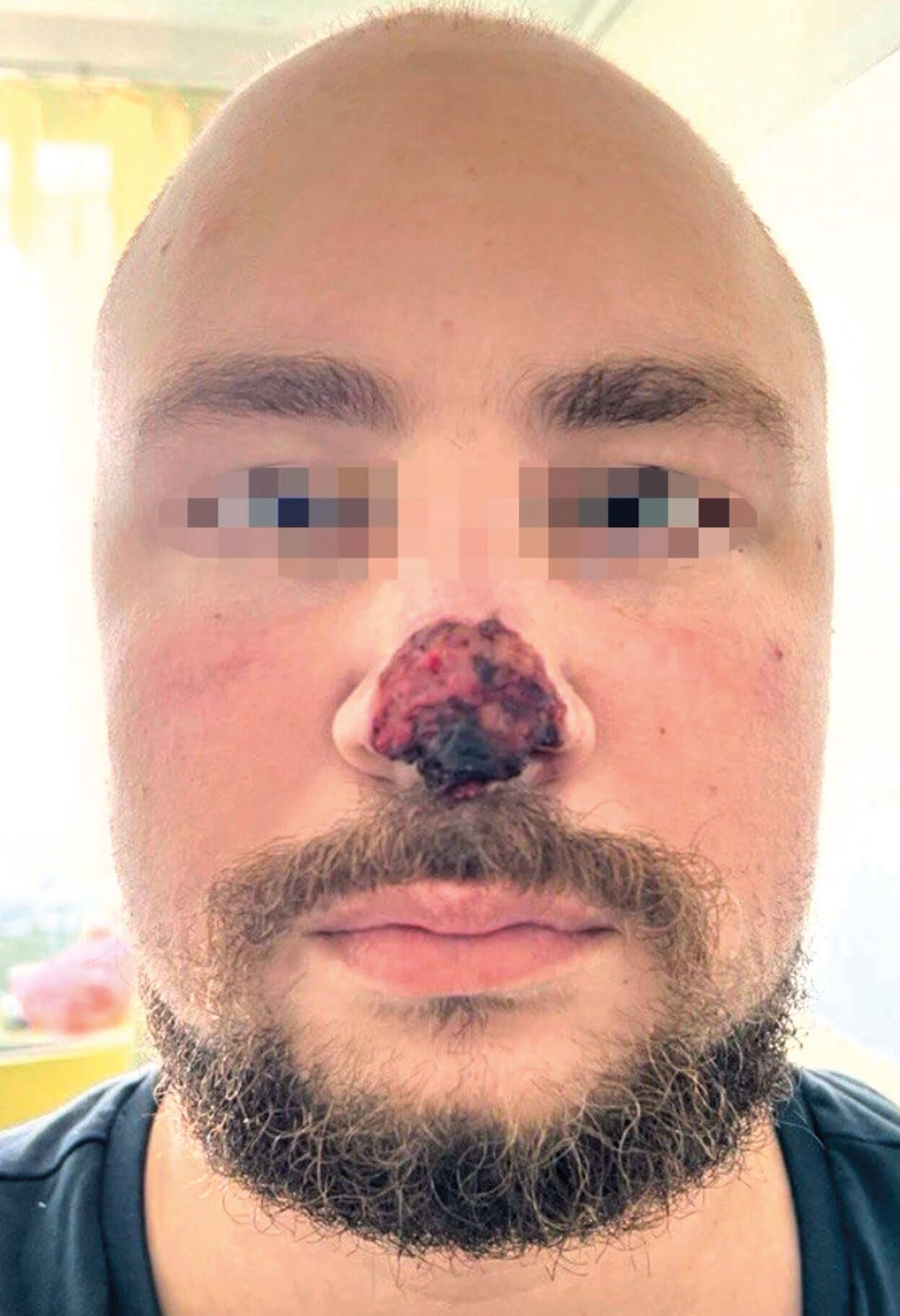
Case 2.
Case 2
A serviceman presented with traumatic amputation of the nasal tip and alae. Treatment spanned nine months and comprised four staged procedures.
All 24 flaps have survived – a 100% take rate, despite contaminated wound beds, associated burns, and high smoking prevalence – reflecting careful patient selection and perioperative planning. Once surgery concludes, most patients are offered structured aftercare: PRP therapy, collagen-stimulating treatments, laser scar resurfacing and hair removal from the flap – often what finally lets the reconstructed nose feel like their own face again.
Discussion
Although our graft survival rate currently stands at 100%, contaminated or burn-injured tissue beds and heavy smoking pose a higher risk of partial necrosis or delayed healing than in routine civilian practice – and we plan our work with this risk in mind.
Psychotherapy in Ukraine still faces significant stigma, and government support for mental health does not meet the needs of these patients; therefore, it is often the surgeon performing the operation who decides how much information the patient can handle and when. There is no one-size-fits-all approach: each patient requires an individualised approach tailored to how they are coping with their situation, not just to the needs of their wound.
Conclusion
The paramedian forehead flap remains, in our team’s hands, the most reliable option for major composite nasal defects, including the combat-related injuries we now see with increasing frequency – reflected in a 100% flap survival rate across 24 cases to date. Beyond the technical outcome, each successful reconstruction restores normal life to men who sacrificed so much of it defending their country. Watching this as a first-year resident, I see it also as proof that skill, resilience and genuine care for patients can be sustained – and passed on – even in the middle of a war.
References
1. Correa BJ, Weathers WM, Wolfswinkel EM, et al. The forehead flap: the gold standard of nasal soft tissue reconstruction. Semin Plast Surg 2013;27(2):96–103.
2. Smart RJ, Yeoh MS, Kim DD. Paramedian forehead flap. Oral Maxillofac Surg Clin North Am 2014;26(3):401–10.
3. Menick FJ. Principles and planning in nasal and facial reconstruction: making a normal face. Plast Reconstr Surg 2016;137(6):1033e–47e.
4. Goldminz D, Bennett RG. Cigarette smoking and flap and full-thickness graft necrosis. Arch Dermatol 1991;127(7):1012–15.
5. Little SC, Hughley BB, Park SS. Complications with forehead flaps in nasal reconstruction. Laryngoscope 2009;119(6):1093–9.
Declaration of competing interests: None declared.