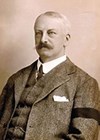
The fact that the cradle of modern otology lies in Britain and Ireland was long unrecognised in continental Europe. Yet it was the Teutonic forefathers of the ‘Vienna School’ who drew their knowledge from such British luminaries as Toynbee and Wilde. Following them, second and third generations of Anglo-Saxon otologists continued to make significant contributions to the worldwide establishment of the specialty. Among their notable publications were the widely acclaimed textbooks of George Purdey Field (Figure 1).

Figure 1: George Purdey Field, 1845–1915. (© Wellcome Collection).
Many will be familiar with Eric Carle’s children’s book in which The Very Hungry Caterpillar (1969) has eaten holes in all the pages [1]. Thousands of children will have poked their little index fingers through the holes made by the caterpillar. Carle’s book, however, was not the first one to be published with holes in its pages.

Figure 2: Three dimensional illustrations from Field’s 1879 otology textbook showing (a) perforation of the tympanic membrane and (b) aural polyp. The reader is instructed to view these book illustrations through an auriscope, and this has been reproduced here. (© Lübbers, Hannover).
Ninety years earlier in 1879, Henry Renshaw, editor of GP Field’s 236-page textbook, Diseases of the Ear had used the same idea [2]. He clearly wanted to give the reader a tactile impression of the deep tube of the external auditory canal. Therefore, in all illustrations depicting, for example, a perforation of the eardrum, the page was pierced and a thick, red-coloured piece of cardboard was glued behind it to emphasise the appearance of the middle ear mucosa (Figure 2a). Running one’s finger over the illustration of an ear polyp (Figure 2b), the swelling can be felt as an actual thickening (an embedded grain in the paper).
Attempting to create a three-dimensional experience goes back more than 700 years. Anatomists (notably Vesalius, 1543), philosophers and scientists have long employed paper engineering in books [3].
In the preface of GP Field’s book, the author effusively expresses his gratitude to the illustrator, Mr E Noble Smith. It is also recommended that the “images of the tympanic membrane be viewed through an ear speculum, as only in this way can a more accurate impression be formed” [2].
Also included is the well-known woodcut, still reproduced in numerous publications today, depicting the use of the otoscope described by Brunton in 1865. Field’s book was so popular that it quickly ran into three editions.
George Purdey Field (1845–1915) worked at St Mary’s Hospital, Paddington, where Toynbee had established the first otology department in 1851. After completing his general surgical training, he quickly went on to specialise in otology, then an almost exotic surgical subspecialty. After working with Joseph Toynbee (1815–1866) and James Hinton (1822–1875), he took over as head of the ear department at St Mary’s Hospital in 1873, and his numerous publications established otology as an independent discipline. As dean of the medical faculty of the hospital from 1883 to 1889, he championed the development of otology as a core component of medical education.
Politzer describes him as “the busiest ear doctor in London” [4]. Through his clinical work, his teaching and the many editions of his textbooks, he became internationally well known. He retired from St Mary’s in 1899 and died in 1915.
Today, the once world famous GP Field would be almost completely forgotten, were it not for his ‘holy’ book in the old ENT library of the Charité Hospital in Berlin.
References
1. Carle E. The Very Hungry Caterpillar. New York, USA; Philomel Books; 1969.
2. Field GP. Diseases of the Ear. London, UK; Henry Renshaw; 1879.
3. Montanaro AR. Pop-up and Movable Books: A Bibliography. Metuchen, USA; Scarecrow Press; 1993.
4. Politzer A. Geschichte der Ohrenheilkunde. Stuttgart, Germany; Enke; 1907.
Acknowledgement
The author must acknowledge the help of John Riddington Young in putting this article into the King’s English.