
You searched for "Aetiology"
At-home earplug testing – a first of its kind
As an audiologist, it can be difficult to confirm the proper fit of earplugs. Although we can use sound field testing to assess the attenuation of the earplugs, this is not equipment that every audiology clinic has. Unfortunately, without proper...Leightons and The Hearing Care Partnership Opens Registration for Groundbreaking New Clinical Conference: Oxygen 2025
Leightons Opticians & Hearing Care is excited to announce that registration is now open for Oxygen 2025, a pioneering clinical conference taking place on the 9th and 10th of May 2025. This highly anticipated event, hosted by the leading independent,...Marshall Chasin wins Career Award in Audiology
Congratulations to Audiologist Marshall Chasin, the recipient of the 2025 Richard Seewald Career Award. This award, from the Canadian Academy of Audiology, recognises a career in research, clinical practice, teaching and/or mentoring young people.Prednisolone and/or acyclovir for Bell’s palsy
Landmark Paper: Sullivan FM, Swan IRC, Donnan PT, et al. Early treatment with prednisolone or acyclovir in Bell’s Palsy. N Engl J Med 2007;357(16):1598-607. Facial nerve paralysis as a consequence of Bell’s palsy can result in devastating long-term effects on...29th Biennial IERASG Symposium
David Jackson Morris, Associate Professor, Speech Pathology and Audiology, University of CopenhagenThe Flatirons, slabs of reddish-brown sandstone, in the foothills of the Rocky mountains, were the backdrop for the International Evoked Response Audiometry Study Group (IERASG) meeting 2025. This biannual...New global alliance brings hearing care to people in 14 developing countries
A global project from MED-EL will provide access to new ear and hearing care services for almost 100,000 people living with undiagnosed and untreated hearing loss in developing and emerging countries around the world.Dispelling myths about audiologic counselling: part two
In the second of a two-part series, Drs Clark and English explore how addressing emotions, embracing silence and managing expectations enhance person-centred care. As discussed in part one of this article [1], when we provide patient education, we must monitor...Audiology research: opportunities, career progression and leadership
A career in research can, at first glance, seem far removed from the clinical world of audiology but is that really the case? In this article Melanie Ferguson explains the role of translational research in bridging this gap, as well...Closing the circle: where art, science and humanity meet
As the final cover of this Art meets Science series arrives in your hands, I find myself filled with gratitude. Gratitude for the journey, for the people who walked it with me and, above all, for the deeper purpose that...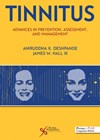
Tinnitus – Advances in Prevention, Assessment, and Management
This is a softcover volume, broken down into six sections over 406 pages printed in greyscale. The book is edited by AK Deshpande and JW Hall III, written by a large number of international experts in the field, and reviewed...


