Nurse-led rhinology clinics and CBCT imaging streamline assessment, improve equity and expand capacity in a resource-constrained public hospital setting.
In the ENT department at Waikato Hospital, New Zealand, we have faced problems that are no doubt well known to many that provide public hospital rhinology services. Resource constraints mean that surgical care cannot be provided for all patients that are referred, and keeping wait times within acceptable limits is challenging.
The many impacts of the Covid pandemic on healthcare services of course served to exacerbate the service pressures that we already faced. For some time, therefore, we have been in pursuit of an improved strategy for providing care in a safe, productive and equitable fashion.
We initially reported on a cohort of patients, referred for rhinology care in our department over a period of six months in 2018 [1]. The established process was of a free-text referral, mostly from primary care, resulting in a clinic appointment with an ENT specialist or registrar for those patients with the greatest apparent need. Alarmingly, we reported marked inadequacies and inequities in service provision when referred patients were assessed in more detail, including using objective measures of disease burden.
During our pursuit of improvements in the patient journey, we were lucky enough to gain access to a cone-beam CT (CBCT) scanner in our clinic, shared with our maxillofacial colleagues who work in the adjacent clinic space, that we have previously reported on [2]. This allowed us to streamline the assessment of new rhinology patients such that in the course of one appointment, patients could complete what previously required three hospital visits, namely a new patient appointment, a booked CT scan and a clinic follow-up appointment.
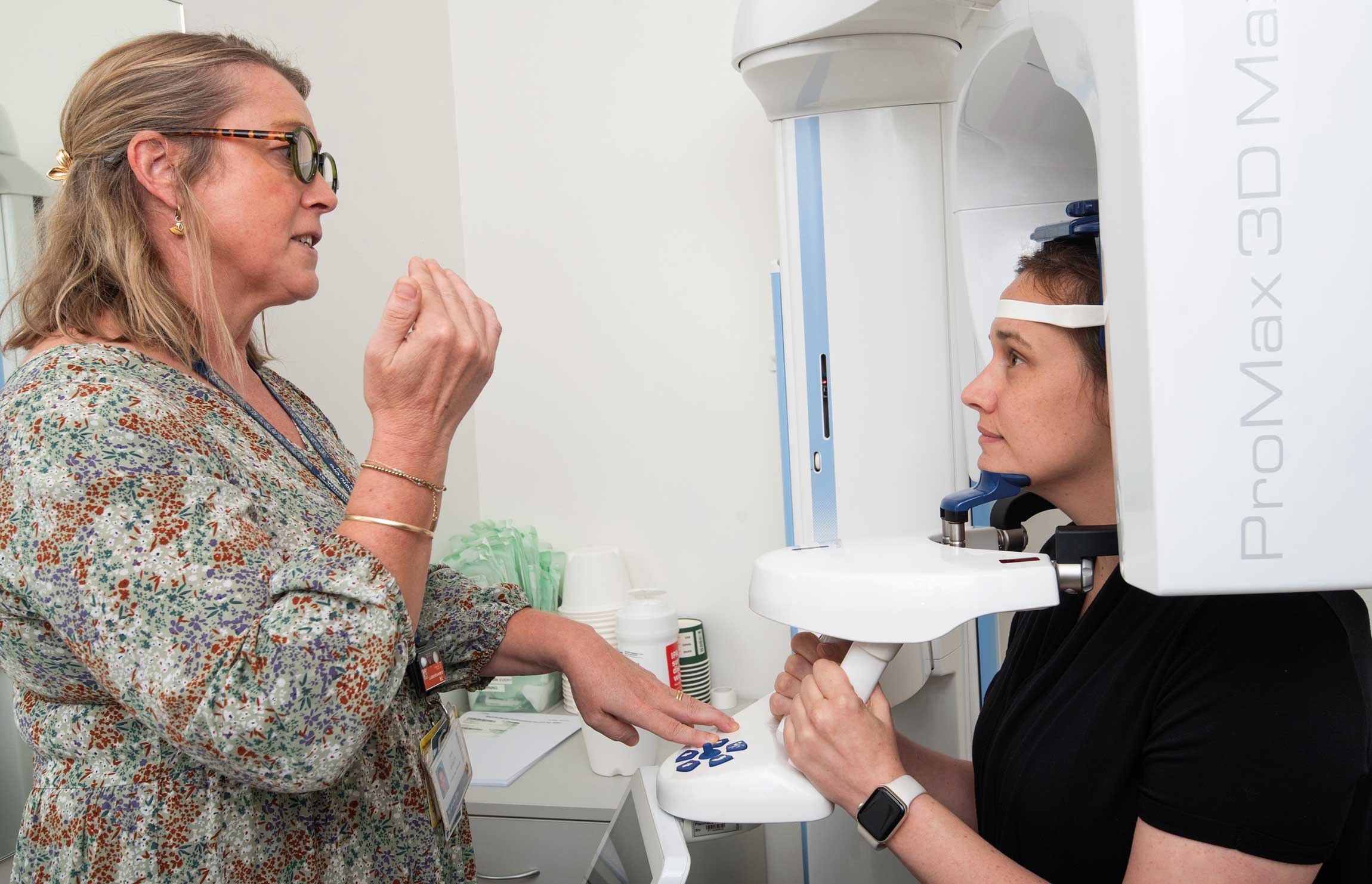
Sarah completing CBCT imaging.
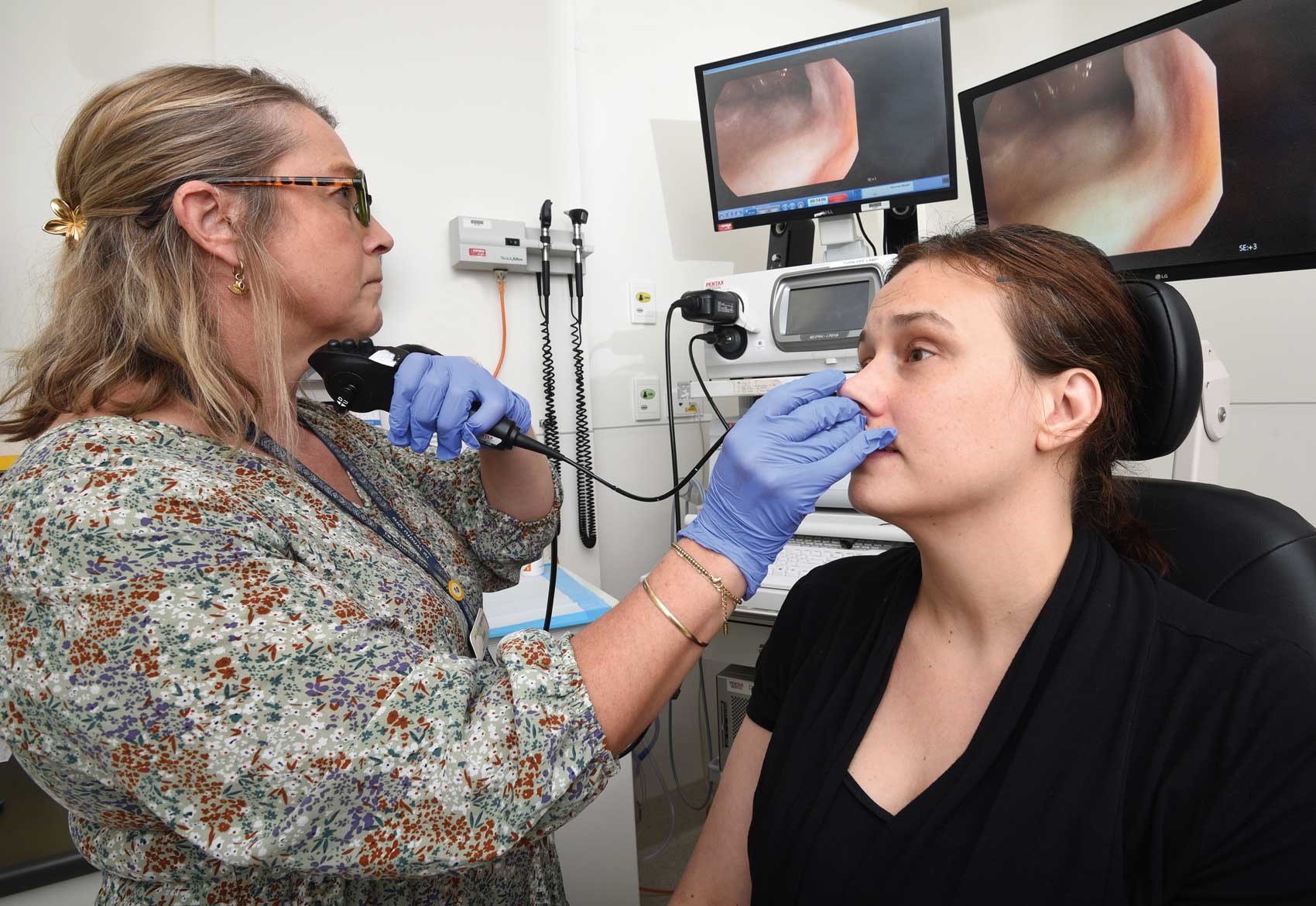
Sarah completing nasal endoscopy.
(Sunil Bange, Medical Photographer, Waikato Hospital.)
The concept of ‘task shifting’ relates to the reallocation of selected tasks, traditionally performed by medically-trained staff, to nursing or other colleagues [3]. The relatively stereotyped nature of the assessment of inflammatory sinonasal disease (history/quality of life, endoscopy and CT imaging) [4] lends itself to a model whereby trained nurses collect the required information, and so this is what we chose to pursue. We conceived a model whereby new adult patients referred in relation to presumed rhinitis or sinusitis that have failed simple medical measures are identified during the triage process and accepted for nurse-led assessment.
Patients then undergo an assessment which includes structured history, completion of SNOT-22 and Epworth scores as well as video-recorded endoscopy uploaded to the clinical record and a CBCT, requested and completed by the same nurse. All patients then have a scheduled five-minute ‘non-contact’ appointment with an ENT specialist who reviews the available clinical information and sends a standardised letter to the referring clinician and patient detailing the diagnosis and management plan.
It is important to note that our department also services smaller community hospitals where there is no access to CBCT in the clinic. We have also been able to conduct nurse-led rhinology assessment clinics in Thames Hospital, a community hospital in our district. By working collaboratively with radiology colleagues, patients undergo a sinus CT scan in the Thames Hospital radiology department via a linked appointment during the same visit as the nurse-led assessment. Equipment for video recording of nasal endoscopy in Thames Hospital was purchased as this clinic was developed. We have therefore demonstrated that this model can be customised to fit with local staffing and resources.
We have found a number of advantages to this approach:
- There has been a significant time-saving in the specialist-led clinic, along with an increase in patient throughput. Patients who can be managed with medical measures only can be identified and returned to the referring clinician, as can patients with milder symptoms that don’t meet the threshold for surgical intervention. The latter group are identified with the benefit of objective data, generating a marked improvement in equity.
- When rhinology patients are followed up in specialist-led clinics, quality of life data, endoscopy images and cross- sectional imaging are all immediately available.
- A number of sinonasal neoplasms have been identified at an earlier stage than would have previously occurred.
- The prompt, yet still detailed assessment process has been well received by patients and staff. It has provided a valued opportunity for our nurse specialist to work at ‘top of scope’ and develop advanced assessment skills.
- Having a stereotyped assessment process has made subsequent audit and research easier to complete.
- Having the clinical records of all patients reviewed by an ENT specialist allows an ongoing focus on governance and quality.
A period of education is of course required for a nurse specialist to be able to function semi-independently in this fashion and this was provided over the course of an eight-week induction programme, joining in regularly with our routine ENT clinics. The main skills to be gained were nasal endoscopy and CBCT imaging, along with a process enabling the nurse specialist to gain authorisation to request CT imaging. Given the model, however, the focus was on completion of the tasks rather than interpretation of the findings. Ongoing teamwork, dialogue and regular scheduled meetings have also been critical, facilitating continuing professional development and quality improvements.
The success of this venture has been recognised locally, nationally and internationally. Initially funded as a one-year trial, we have now been able to gain permanent funding for our nurse specialist post. The pathway was also selected for presentation at a healthcare innovation forum in Brisbane, Australia.
Nurse-led assessment is now embedded in how we practise rhinology in our department. We foresee that a similar model could be employed in other domains, such as selected laryngology and otology patient referrals. The system allows uploading not only a structured history but also relevant information, such as voice recordings, laryngeal endoscopy, audiometry and otomicroscopy, to the electronic patient record.
References
1. Cate L, van der Werf B, Wood A. The complexities of practising equitable Rhinology within resource limitations. Aust J Otolaryngol 2021;4:22.
2. Uiyapat T, Ni Mhuinechain A, Wood AJ. Addition of in clinic cone-beam computerised tomography imaging to a Public Hospital Rhinology clinic: early experience. Sinusitis 2025;9(2):13.
3. Seidman G, Atun R. Does task shifting yield cost savings and improve efficiency for health systems? A systematic review of evidence from low-income and middle-income countries. Hum Resour Health 2017;15(1):29.
4. Hopkins C, Lee SE, Klimek L, Soler ZM. Clinical Assessment of Chronic Rhinosinusitis. J Allergy Clin Immunol Pract 2022;10(6):1406–16.
Declaration of competing interests: None declared.