The Ebers Papyrus was written around 1500 years before the birth of Christ, and is arguably the most complete and most beautiful of the medical texts to have survived from ancient Egypt. It was purchased from a Coptic antiquarian in Upper Egypt by Georg Moritz Ebers (1837–1898) who was professor of Egyptology at Leipzig.
He brought it to the Leipzig University Library, where it has remained (apart from a brief period during the Second World War when it was hidden for safekeeping in a dog kennel in Rochlitz Castle). Ebers reported that it had been found between the legs of a mummy in the Theban Necropolis at Il Assiût [1].
What tragic irony was to follow the death of Professor Ebers in 1898. He had been working for no less than 25 years on a translation of the hieratic script. His death occurred before this opus vitae had reached completion. On opening and reading his last will and testament, it was discovered that if he should die before the translation was finished, the entire unfinished manuscript was to be burned! The executors had no alternative but to carry out Ebers’ final wishes [2].
It is a miscellany of 700 magical spells, recipes and folk remedies to cure ailments from crocodile bites to constipation. There is an extensive section on contemporary ophthalmology and a short subdivision on otology. It also contains a section on ideas about anatomy and physiology, noting the importance of blood vessels and the heart’s function as the centre of the blood supply.
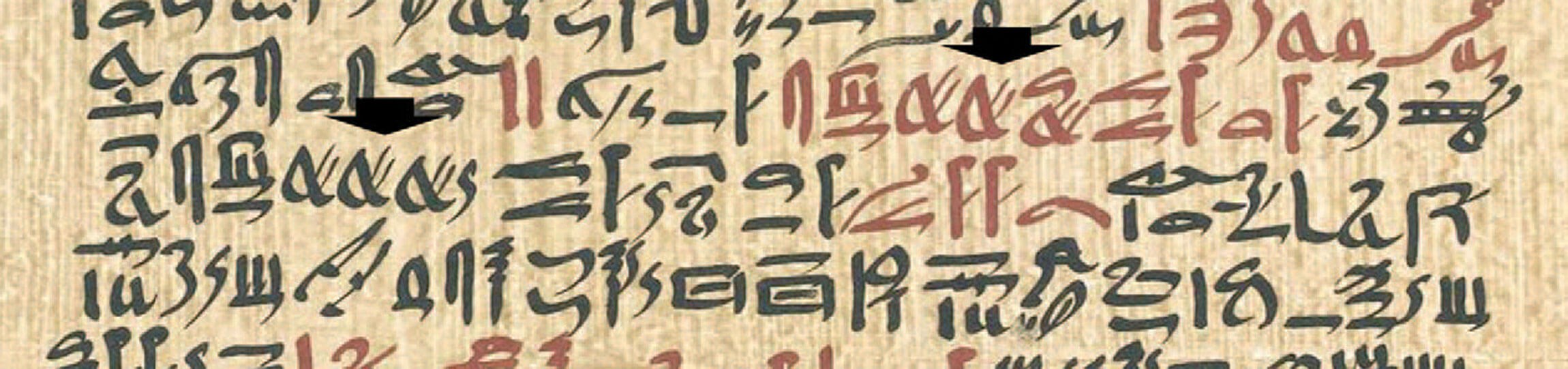
Figure 1: Detail from Ebers Papyrus at Leipzig with arrows showing ideograms for ‘deafness’. These are hieratic ideograms symbolising a cow’s ears. In this section, there are two occasions (marked with arrows) when a group of three identical cow’s ear ideograms are linked together with a ligature (this is a typical feature in hieratic script where two or more graphemes are joined together into a single glyph). One cow’s ear simply means ‘ear’; two ears signifies plural (i.e. ‘ears’) and three ears linked together says ‘deafness’. (This has parallels in contemporary Mandarin Chinese ideography; here the pictogram for ‘ear’ (耳) when doubled means ‘ears’ or ‘earlobe’ (聑), and when tripled becomes ‘whisper’ (聶)). Image courtesy of A Mudry.
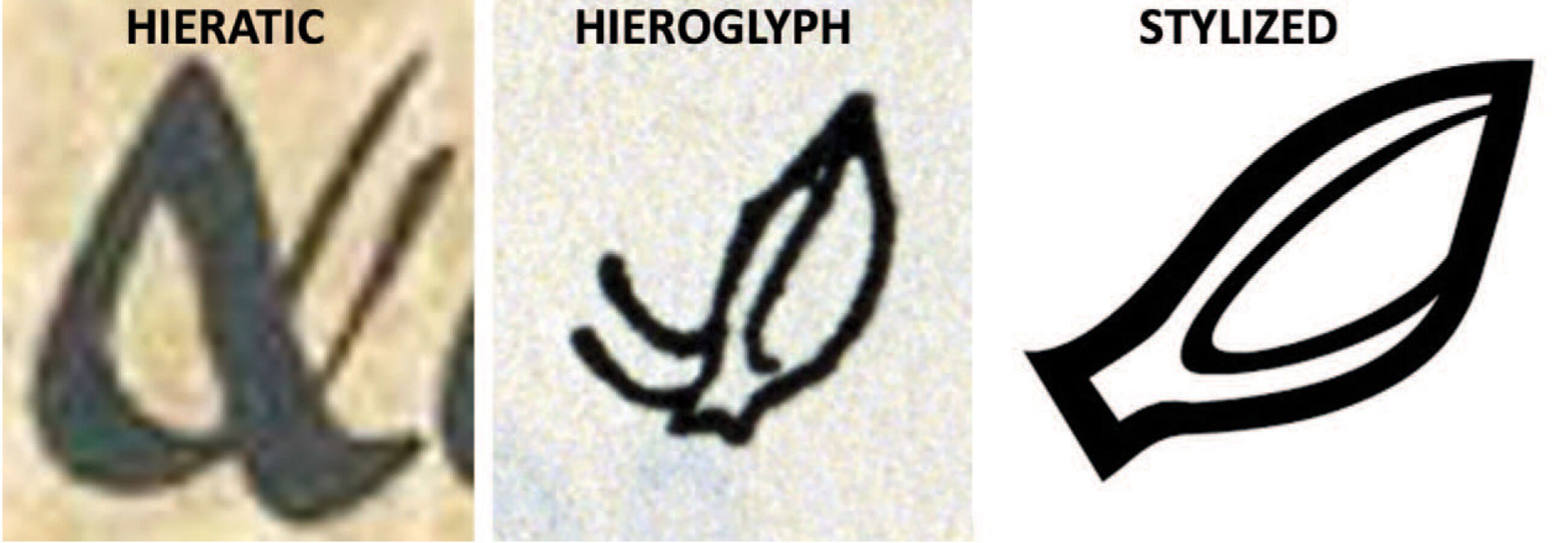
Figure 2: Different hieroglyphic representations. Personal montage by A Mudry.
In the paragraphs on how physicians examined and treated ear disease, treatments range from red ochre in oils for hardness of hearing (“modest” hearing) to different types of ear discharges – watery, purulent and foetid, each treated with different mineral and herbal remedies applied in honey, oil or goose grease. Dressings for penetrating wounds and elaborate bandaging and head-nets are also described [3].
Otological references in the anatomy section are far more interesting [4]. They outline contemporary perceptions of the functions of the body and the origins of disease. The belief was that air is drawn in through the nose and finds its way to the heart and lungs, which then gave air to the whole body through “vessels”.
Deafness is caused by the two vessels “leading to the roots of the eyes”. These vessels (which are on the temples) contain “buzzing air”, received from a “beheading demon” (Figure 1). It also says that when one is deaf, one cannot speak – “his mouth cannot be opened” – perhaps a reference to mutism. This section on deafness and blood vessels to the ear finishes by saying: “There are four vessels to his two Ears, two to the Right side and two to the Left. The Breath-of-Life enters into the Right Ear and the Breath-of-Death into the Left ear.” It is noteworthy that a similar belief existed in early modern Europe, when it was held that evil words went in the left (sinister) ear, whilst holy ideas went in the right (dexter) ear.
References
1. Mudry A. Otology in Medical Papyri in Ancient Egypt. Med J Otol 2006;3:133–42.
2. Von Klein, Carl H. The Medical Features of the Papyrus Ebers. JAMA 1905;45:1928–35.
3. Ghalioungui P. The Ebers Papyrus. A New English Translation. Cairo, Egypt; Academy of Scientific Research and Technology; 1987:194–7 (Eb 764–6 [91, 1–19]; Eb 767–70 [92, 1–6]).
4. Mudry A, Young JR. A Critical Evaluation of ‘‘The Ear that Hears Badly’’ in the Ebers Papyrus. Otol Neurotol 2021;42:1285–90. [This paper gives a full exploration of the otological aspects of the Ebers papyrus and an explanation of the hieroglyphics.]