You searched for "Cancer"
In conversation with Professor Jos Eggermont
Having known Jos for many years, I jumped at the opportunity to catch up with him for our Nov/Dec 2020 series of tinnitus items. My questions reached him during lockdown, and he was enjoying the chance to get on top...WENTS - Mentoring skills training workshop November 2020
WENTS, in affiliation with ENT UK, aims to inspire and support women training and working in ENT (www.entuk.org/wents).Prof Quraishi OBE awarded Fellowship ad hominem FRCSEd
At a presentation ceremony on Friday 3 September, President of the Royal College of Surgeons of Edinburgh (FRCSEd), Prof Michael Griffin OBE, welcomed the members of the Council, fresh diplomates, their families and other guests. This was the first conferring...IFOS 2023: from state-of-the art science to global inequalities
The Dubai World Trade Center will open its doors on 17 January 2023 to welcome delegates to the IFOS 2023 World ENT Congress.Join us at CI2023
Registration is now open for CI2023: Cochlear Implants in Children and Adults, 7-10 June, in Dallas, Texas, USA, with early bird rates until 7 April 2023. The conference will explore current and emerging topics for CI patients across the lifespan....Jan Plzák takes helm as president of the CEORL-HNS
The Confederation of European Otorhinolaryngology Head and Neck Surgery (CEORL-HNS) proudly announces the appointment of Professor Jan Plzák as its new president.Research funding opportunity for audiologists
A research funding call is encouraging applications from disciplines that rarely lead clinical research, offering an important opportunity for UK audiology. It comes from the Research for Patient Benefit (RfPB) Programme of the National Institute for Health and Care Research (NHCR) and aims to strengthen the careers of under-represented disciplines and specialisms.
Consultative Selling Skills for Audiologists
I must admit that when I was first asked to review this book I tried to find excuses not to do it. The title rather put me off as whilst I am Hearing Aid Dispenser registered, I do not dispense...
Fitting and Dispensing Hearing Aids, Second Edition
As you might expect from two authors of such stature, this book is extremely effective and well written. In form it is as close to a pop-science book as one could get while still being very much focussed for those...
Advances in Hearing Rehabilitation
This book is Vol. 81 of a series - Advances in Oto-Rhino-Laryngology - of which there are three current volumes: Rhinosinusitis with Nasal Polyposis, Sleep-Related Breathing Disorders, and Advances in Hearing Rehabilitation. A fourth volume on Vestibular Disorders is imminent....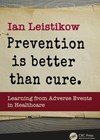
Prevention is Better than Cure: Learning from Adverse Events in Healthcare
Ian Leistikow has an impressive CV; as Senior Inspector at the Dutch Healthcare Inspectorate and a member of the Strategic Advisory Board of the International Forum on Quality and Safety in Healthcare, it is clear he is passionate about advancing...