A UK-wide priority-setting project gave deaf children, families and professionals a voice in shaping the research needed to improve education, communication and wellbeing.
Research priority setting for childhood deafness and hearing loss Research priority setting involves identifying the research questions that matter most to those affected by a particular issue or health condition. It allows researchers to focus their efforts and resources on what is most important as defined by patients or professionals.
Our group followed the James Lind Alliance (JLA) priority setting partnership (PSP) methodology to define the Top 10 research priorities in childhood deafness and hearing loss [1]. We set out to identify which unanswered questions in childhood deafness and hearing loss matter most to children themselves, to professionals working in health and education, and to families affected by childhood deafness. We were interested in issues that affect children with different types and levels of deafness and hearing loss, and from different areas of the UK.
What we did
Key elements of the process included: giving equal voice to professionals and people with lived experience, sampling a diverse and representative range of these stakeholders, working with a steering group made up of similarly representative stakeholders to guide decision-making throughout the process, and ensuring transparency of methodology and data at all stages. A further guiding principle was that researchers (without a clinical role), funding bodies and industry did not form part of the stakeholder group who were consulted. This was to ensure the Top 10 lists represented the perspective of those with daily experience of childhood deafness or of caring for deaf children.
A series of surveys and a children’s workshop gathered over 1200 ideas for research questions which, following JLA methodology, were condensed to 21 unique questions. These were assessed to ensure they were not already answered through research. These 21 questions were then taken to an adult and a children’s workshop to determine the Top 10s from both perspectives.
Parents of deaf children, deaf adults, medical and education specialists (SLT, doctors, audiologists, teacher of the deaf) and voluntary sector specialists attended the adult priority setting workshop. This was a hugely collaborative project, and we were the first JLA to also run a children’s final workshop to generate a child-specific Top 10. The group comprised children aged seven to 16 with deafness to provide views on the key difficulties they face in an interactive group workshop to rank the research priorities.
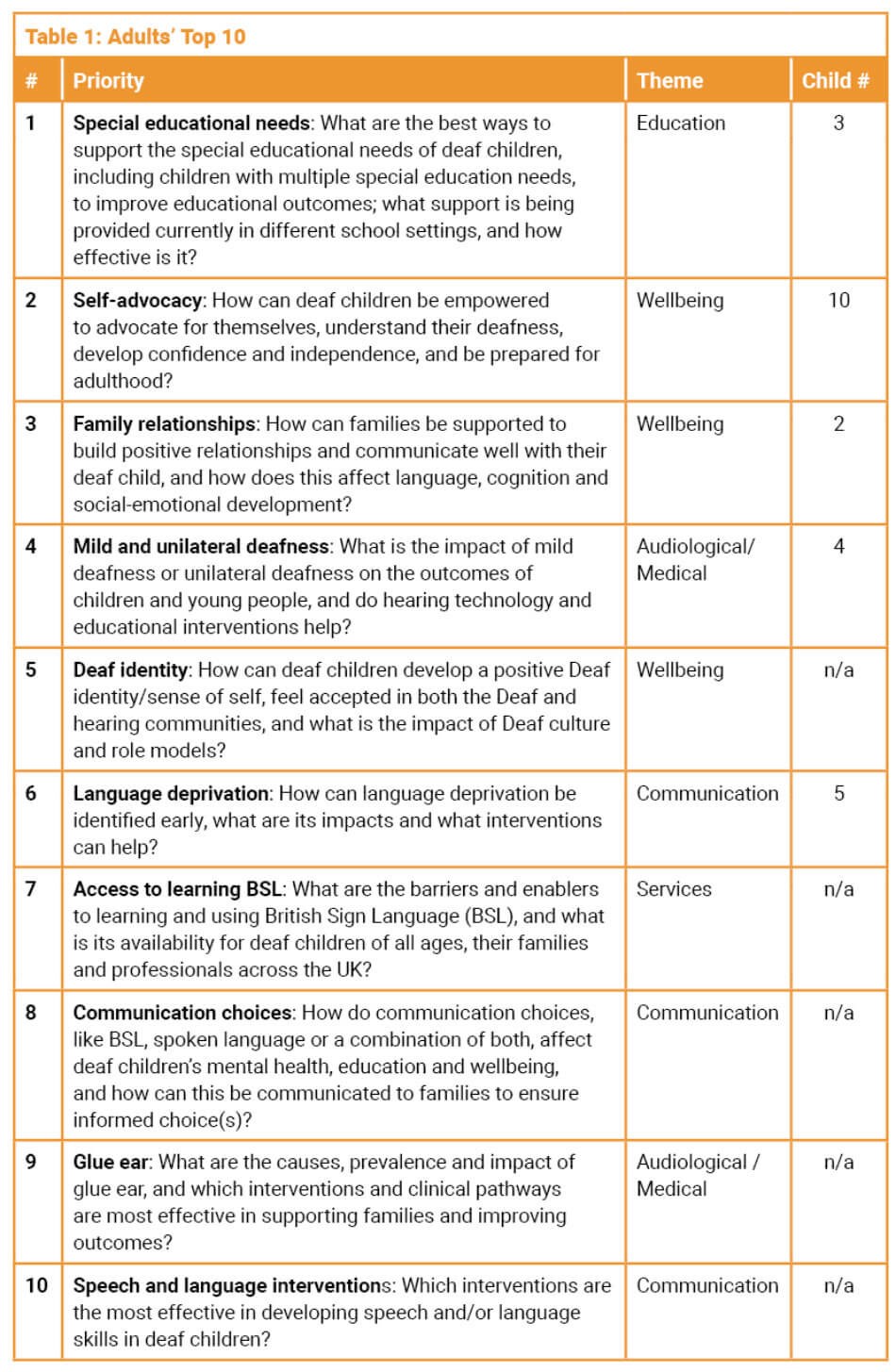
Which questions were in the two Top 10s?
The Top 10 lists were published in September 2025 [2](www.childdeafnessresearch.co.uk). The adults’ Top 10 is based on views of parents and professionals (Table 1) and the children’s Top 10 is based on views of deaf children (Table 2). The Top 10 lists included a variety of topic areas covering education, wellbeing, audiology/medical, communication, services and intervention/outcomes. Participation was diverse and widespread, giving us confidence that these research priorities truly represent what matters most to people.
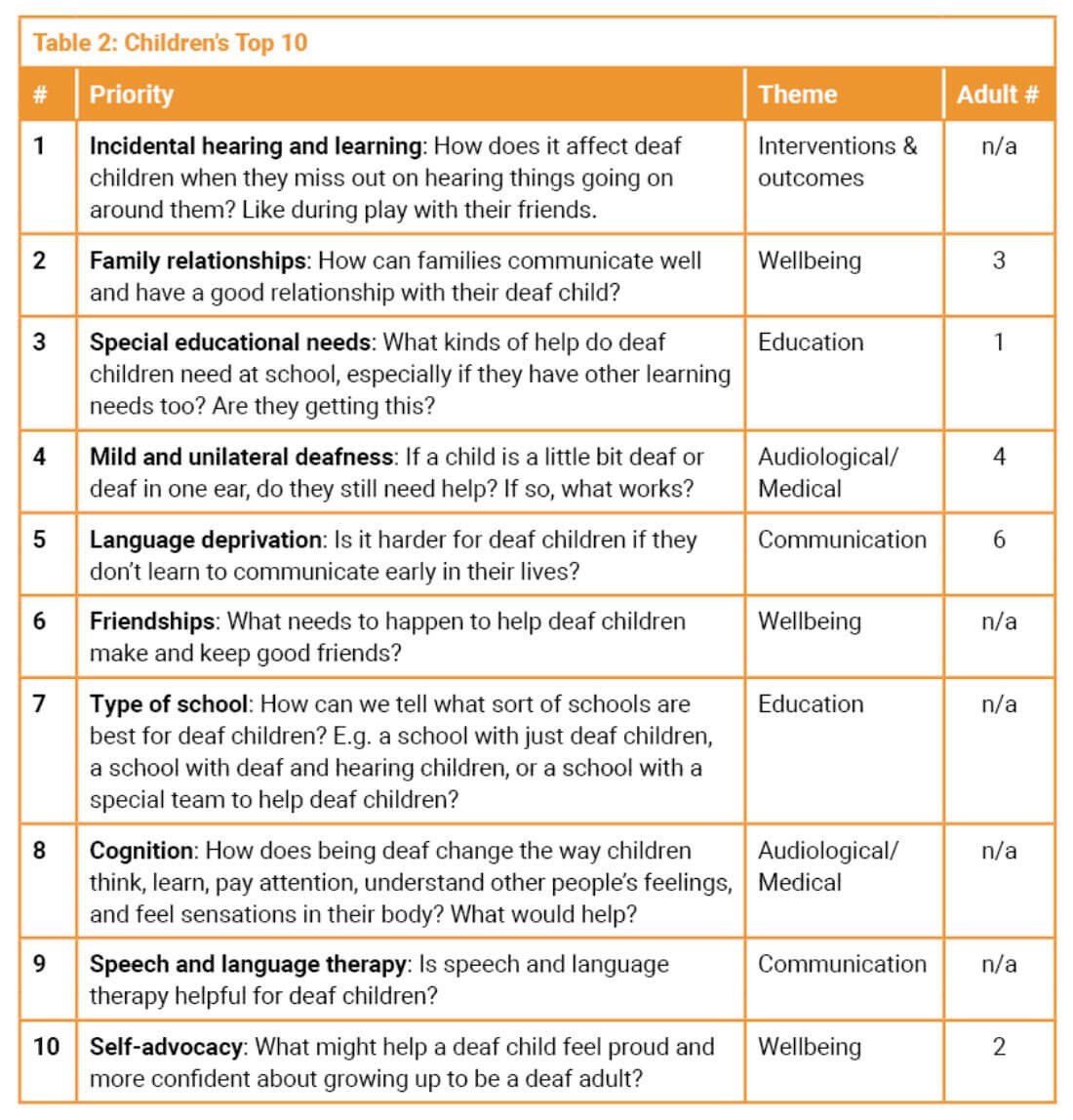
Both the adults’ and children’s priorities have a strong emphasis on the psychosocial elements of deafness. The results highlight the importance of education, communication and wellbeing. Children named missing out on hearing things in social settings as their number one priority for future research. Adults named learning how to support deaf children and those with additional needs in schools as their number one priority.
"Of particular relevance to ENT and audiology researchers is that both adults and children prioritised research relating to mild and unilateral deafness"
Of particular relevance to ENT and audiology researchers is that both adults and children prioritised research relating to mild and unilateral deafness in an effort to understand its impact and what the best interventions might be.
Looking to the future: the Childhood Deafness Research Network
Following up the JLA PSP with tangible action to promote the priorities and design studies to address the questions is key to ensuring the hard work of this project is not wasted and that it leads to genuine benefit for deaf children.
We therefore established The Childhood Deafness Research Network to promote our findings and support research towards answering the identified priority research questions. Our website (childdeafnessresearch.co.uk) which has been accessed over 3000 times, tells the story of the JLA and outlines how to join the network.
As a network, our priorities are to:
- Continue to publicise and promote the Top 10 lists.
- Ensure meaningful opportunities for everyone with an interest in childhood deafness research, particularly those with lived experience, to embed their insights and ideas and have a genuine voice in research.
- Provide Patient and Public Involvement and Engagement (PPIE) expertise and support for any research projects relating to the Top 10s.
- Offer professional mentorship to those developing research projects related to the Top 10s.
- Grow long-lasting partnerships between researchers, professionals, charities and people with lived experience to maintain and develop our work in representing deaf children’s voices.
We also plan to run our own research projects as a network. Our first research project relates to children with additional needs (specifically mentioned in adult question #1 and children’s #3). Led by Lancaster University, we are conducting a scoping literature review to investigate what is known about deaf children and young people with additional needs, including complex needs and disabilities, and what are the implications for future research priorities. This work is funded by the National Deaf Children’s Society [2].
If you’re interested in finding out more about the Network or are looking for PPIE support for a research project related to childhood deafness, we’re keen to work with you. Please contact us by email (childhooddeafness@manchester.ac.uk) or via our LinkedIn page: www.linkedin.com/groups/42253003
Finally, we are keeping track of any research projects that are relevant to or directly answering the Top 10s research questions. Please use the QR code to tell us on our Padlet board about any projects that you are involved in that are relevant to the Top 10s.
References
1. James Lind Alliance Priority Setting Partnership. Childhood Deafness and Hearing Loss.
https://www.jla.nihr.ac.uk/priority-setting-partnerships/
childhood-deafness-and-hearing-loss
[Last accessed October 2026].
2. Blair L, Chan J, Visram A, et al. DeafCAN Scoping Review (NDCS). 2026.
Declaration of competing interests: HS is vice-chair of the BSA APD SIG.