You searched for "collaboration"

Electronystagmography and Videonystagmography ENG / VNG
This book provides a good reference for anyone starting out in the field of balance assessment, and would be a useful book in any balance assessment clinic as a source of information from anatomy to test interpretation. Anatomy and physiology...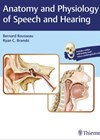
Anatomy and Physiology of Speech and Hearing
This American book is written for students “in the field of communication sciences and disorders”, however, this is a very useful text for anyone wanting to understand the underpinning science behind speech, swallowing and hearing and balance. The book is...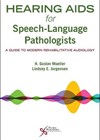
Hearing Aids for Speech-Language Pathologists: a Guide to Modern Rehabilitative Audiology
This is a book of two parts. The first six chapters are not pitched at speech language pathologists (SLP), at least not for those in typical practice in the UK. This section of the book is appropriate to experienced audiologists...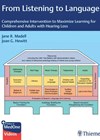
From Listening to Language: Comprehensive Intervention to Maximise Learning for Children and Adults with Hearing Loss
How does one build a two-storey house? Start with a firm foundation, followed by a strong structure. Only then can the floors and attic be added. Madell and Hewitt provide practitioners with this same blueprint to facilitate optimal outcomes for...
Cochlear microphonics in children
Cochlear microphonics (CM) are generated mainly from outer hair cells and are routinely tested in children with hearing loss in some parts of the world. In this retrospective study, the aim was to compare the cochlear microphonics features (mainly CM...
Better conversations for children with Autism and peers for now and for their futures
There are around 700,000 people with diagnosed Autism Spectrum Disorder (ASD) in the UK, according to 2011 census figures. A key diagnostic feature in ASD are difficulties in social interactions and conversations, social-emotional responses and relationships. The authors of this...
Tell me like it is: advice for relatives of people with aphasia
More than a quarter of people who have a stroke present with aphasia immediately post-stroke (approx. 30%) and of these, around 60% experience chronic communication difficulties. Provision of information is seen as one of the top 10 best practice recommendations...
Doing it for the people: how to do speech and language therapy
This review article distils 58 studies, collating information from people with aphasia, their families and clinical speech and language therapists summarising the seven habits of highly effective aphasia therapists. Habit 1: Effective therapists invest time in and prioritise relationships with...
Remembering how to speak
Reminiscence therapy (RT) is an approach that provides people with dementia opportunities to recount nostalgic memories and access thoughts for communication. It is one of the most commonly used therapies in aged care settings. The aim of RT is to...
Can we get some satisfaction (in aphasia therapy)?
Patient satisfaction is associated with improved health outcomes, yet using surveys to collate information on satisfaction is limited by the types of questions asked. Satisfaction remains a broad concept but asking respondents more open questions allows service users to define...
Bringing aged care back
Worldwide, our older population is increasing, and thus a need for the provision of care to older people is also increasing. Aged care may be informal, provided by unpaid carers; or formal, provided or subsidised by government or other organisations....