
You searched for "communications"

A comparison between artificial and cadaveric temporal bones in terms of providing realistic setting and structural details
Increasing difficulties, costs and risks of infection have led to the use of artificial temporal bones for training in mastoid and middle ear surgery. Whether these provide a realistic learning environment (face value) and offer structural details to learn from...New international collaboration: Young Otolaryngologists of IFOS – ‘YO-IFOS’
The Young Otolaryngologists of IFOS, founded in Paris in 2017, has an ambition to fulfil four key missions at an international level: education, research, networking and congress-related activities. Kate Stephenson tells us more about this exciting initiative. During the recent...Consultation on cochlear implantation guidelines
A taskforce of 52 hearing experts has released Living Guidelines for hearing care.WENTS - Mentoring skills training workshop November 2020
WENTS, in affiliation with ENT UK, aims to inspire and support women training and working in ENT (www.entuk.org/wents).Future of Hearing Healthcare virtual conference
The fifth annual Future of Hearing Healthcare Conference (FHH) will be held virtually on Wednesdays May 14, 21 and 28, continuing its mission to highlight the ideas, innovations, and individuals shaping the future of hearing care. Organised by Hearing Health...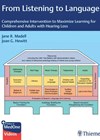
From Listening to Language: Comprehensive Intervention to Maximise Learning for Children and Adults with Hearing Loss
How does one build a two-storey house? Start with a firm foundation, followed by a strong structure. Only then can the floors and attic be added. Madell and Hewitt provide practitioners with this same blueprint to facilitate optimal outcomes for...
Cochlear microphonics in children
Cochlear microphonics (CM) are generated mainly from outer hair cells and are routinely tested in children with hearing loss in some parts of the world. In this retrospective study, the aim was to compare the cochlear microphonics features (mainly CM...
Doing it for the people: how to do speech and language therapy
This review article distils 58 studies, collating information from people with aphasia, their families and clinical speech and language therapists summarising the seven habits of highly effective aphasia therapists. Habit 1: Effective therapists invest time in and prioritise relationships with...
Alcohol and hearing
Alcohol is a well-known central nervous system depressant. Individual reactions to alcohol might vary, but the connection between alcohol consumption and tolerance to loud noise or difficulties in communication in noisy environments are well-observed phenomena; for example, at evening parties....
Further understanding of GJB2 hearing loss
For many years, hearing loss has been an area which has attracted the interest of clinical and academic geneticists. Genetic testing for severe-profound hearing loss is now commonplace in many healthcare systems. Understanding the genetics of hearing loss has improved...
Do personal listening devices cause cochlear synaptopathy?
Cochlear synaptopathy is a condition in which noise interrupts the synaptic communication between sensory inner hair cells and low spontaneous rate cochlear nerve fibres. Since these nerve fibres are associated with signal coding in noisy backgrounds, their disruption leads to...


