
You searched for "therapeutics"
‘Bare below the elbows’
So it has finally happened. I have reached that stage of reactionary bewilderment known as middle age. As well having my finger nowhere near the pulse of contemporary culture, I am finding the siren charms of BBC Radio 2 and...BACO 2015 – Liverpool
Team BACO 2015: Academic Secretary, Peter Andrews; Treasurer, Chris Potter; Master, Ian Mackay and Local Host and Programme Director, Andrew Swift. (Photo taken by Academic Chairman, Shakeel Saeed.) In the height of a glorious English summer, over 1200 of the...The future role of technology in rhinology
Technology is moving our speciality forward very rapidly in all domains, but none more so than in rhinology. David Whitehead looks at current and future trends. How will a surgeon justify their position in a team where artificial intelligence (AI)...What’s happened since the European position paper on nose and sinus tumours?
The management of malignant sinonasal tumours has gone through radical changes in recent years. Prof Valerie Lund gives us an update based on her upcoming talk at IFOS. In 2010 when we published the European position paper on ‘endoscopic management...Vocal cord dysfunction and dysfunctional breathing: an evolving clinical paradigm
Patients frequently present to the ENT department with breathing difficulties. The entity of ‘vocal cord dysfunction’ (also known as paradoxical vocal cord movement, inducible laryngeal obstruction, and many other names) is increasingly well recognised. Ravi Thevasagayam gives us an overview....Papzimeos: a major advance in treating adult recurrent respiratory papillomatosis
Since the beginning of our specialty, generations of patients and surgeons have faced the challenging clinical problem of recurrent respiratory papillomatosis (RRP). Driven by a persistent and chronic infection with low-risk human papillomavirus (HPV) types 6 or 11, it is...ESPO 2025
Ayla TabaksertOver 1000 paediatric ENT specialists from 68 countries said “Guten tag!” as they convened for the 17th Congress of the European Society of Paediatric Otorhinolaryngology (ESPO 2025) at the International Congress Centre, Stuttgart. In a city known for world-class...Teenagers with misophonia
Misophonia can be a distressing condition for teenagers and can have devastating effects upon their home and school lives. There is little research in this area and, as Lucy Partridge explains, more is greatly needed in order to identify interventions...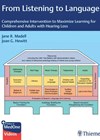
From Listening to Language: Comprehensive Intervention to Maximise Learning for Children and Adults with Hearing Loss
How does one build a two-storey house? Start with a firm foundation, followed by a strong structure. Only then can the floors and attic be added. Madell and Hewitt provide practitioners with this same blueprint to facilitate optimal outcomes for...


