You searched for "tumour"
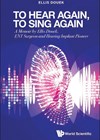
To Hear Again, To Sing Again: A Memoir by Ellis Douek, ENT Surgeon and Hearing Implant Pioneer
“The past is a foreign country: they do things differently there.” LP Hartley’s immortal words could have been written for these fascinating reflections on the practice of ear, nose and throat surgery during the second half of the 20th century....
Parkinson’s humour: recognising social communication difficulties
Parkinson’s results in a progressive motor disease with symptoms including tremor, rigidity and bradykinesia. However, people with Parkinson’s also experience non-motor symptoms such as cognitive difficulties that can impact social communication, often due to their co-existing speech difficulties, auditory and...Auditory brainstem implant results in adults and children
Background The auditory brainstem implant (ABI) has been developed from cochlear implant (CI) technology and is indicated for people who have anatomical abnormalities of the cochlea or dysfunction of the auditory nerve. The majority of people who have received an...Robotic head and neck surgery: current state of the art and future innovations
Technology and innovation has provided modern head and neck surgeons with successive generations of robotic surgical systems, fibre-optic lasers, and novel tools which have ushered in a new era of minimally invasive surgery for tumours of the pharynx and larynx....
The push towards scarless parotid surgery
When dealing with benign parotid pathology, high expectations are placed on the operating surgeon to preserve key neurovascular structures, especially the animating facial nerve, through meticulous dissection. With time, there has been a greater emphasis on improving cosmesis in parotid...
Olfactory protective effect of omega-3 supplements during healing after endoscopic sellar and parasellar resection
This multicentre study, led by researchers from Stanford, demonstrates another use for omega-3 supplements. The study analysed cohorts equally divided between control arm and omega-3 supplementation. Post endoscopic sellar and parasellar resection, better olfactory function was observed at three and...Quo vadis FESS? Future directions in functional endoscopic sinus surgery
Endoscopic sinus surgery is now so ubiquitous that it is hard to imagine a time when it was not part of our clinical practice. Valentin Tomazic takes a look at its early development and looks ahead to endoscopic sinus surgery...
Anterior skull-base surgery: current opinion
This review examines the changes in the field of anterior skull-base surgery and the rapid advancement that has taken place in the last 10–15 years. Tumours of the anterior skull base that were once considered inoperable are now routinely resected...The ear, nose and throat anaesthesia practice of Dr John Snow (1813-58)
News of the first successful public demonstration of general anaesthesia in Boston, Massachusetts in October 1846 reached Britain in mid-December of that year. James Robinson, a London dentist, gave the first anaesthetic in the United Kingdom when, on 19 December,...